A closed cell rubber base can influence cushioning, recovery and moisture uptake, but its performance depends on more than the presence of small pores. Rubber formulation, cell distribution, layer thickness and molded backing geometry work together. For a prefabricated running track, the right specification evaluates the complete installed surface rather than assuming that a softer or more visibly porous sample will perform better.
Keywords: closed cell rubber track, prefabricated track base, track shock absorption, vertical deformation, rubber track water absorption
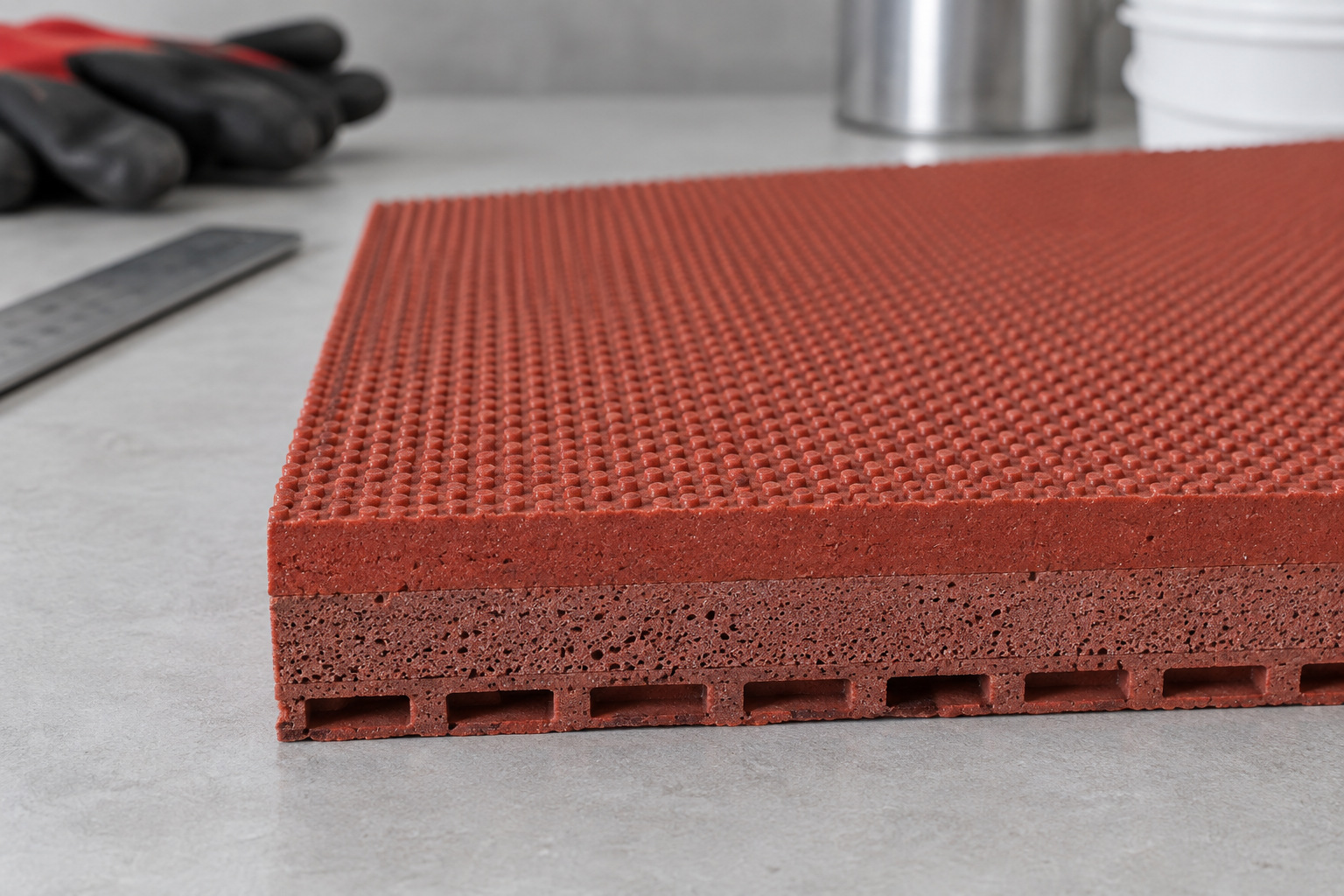
![Cut section of a prefabricated rubber track showing the wearing layer and cellular base]()
Figure 1. Cut section of a prefabricated rubber track showing the wearing layer and cellular base. AI-generated technical illustration.
Separate Internal Cells From the Molded Backing
Two different features are often described as a track's cellular structure. Internal microcells are small voids within the rubber compound. Molded cavities are the larger, regularly shaped recesses visible on the underside of some prefabricated sheets. They operate at different scales and should not be treated as interchangeable.
A photograph of a square or rectangular backing pattern does not establish whether the rubber itself is closed cell. Likewise, the color of the base does not identify its polymer composition. When comparing products, request a section drawing, material description and results for the exact construction offered. HUADONG's prefabricated track system overview describes an embossed upper surface and an engineered lower layer; the selected model's documents should define its particular geometry.
Understand Cushioning and Deformation Together
Under load, rubber stretches and compresses while internal cells and backing features deform. Changing density, wall thickness or rubber stiffness changes that response. A base that feels comfortable when squeezed by hand may behave differently under a short athletic impact.
Shock absorption and vertical deformation answer different questions. Shock absorption concerns the reduction in a specified impact response relative to a reference. Vertical deformation describes displacement under the specified test. Neither measurement alone proves energy return or a reduction in injuries. The installed surface must provide a suitable balance for the intended athletics use.
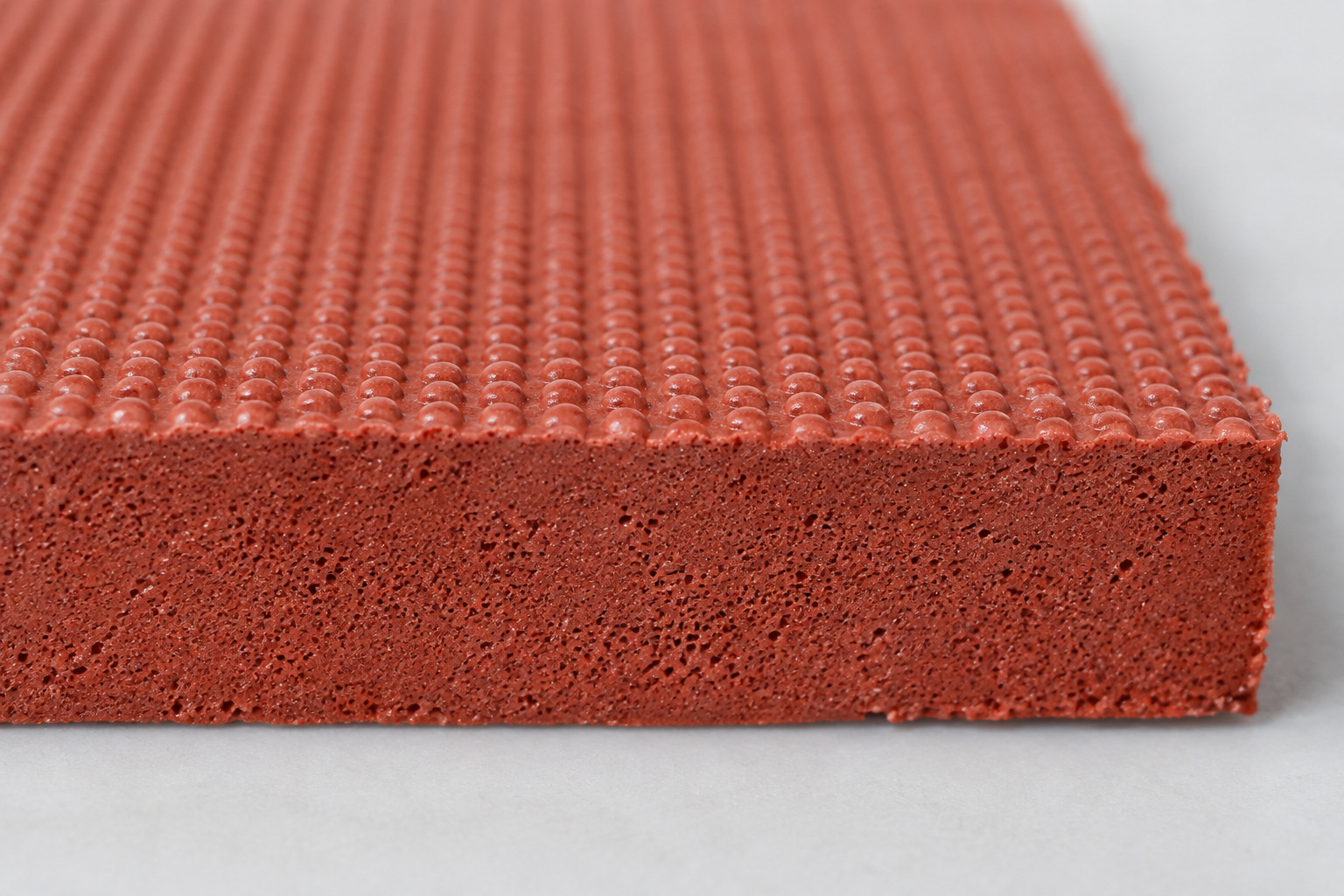
![Close view of fine pores within the cut edge of a cellular rubber specimen]()
Figure 2. Close view of fine pores within the cut edge of a cellular rubber specimen. AI-generated technical illustration.
Compare the Variables That Actually Change Performance
Keep specimen thickness, conditioning and support consistent when comparing constructions. Otherwise, a result attributed to cell shape may actually reflect a different test temperature or sample thickness.
| Design variable | Possible influence | Evidence to request |
| Rubber stiffness | Resistance to deformation | Hardness and relevant dynamic test results |
| Cell distribution | Uniformity of local compression | Representative sections and density checks |
| Base thickness | Available deformation space | Measured layer profile |
| Backing geometry | Support area and deformation pattern | Backing drawing and system testing |
| Recovery after loading | Residual indentation | Defined compression or repeated-load assessment |
| Foundation and bond | Consistency of support | Trial installation and field observations |
A meaningful specification connects each claimed benefit to an observable property. Descriptions such as soft, elastic or high rebound need a stated test method before they become comparable procurement data.
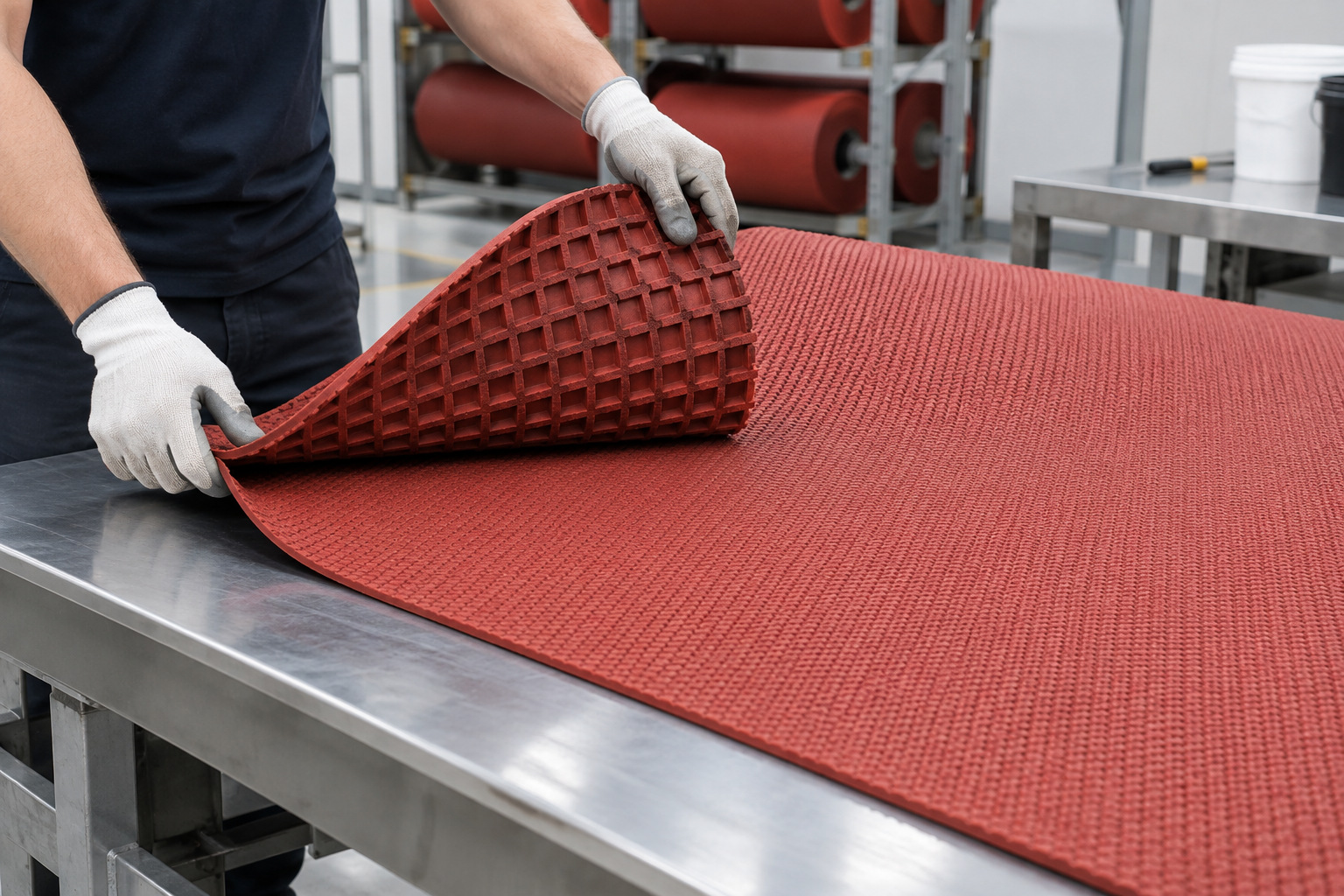
![Regular molded cavities on the underside of a prefabricated rubber track roll]()
Figure 3. Regular molded cavities on the underside of a prefabricated rubber track roll. AI-generated technical illustration.
Assess Recovery Without Confusing It With Energy Return
Recovery describes how a material regains its dimensions after a load is removed. Energy return describes the mechanical energy recovered during a defined loading cycle. A sample can recover its shape slowly while dissipating a substantial proportion of the applied energy.
ASTM D395 addresses compression set in rubber. It can support material evaluation, but it is not a substitute for the sports-surface tests required by a project. For athletics applications, use the relevant testing framework available through World Athletics technical information, and compare results obtained under matching conditions. Material tests and installed-surface tests serve different purposes.
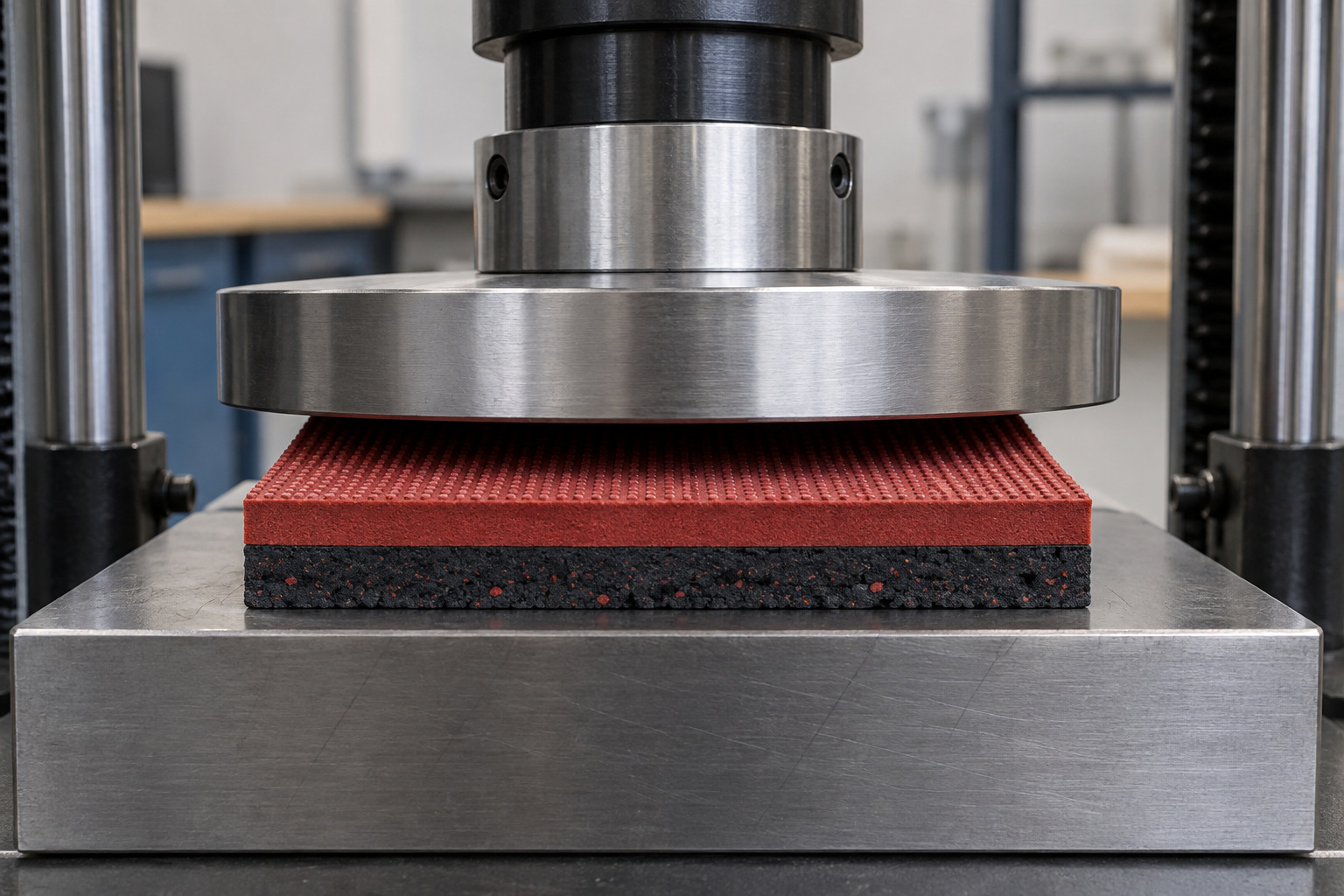
![Rubber specimen being compressed between steel platens in a laboratory fixture]()
Figure 4. Rubber specimen being compressed between steel platens in a laboratory fixture. AI-generated technical illustration.
Put Water Resistance in the Context of the Whole Track
Isolated cells can limit water movement through the rubber compared with a connected pore network, but low water uptake does not make an installed track a waterproofing membrane. Cut edges, seams, foundation cracks and perimeter details remain potential pathways.
Ask how water absorption was measured, whether the specimen included cut edges and whether performance was checked after conditioning. Drainage still needs a suitable surface profile and functioning outlets. In cold regions, the design also needs to consider water trapped beneath a sheet and the effects of freezing on the base and adhesive interface.
![Water droplets resting on the embossed surface of a prefabricated rubber running track]()
Figure 5. Water droplets resting on the embossed surface of a prefabricated rubber running track. AI-generated technical illustration.
Specify the Base Alongside the Wearing Surface
For a project considering GOTER prefabricated rubber track, begin with the venue's training and competition requirements, then review the complete construction. Provide the expected temperature range, foundation type and drainage arrangement. The most useful comparison combines surface texture, lower-layer design, test results and installation compatibility instead of ranking samples by softness alone.
Frequently Asked Questions
1. Does closed cell mean the track cannot absorb any water?
No. Water uptake depends on the material and test conditions, and an installed system also has joints and edges. Request measured results rather than relying on an absolute waterproof claim.
2. Are larger backing cavities always better for cushioning?
No. Cavity size must be considered with wall thickness, rubber stiffness and support area. Excessive deformation can be undesirable, so the finished system needs appropriate testing.
3. Can I compare two tracks by pressing them with my thumb?
A hand check may reveal obvious differences, but it does not reproduce athletic impact. Use controlled measurements with equivalent thickness, temperature and support.
4. Is compression set the same as shock absorption?
No. Compression set evaluates remaining deformation after prescribed loading and recovery. Shock absorption evaluates response to a specified impact. They describe different behavior.
5. Does every HUADONG product have the same base design?
Confirm the construction for the chosen product and configuration. Use the current specification and representative sample rather than extending one product description to the whole range.