The correct adhesive for a prefabricated rubber running track is the one verified for the actual roll backing, prepared substrate and service environment. Chemistry alone cannot establish suitability. A dependable selection also checks working time, cure conditions, moisture limits, application tools and aged bond performance. For contractors, a small representative trial can expose compatibility problems before thousands of square meters are installed.
Keywords: prefabricated track adhesive, polyurethane track glue, rubber track bonding, adhesive open time, track peel strength
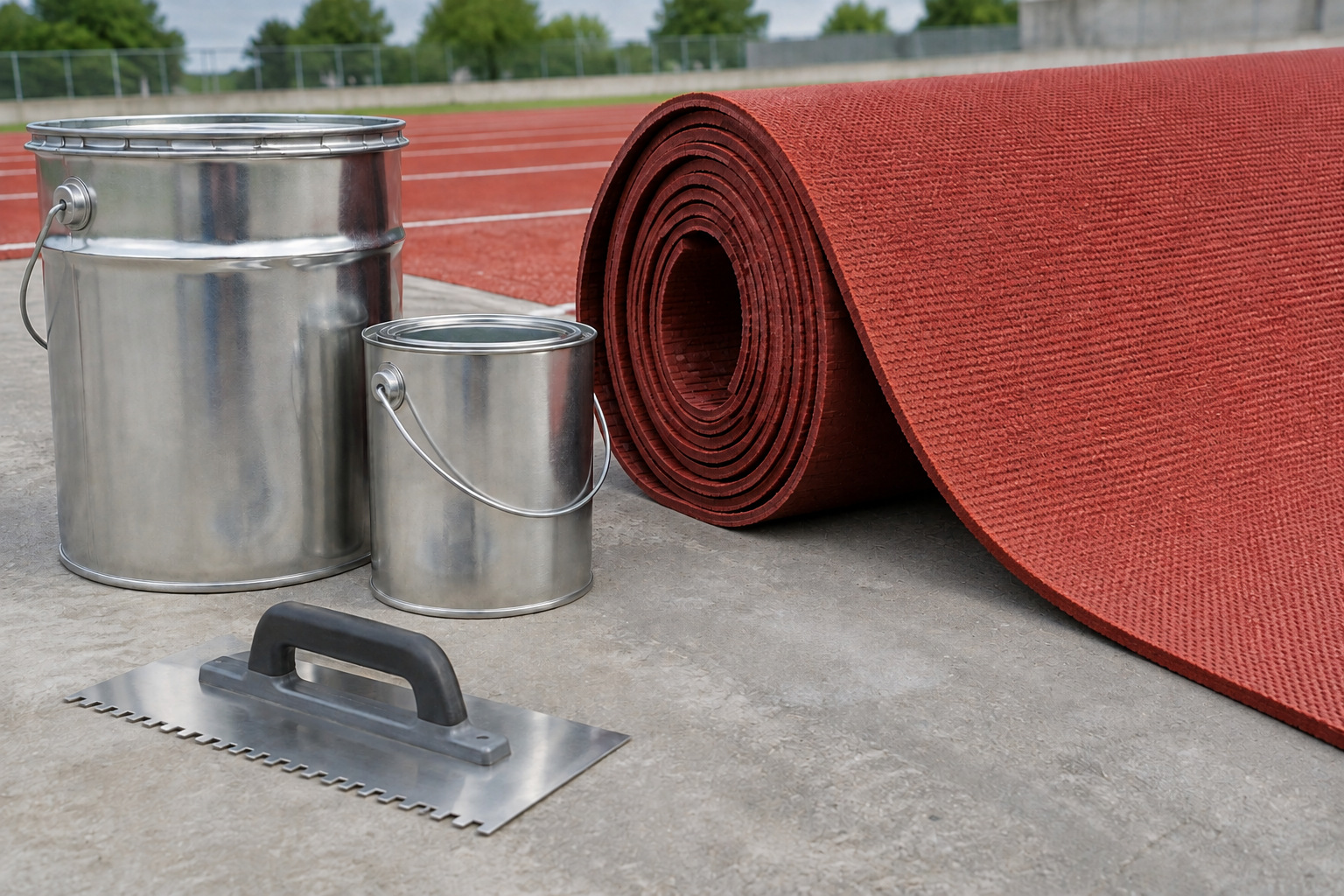
![Unmarked adhesive containers and a notched trowel beside a single prefabricated rubber track roll on concrete]()
Figure 1. Unmarked adhesive containers and a notched trowel beside a single prefabricated rubber track roll on concrete. AI-generated technical illustration.
Begin With the Bonded Assembly
The adhesive joins two surfaces with different characteristics. Concrete may be porous, alkaline or affected by curing compounds. Asphalt may contain mobile oils or lack sufficient stability. The rubber backing may have molded cavities, surface residues or a composition that needs particular preparation.
Identify all three components in the specification: track model, adhesive product and prepared foundation. Include any primer, moisture treatment or leveling compound because these create additional interfaces. Approval for rubber flooring does not automatically establish approval for every vulcanized athletics-track roll, especially outdoors.
Compare Adhesive Families by Their Intended Use
Two-component reactive adhesives cure after their components are mixed. One-component moisture-curing adhesives rely on a reaction involving available moisture. Water-based dispersion adhesives lose water as part of film formation. These mechanisms influence installation behavior, but products within each family can differ substantially.
| Adhesive family | Potential role | Main checks before selection |
| Two-component polyurethane | Compatible sports surfaces | Ratio, mixing, pot life and outdoor approval |
| Epoxy polyurethane | Demanding resilient flooring | Flexibility and product-specific substrate limits |
| Moisture-curing polyurethane | Selected rubber flooring systems | Exact backing approval and cure restrictions |
| Water-based dispersion | Selected indoor flooring | Absorbency, drying route and exposure limits |
MAPEI Adesilex G19 is described for rubber athletic tracks and interior or exterior use. By contrast, Ultrabond ECO 570 is specifically described for reground-rubber sports flooring. These examples illustrate why intended use matters; they do not establish approval for a particular HUADONG assembly.
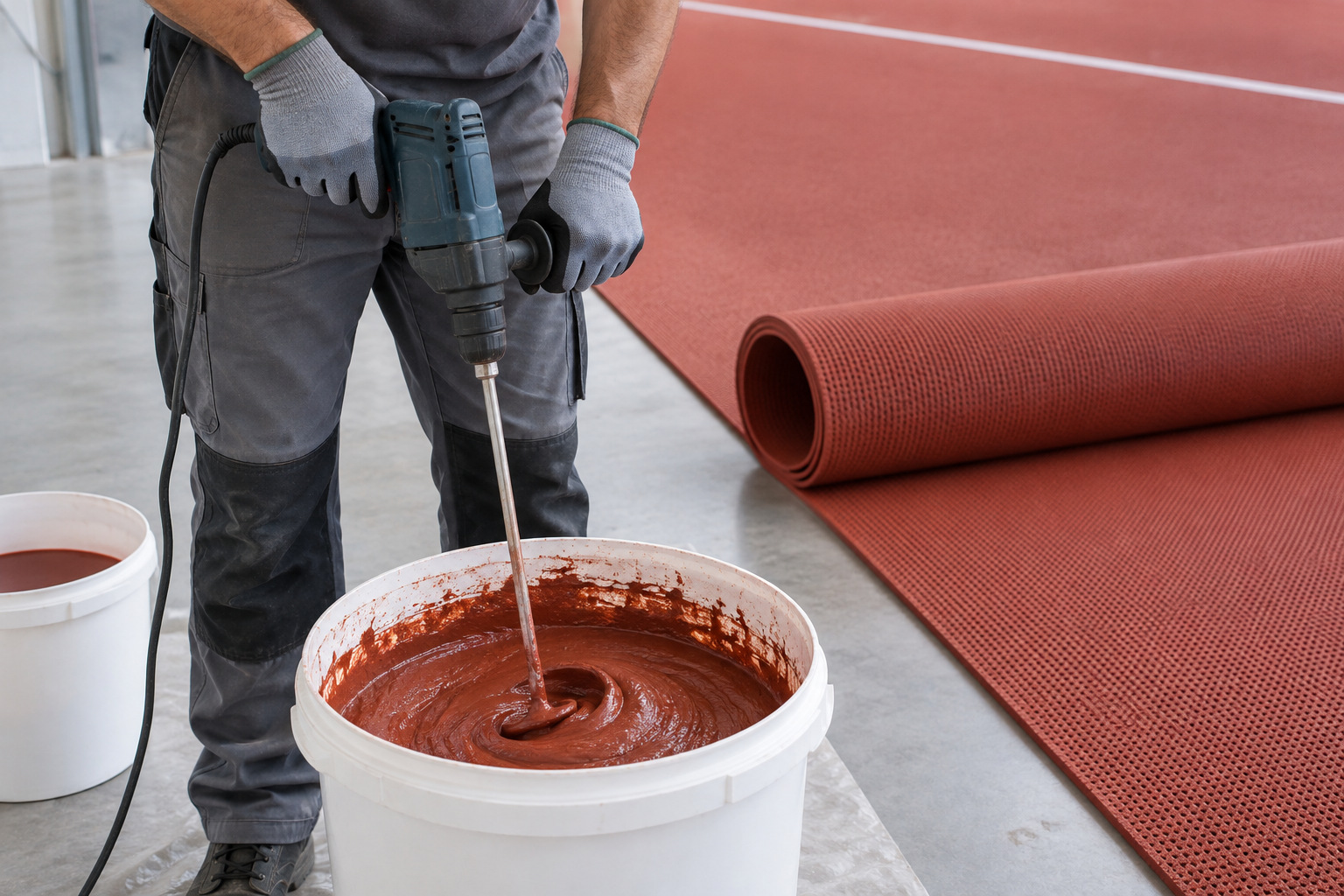
![Installer mixing a two-component flooring adhesive in a plain container]()
Figure 2. Installer mixing a two-component flooring adhesive in a plain container. AI-generated technical illustration.
Separate Pot Life From Open Time
Pot life is the usable period of a mixed reactive adhesive under specified conditions. Open time concerns the interval after spreading during which the flooring can be installed successfully. Assembly time, initial set and full cure describe further stages. Treating all of these as one drying time creates avoidable errors.
Temperature affects reaction rate and viscosity. A large mixed batch can behave differently from a thin spread layer, and a sun-heated foundation may be much warmer than the air. Record material and substrate temperatures and mix quantities the crew can place within the manufacturer's limits. Never restore expired adhesive by adding solvent or extra components unless the product instructions explicitly require it.
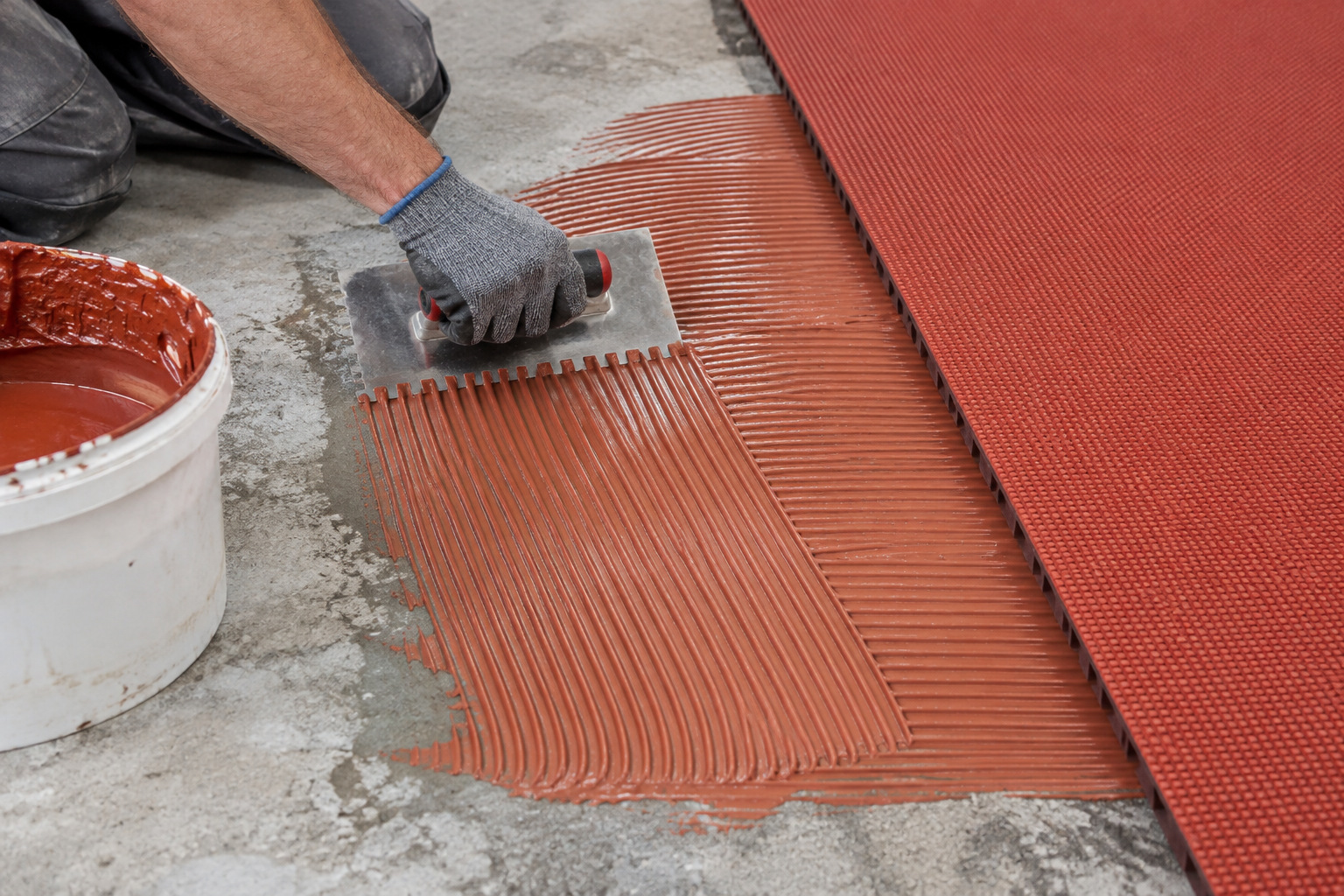
![Uniform adhesive ridges formed with a notched trowel on a prepared foundation]()
Figure 3. Uniform adhesive ridges formed with a notched trowel on a prepared foundation. AI-generated technical illustration.
Verify Transfer and Cured Bond Quality
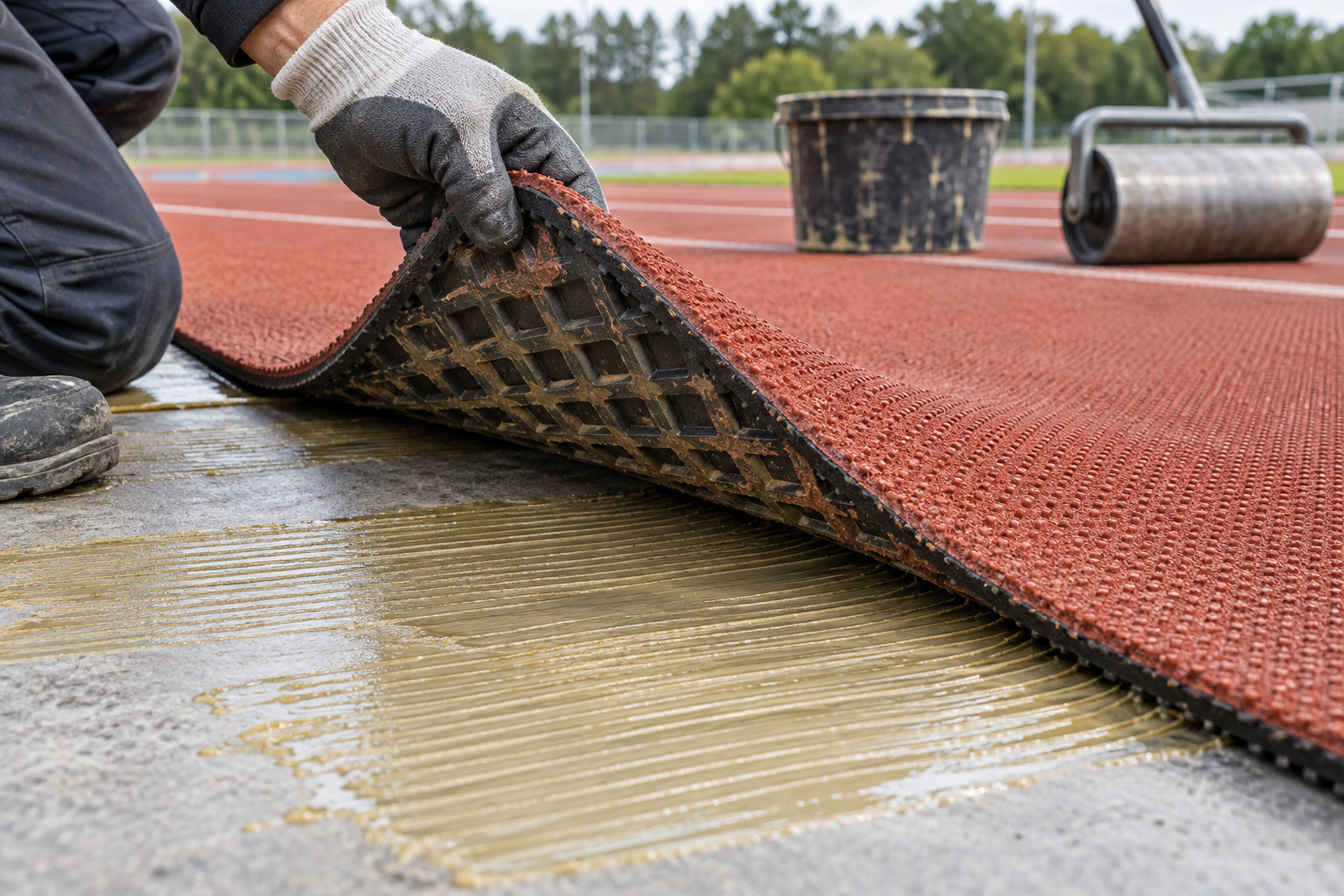
Select the trowel and application rate for the backing profile and foundation condition. Check contact by lifting a recently placed trial section within the permitted installation window. Look for the contact pattern required by the approved method, including at edges. The adhesive should bond the sheet consistently without creating avoidable lumps or unsupported areas.
Evaluate the cured trial using an agreed method and record the failure mode. A numerical peel result is incomplete without specimen width, pull geometry, conditioning, cure period and test speed. Rubber tearing, adhesive splitting and clean interface separation have different meanings. Where exposure warrants it, compare conditioned samples after water or thermal exposure using the same procedure.
![Raised edge of a trial strip showing adhesive transfer to the rubber backing]()
Figure 4. Raised edge of a trial strip showing adhesive transfer to the rubber backing. AI-generated technical illustration.
Account for Moisture and Installation Logistics
A moisture-resistant cured adhesive is not necessarily suitable for installation on wet concrete. Use the test method and limit stated for the complete bonding system. Handheld screening readings, internal relative humidity and gravimetric moisture are different measurements and should not be substituted without justification.
Plan installation around mixing capacity, roll handling, weather protection and time for consolidation. Record batch numbers and spread times by work area. Protect fresh seams from premature traffic, rain and cleaning until the system reaches the required cure. This practical planning often determines whether an otherwise suitable adhesive performs as intended.
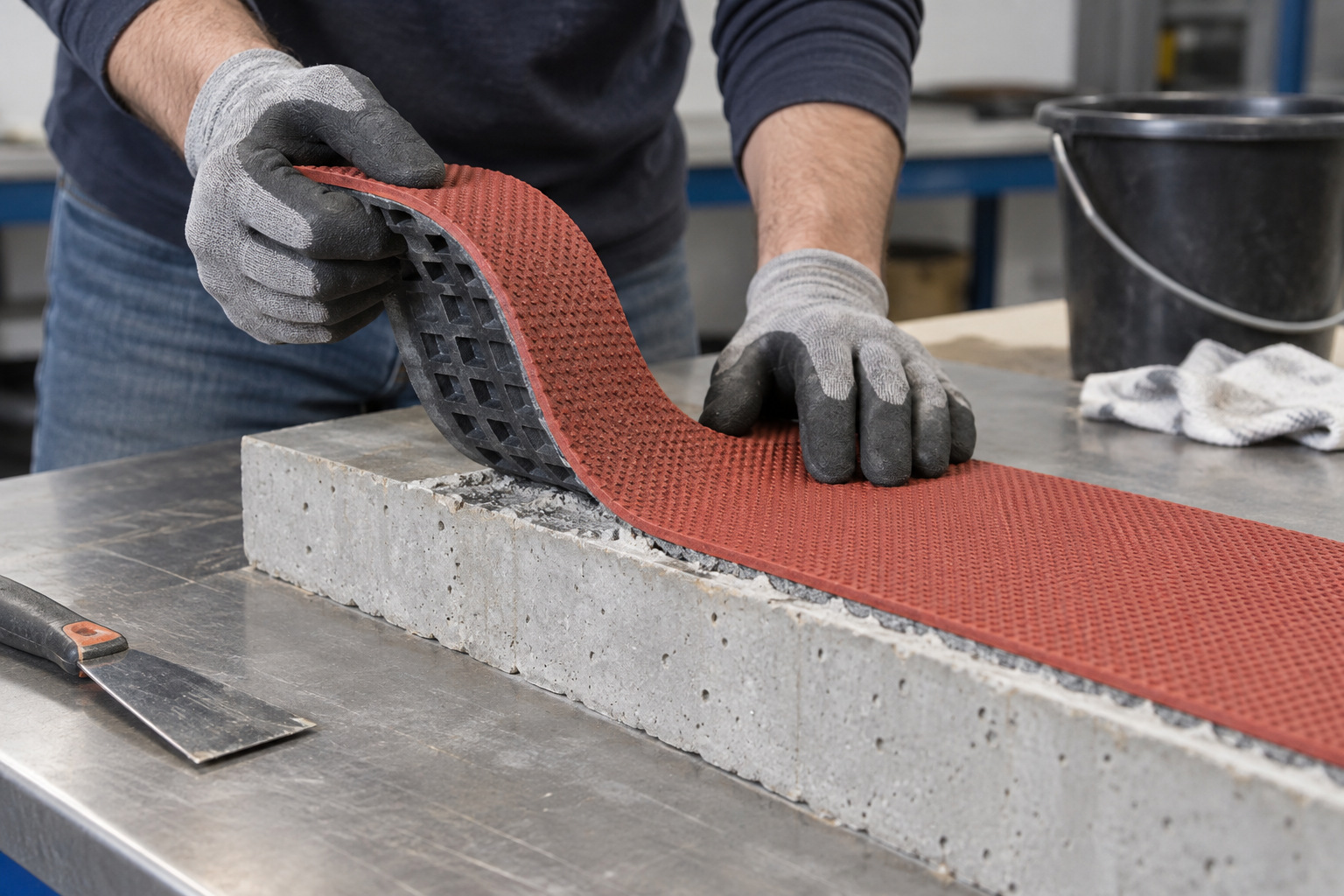
![Bonded rubber test strip on a concrete panel with its free end raised for examination]()
Figure 5. Bonded rubber test strip on a concrete panel with its free end raised for examination. AI-generated technical illustration.
Match the Adhesive to Your HUADONG Track
When evaluating GODER or GOTER, supply the actual foundation description and expected installation conditions. Ask for a compatible bonding specification covering every interface, then validate it with a site trial. The aim is a repeatable installation process with documented acceptance criteria, not a universal ranking of glue types.
Frequently Asked Questions
1. Is two-component polyurethane always the strongest option?
No universal ranking applies. Formulation, substrate preparation, backing compatibility and conditioning can change the result. Compare complete assemblies tested by the same method.
2. Can a glue for rubber gym tiles bond a running track?
Only if the manufacturer confirms suitability for the specific track backing and exposure. Tile composition and service conditions may differ from a vulcanized outdoor track roll.
3. Does waterproof adhesive allow work on damp concrete?
Not automatically. Resistance after curing and tolerance during installation are separate properties. Check the stated moisture test and installation limit.
4. How much adhesive is needed per square meter?
Use the product's guidance and a trial on the actual base. Consumption changes with trowel geometry, substrate texture and the track's backing profile.
5. When can athletes use the newly bonded track?
Release the area only after the specified curing and acceptance requirements have been met. Air temperature alone cannot establish readiness; adhesive, base conditions and loading all matter.