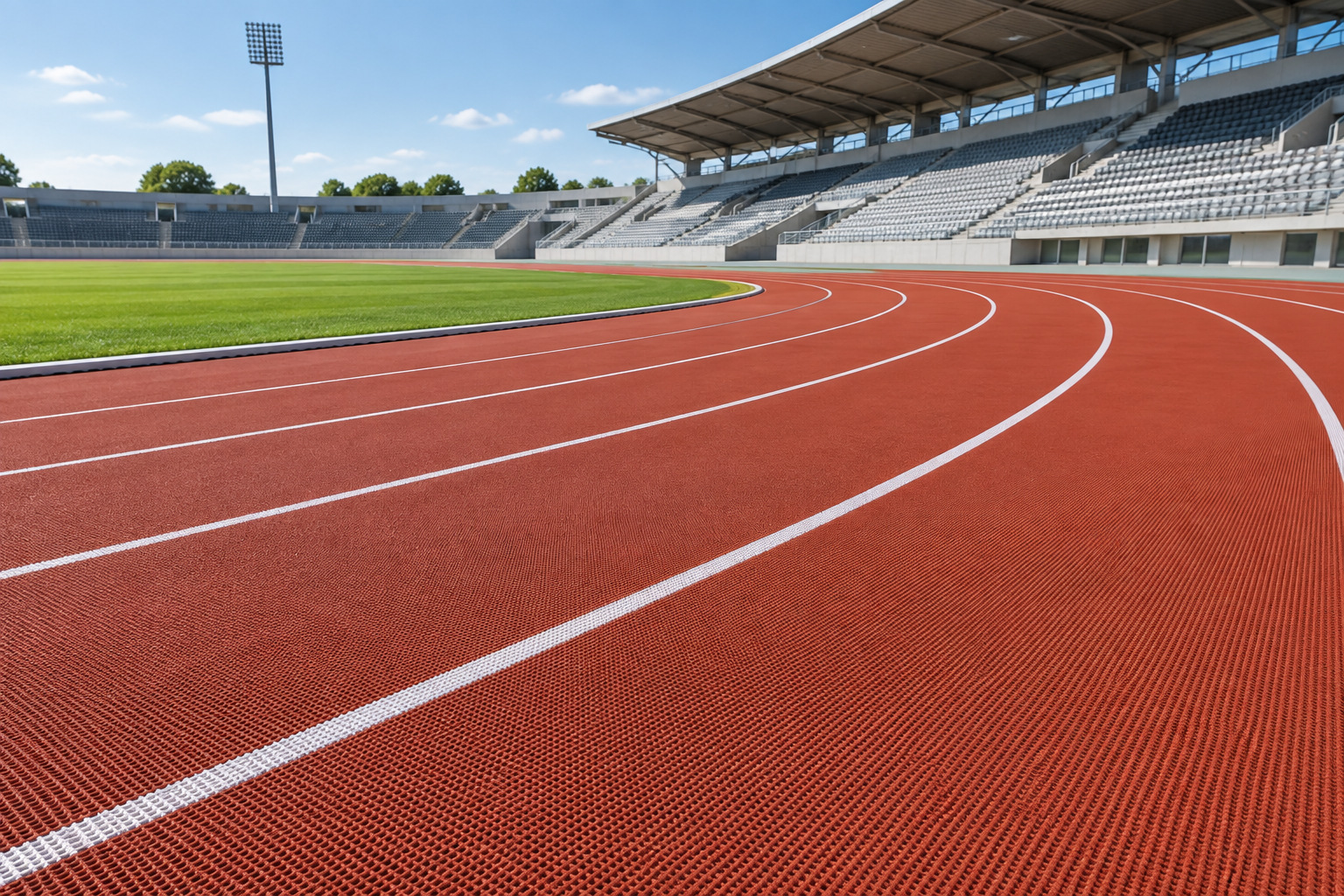
A prefabricated running track can be a candidate for localized repair when the damage is limited and the surrounding sheet, bond and foundation remain sound. Widespread deterioration, repeated bond failures or unresolved foundation movement may justify a larger intervention. The decision should be based on the cause and distribution of defects, the required sports performance and the cost of keeping the facility usable, not appearance alone.
Keywords: prefabricated track repair, running track replacement, rubber track patching, track surface renovation, running track maintenance
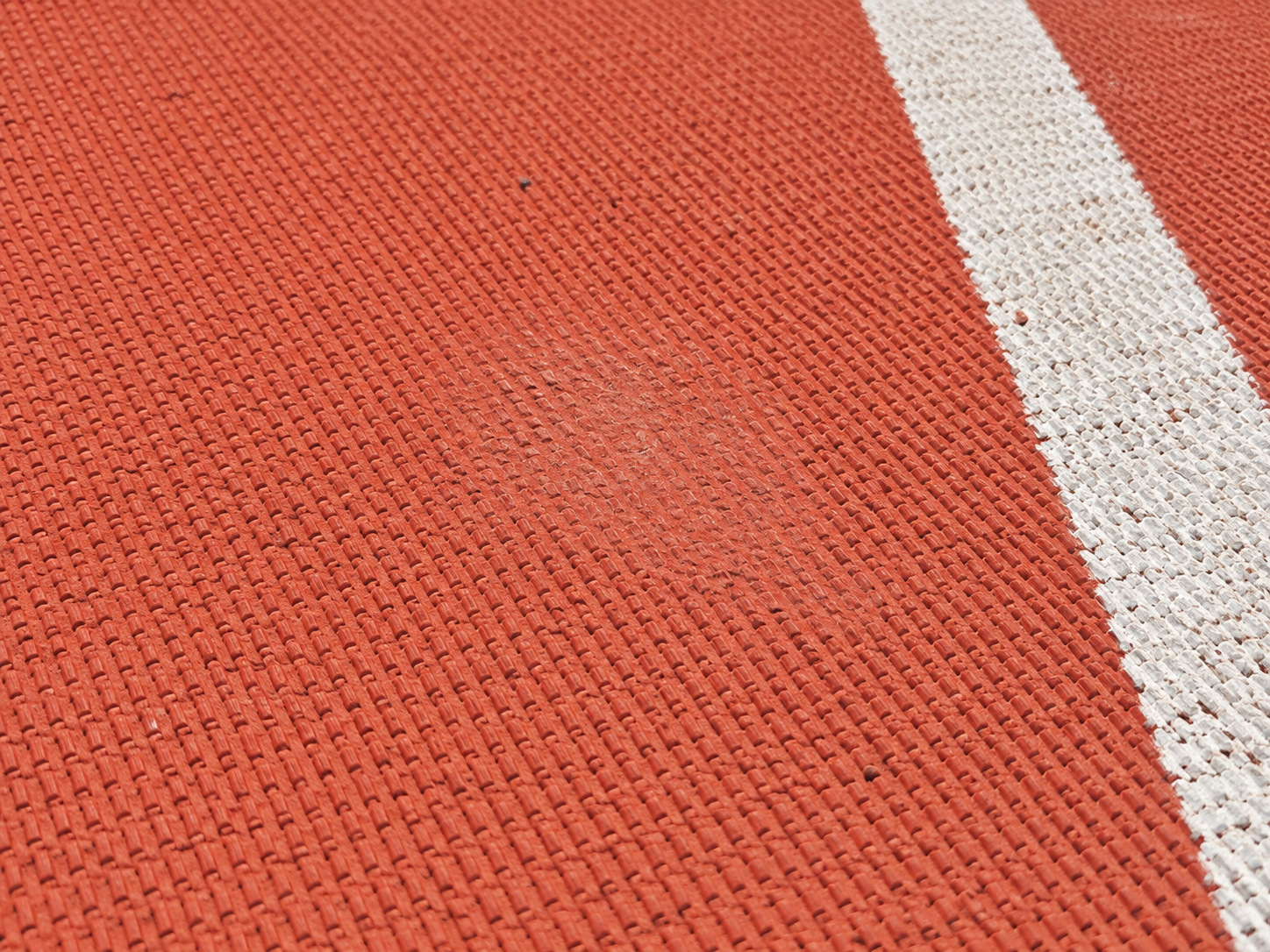
![Localized worn area in a prefabricated rubber running lane beside intact surface]()
Figure 1. Localized worn area in a prefabricated rubber running lane beside intact surface. AI-generated technical illustration.
Diagnose the Defect Before Choosing a Repair
Map the affected area and record what changed: surface texture, thickness, seams, support or drainage. Ask whether damage followed a specific incident or developed gradually. Tool cuts and isolated equipment damage suggest a different response from repeated blisters along a wet perimeter.
Inspect the surrounding material, not just the visible center of the defect. A small opening can conceal wider debonding, while discoloration can occur without a comparable loss of mechanical performance. Where necessary, use agreed sampling and testing to establish the extent of deterioration. Preserve photographs and removed material that may help explain the failure.
Decide Whether the Existing System Can Support a Patch
A successful patch requires sound boundaries, a stable base and compatible replacement materials. The new section should fit the existing thickness and surface geometry without creating a raised edge. Its backing and adhesive need to work with the prepared foundation.
| Condition found | Likely planning direction | Issue to resolve first |
| Isolated cut with sound surrounding material | Localized sheet replacement | Remove the complete damaged area |
| Small detached zone on a stable dry base | Investigated local rebond or replacement | Identify why adhesion was lost |
| Repeated defects along a water path | Drainage or base work plus surface repair | Stop continuing moisture entry |
| Widespread brittle or badly worn surface | Broader renewal assessment | Establish remaining performance |
| Moving or deteriorating foundation | Civil works and surface reinstatement | Stabilize the supporting structure |
| Many patches affecting continuity | Compare staged renewal with replacement | Evaluate uniformity and future maintenance |
No single percentage of damaged area provides the correct answer for every facility. Location, consequence and cause can matter as much as size.
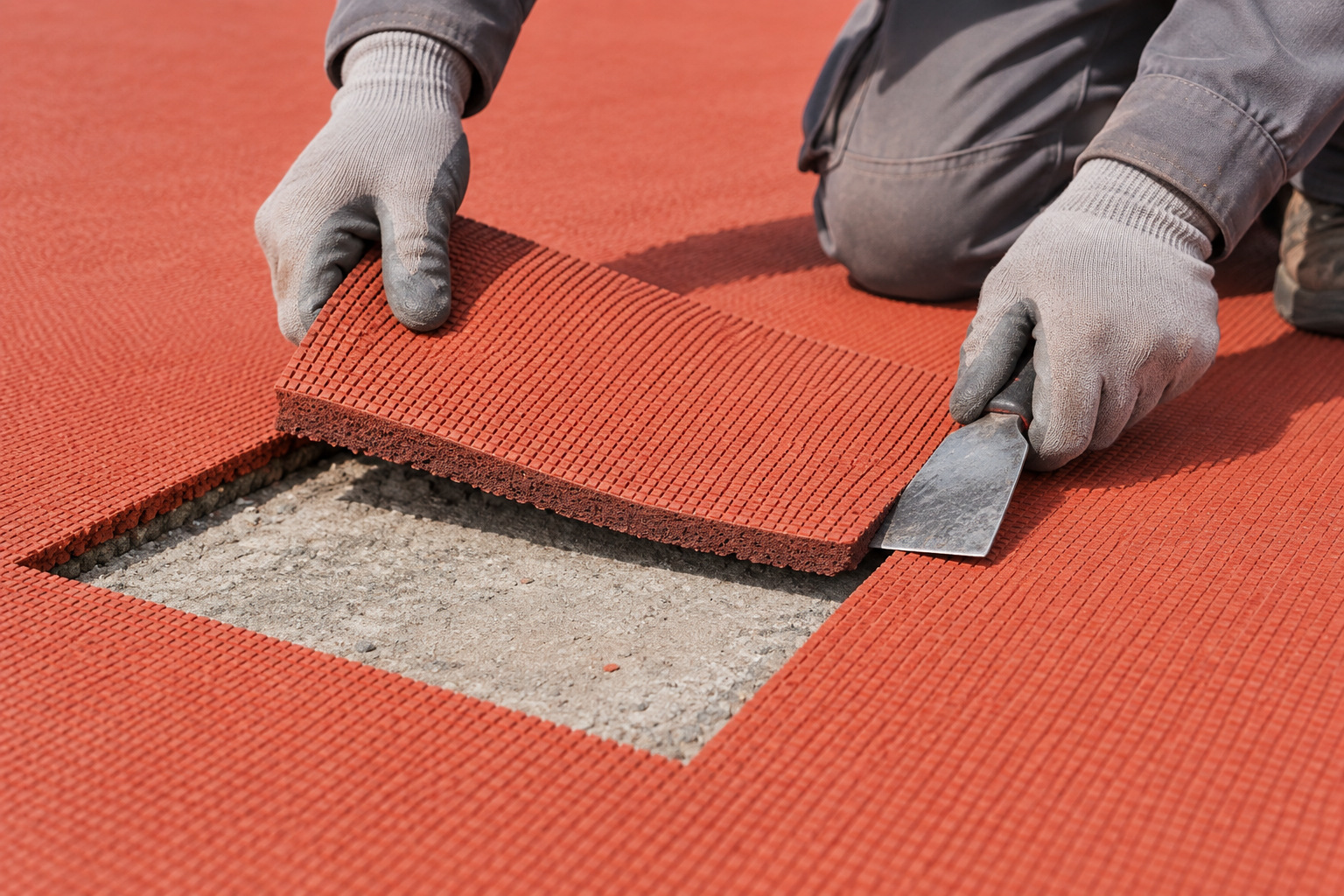
![Damaged rectangular section of rubber track being removed to expose the foundation]()
Figure 2. Damaged rectangular section of rubber track being removed to expose the foundation. AI-generated technical illustration.
Prepare the Repair Area as a New Bonding Surface
Remove the defective material and unsuitable adhesive within the agreed repair boundary. Inspect the exposed base for weakness, moisture and movement. Correct those issues before installing the replacement. Grinding, cleaning and any leveling or primer treatment must be compatible with the specified system.
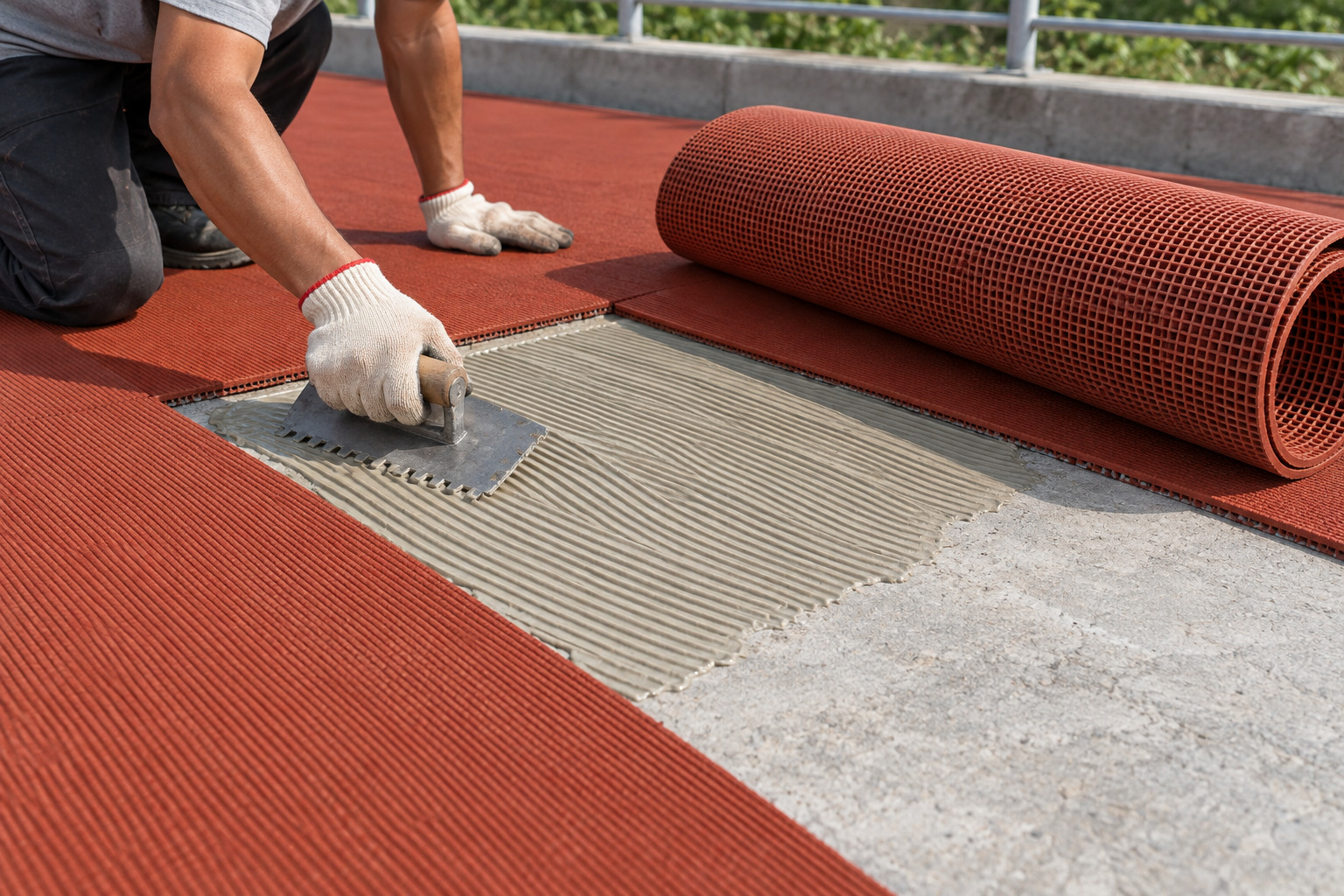
Dry fit the conditioned replacement piece and confirm thickness, orientation and joint fit. Do not force an oversized patch into the opening or stretch an undersized one to close the edges. Use a controlled cutting method and protect adjacent sheets from damage. If the available replacement does not match the required construction, resolve that difference before bonding.
![Prepared repair opening with adhesive and a matching prefabricated rubber replacement piece]()
Figure 3. Prepared repair opening with adhesive and a matching prefabricated rubber replacement piece. AI-generated technical illustration.
Bond and Consolidate the Replacement Correctly
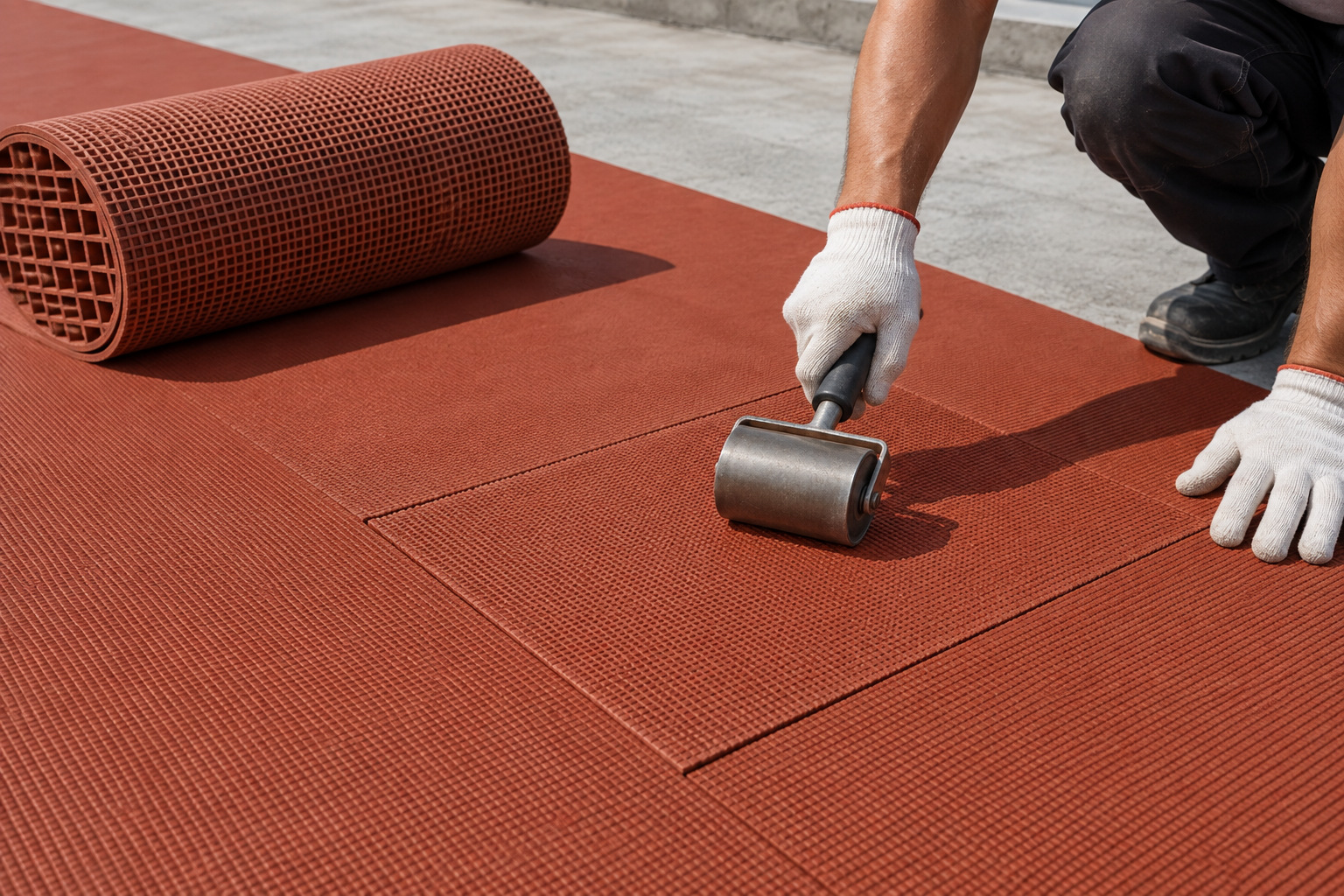
Use the approved adhesive and application procedure for the existing base and new backing. Observe mixing and working-time requirements, check transfer where specified and consolidate the patch without creating an indentation or step. Clean the surrounding surface using a compatible method.
Protect the repair through the required cure. Before reopening, check edge stability, surface regularity and the condition of any reinstated lane marking. A patch in a high-use approach or competition lane may need additional project-specific assessment. The completion record should identify the replacement material, adhesive, location and date.
![Hand roller consolidating a flush replacement section within a rubber running track]()
Figure 4. Hand roller consolidating a flush replacement section within a rubber running track. AI-generated technical illustration.
Compare Repair Costs With Remaining Serviceability
The least expensive immediate patch may not be the best long-term option if failures recur. Compare direct work, closure time, testing, repeated mobilization and the likelihood of further intervention. Assess whether the remaining surface can continue meeting the venue's required use and performance.
Avoid basing replacement solely on age or a generic advertised life. Exposure, training volume, footwear, cleaning and the condition of the foundation all influence serviceability. Conversely, a visually attractive track may still require work if the bond or measured performance is unacceptable. Use current inspection evidence to define the scope.
Check the Effect on Competition and Certification
Where the venue operates under formal certification or event requirements, coordinate significant repairs or surface replacement with the relevant responsible parties. The World Athletics technical document library provides the relevant certification and testing references. Determine whether the proposed work changes the configuration, geometry or evidence required for the venue; do not assume every repair has the same administrative or testing consequence.
![Renovated stadium with a continuous prefabricated rubber running surface]()
Figure 5. Renovated stadium with a continuous prefabricated rubber running surface. AI-generated technical illustration.
Plan Compatible Reinstatement With HUADONG
For an existing GODER running track, provide HUADONG with the original model and batch information, photographs and defect map. Confirm the availability and compatibility of replacement material before scheduling work. Where the scope extends beyond a patch, compare repair, partial renewal and full replacement using the same technical and operational criteria.
Frequently Asked Questions
1. Can any red rubber sheet be used as a patch?
No. Color alone does not establish compatibility. Check construction, thickness, texture, backing and adhesive requirements against the existing surface.
2. Will a new patch be invisible?
An exact appearance match cannot be assumed. Existing material may have aged or worn. Evaluate representative material while prioritizing flushness, support and suitable performance.
3. Should a blister be punctured and pressed down?
Do not treat that as a complete repair method. Identify the cause and restore the bond using an approved procedure; a puncture does not remove moisture or defective adhesive.
4. When is full replacement more reasonable?
Consider it when deterioration is widespread, failures recur or the remaining system cannot support the required use economically. Include the foundation condition in that decision.
5. When can a repaired area reopen?
After the specified cure, inspection and any required tests are complete. The patch size does not remove the need to confirm adhesive readiness and edge stability.