Tensile strength helps describe a rubber material, but it cannot independently predict the durability of a prefabricated running track. Athletic surfaces experience repeated impacts, spike contact, weather exposure and stress at seams and bonded interfaces. A useful comparison combines tensile results with tear resistance, aging behavior, wear and installed-system performance. Buyers should first make sure the numbers being compared were produced under equivalent conditions.
Keywords: running track tensile strength, rubber track durability, elongation at break, rubber aging resistance, prefabricated track specification
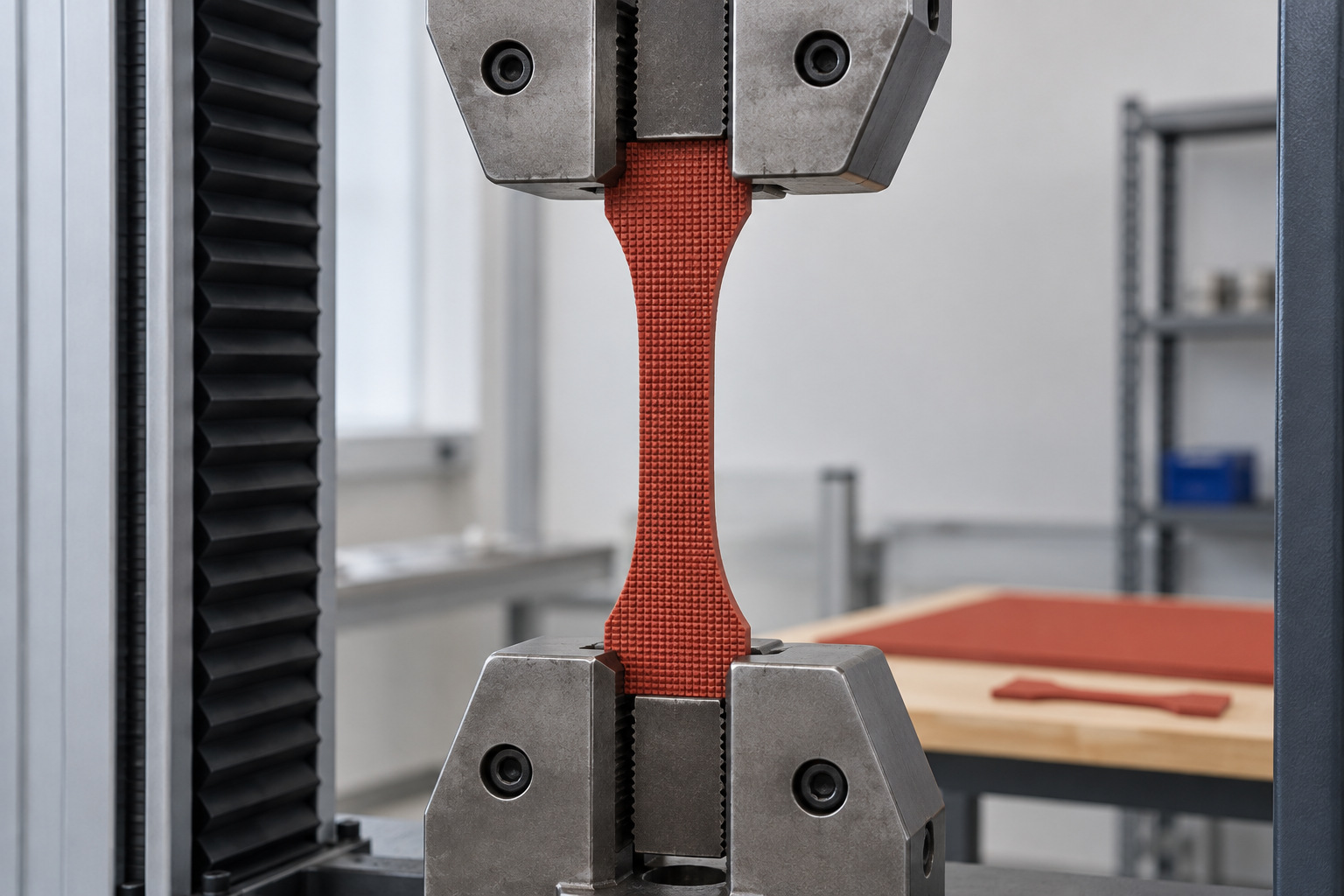
![Rubber dumbbell specimen held under tension in a laboratory testing machine]()
Figure 1. Rubber dumbbell specimen held under tension in a laboratory testing machine. AI-generated technical illustration.
Know What a Tensile Result Measures
A tensile test pulls a prepared specimen until a defined endpoint, often rupture, while recording force and extension. The reported strength relates the force to the specimen's cross-sectional area. Elongation at break describes the extension reached before rupture under that procedure.
These values are meaningful material descriptors. They are not direct measures of grip, shock absorption, water resistance or the bond to concrete. ASTM D412 sets out rubber tension test methods; specifying that method still requires attention to specimen preparation and test conditions. A complete report is more useful than a strength value copied into a sales table.
Compare Equivalent Specimens and Conditions
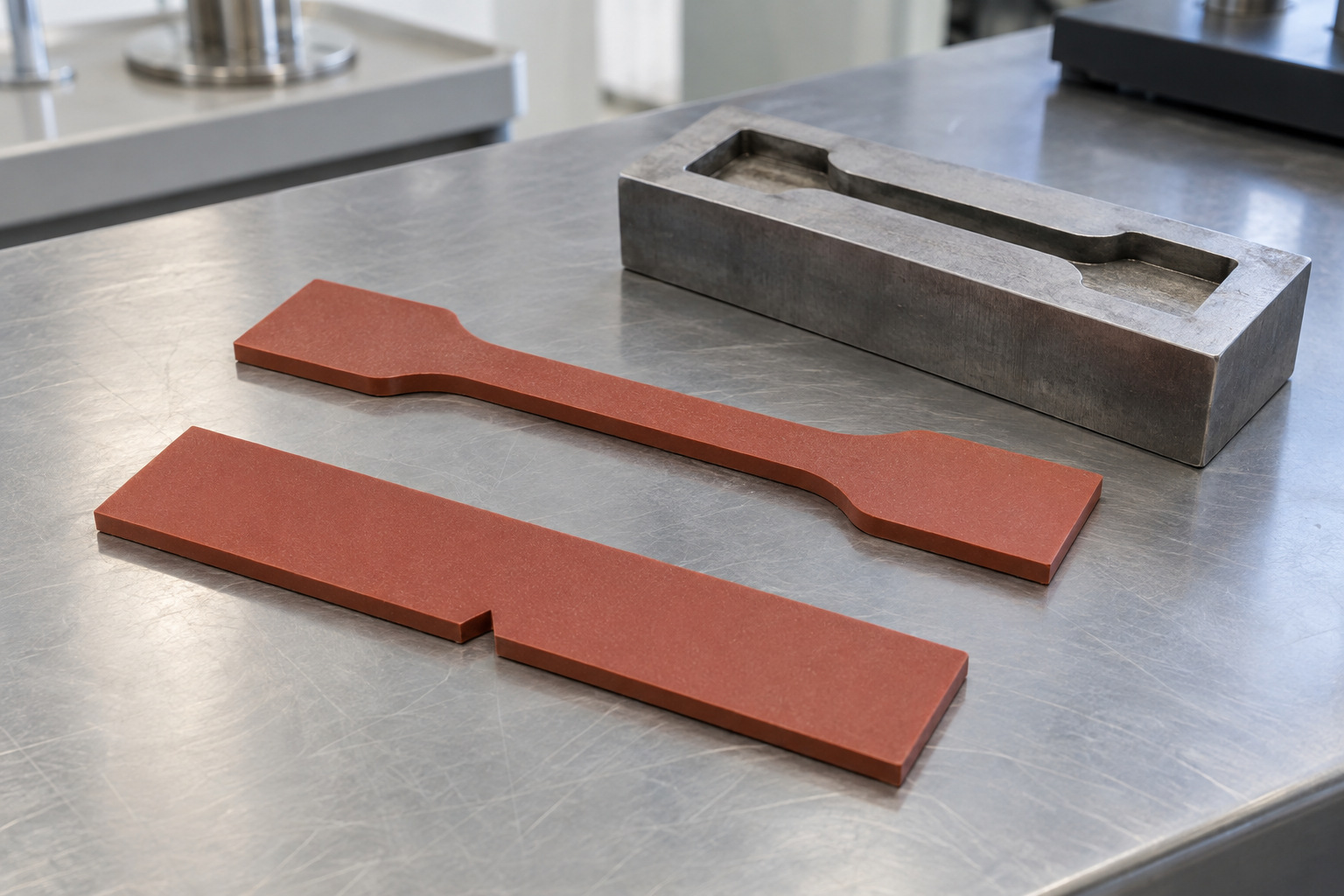
Check whether the test used the wearing compound, lower layer or complete sheet. Also check specimen direction, thickness measurement, conditioning temperature and test speed. A molded backing with cavities can complicate the interpretation of cross-sectional area, so the sampling and calculation method need to be clear.
Higher results from dissimilar specimens do not establish a better running track. A strong dense upper-layer coupon cannot be compared directly with a specimen representing the whole cellular construction. Compare like with like, then evaluate how each measured property relates to the intended facility.
![Prepared tensile and notched rubber specimens placed together on a laboratory bench]()
Figure 2. Prepared tensile and notched rubber specimens placed together on a laboratory bench. AI-generated technical illustration.
Add the Failure Modes a Tensile Test Misses
| Property or assessment | Question it helps answer | Why it complements tensile strength |
| Tear resistance | How does a defined cut propagate? | Local damage can grow from small defects |
| Abrasion or wear | How does repeated contact affect the surface? | Material can wear without tensile rupture |
| Aged property retention | How do properties change after exposure? | New material results do not describe aging |
| Repeated loading | Does damage accumulate over cycles? | A single pull does not reproduce fatigue |
| Bond assessment | Does the installed sheet remain attached? | Material strength does not prove adhesion |
| Sports-performance tests | Does the surface provide the required response? | Strength alone cannot describe athletic behavior |
ASTM D624 treats tearing as a distinct behavior. Its published description also explains that results are specific to test conditions. That is a reason to use several relevant assessments rather than replacing one isolated number with another.
Evaluate Change After Aging
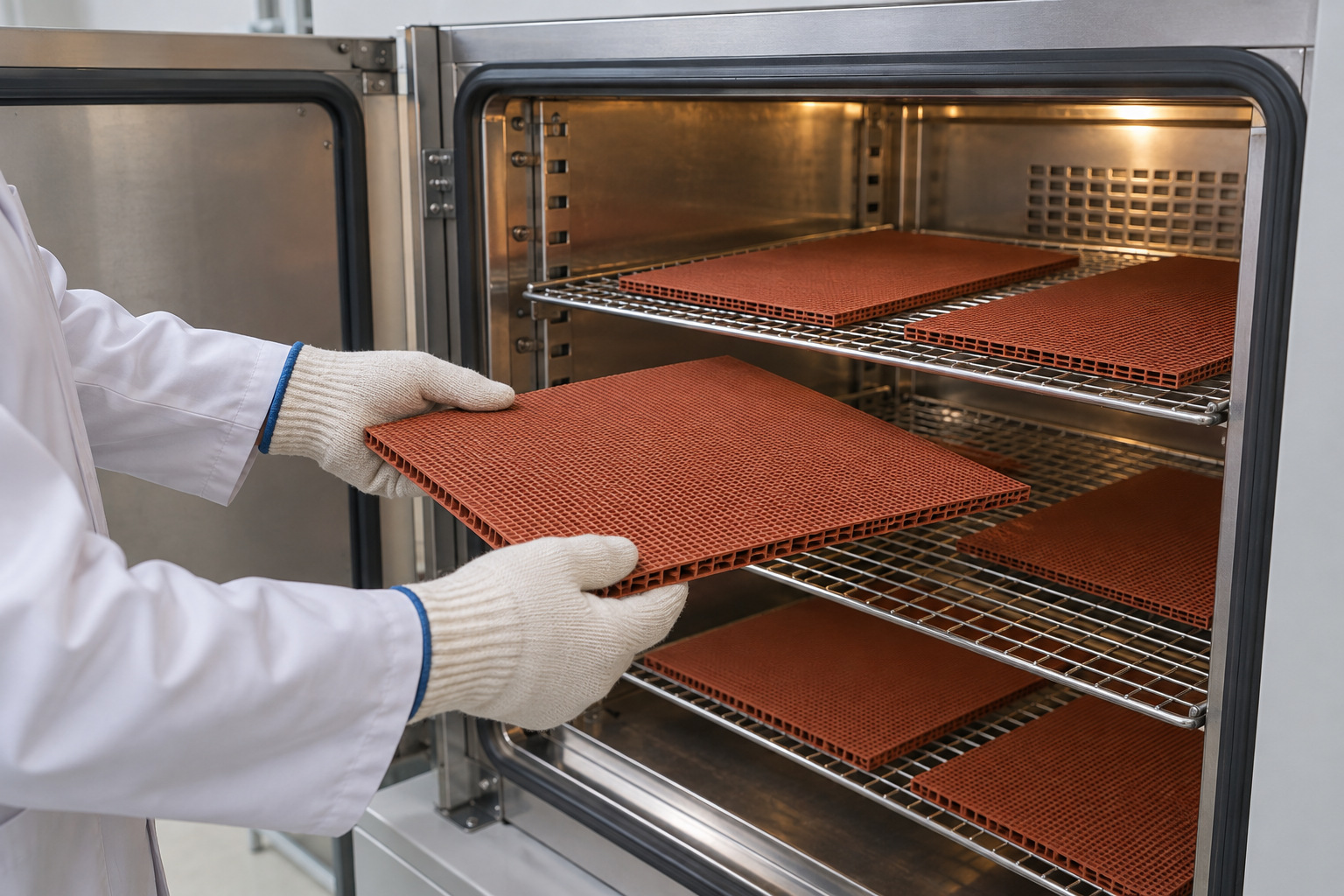
Outdoor exposure combines heat, sunlight, water and mechanical use. Accelerated testing can compare material responses to controlled conditions, but the exposure must be described. ISO 188 addresses accelerated aging and heat-resistance tests for rubber. It does not convert a laboratory exposure directly into a guaranteed number of years at every site.
Compare retained properties alongside the original results. Retention can be expressed as the aged value divided by the initial value, multiplied by 100 percent, when the specimens and test methods are comparable. Examine absolute values as well: a high retention percentage does not make an initially unsuitable property acceptable. Record visible cracking, hardening and color change separately where relevant.
![Rubber specimens arranged inside a laboratory heat aging chamber]()
Figure 3. Rubber specimens arranged inside a laboratory heat aging chamber. AI-generated technical illustration.
Consider Repeated Flexing and Installed Support
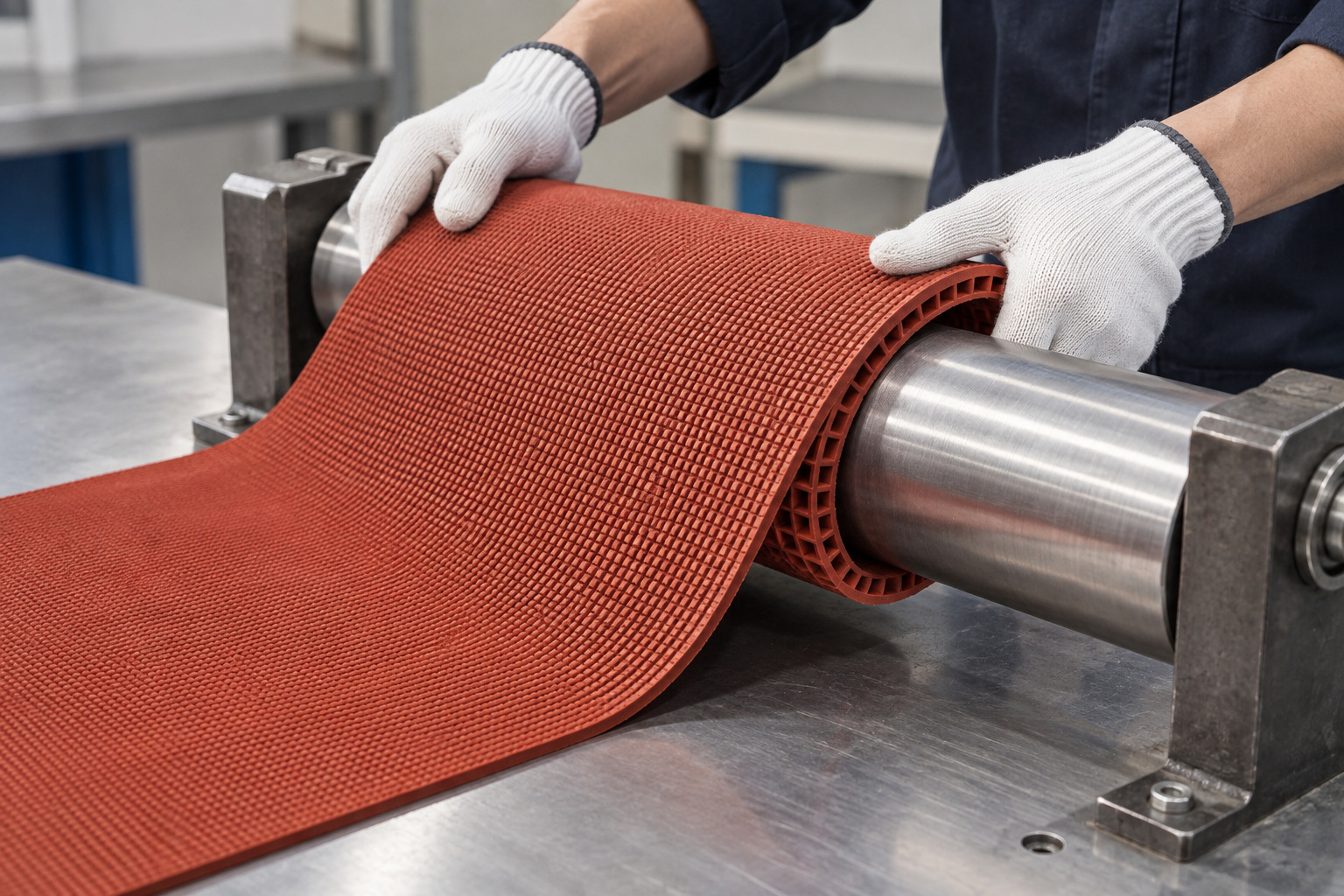
A running track receives many load cycles. Small defects can develop under repeated loading even when a new specimen survives a strong single pull. Temperature and aging may change how the material responds to these cycles.
Support conditions matter too. A sheet bonded uniformly to a sound base experiences different local movement from one spanning an air pocket or a damaged patch. Evaluate suspect areas for foundation and adhesive issues before attributing all wear to the rubber compound. Factory testing and installation inspection are complementary parts of durability assessment.
![Rubber strip flexed around a smooth cylindrical fixture for examination]()
Figure 4. Rubber strip flexed around a smooth cylindrical fixture for examination. AI-generated technical illustration.
Turn Test Data Into a Better Purchasing Decision
Create a comparison sheet listing the property, method, specimen, conditioning and result for each offered product. Mark unmatched data as requiring clarification rather than forcing it into a ranking. Link acceptance criteria to the intended track construction and use.
For GOTER and GODER, ask HUADONG for the relevant model documents and evaluate them against the same project requirements. Include training volume, spike use, weather exposure and maintenance capacity. This approach supports a product decision that reflects service conditions rather than one headline strength figure.
![Localized wear on a running lane compared with the adjacent intact embossed surface]()
Figure 5. Localized wear on a running lane compared with the adjacent intact embossed surface. AI-generated technical illustration.
Frequently Asked Questions
1. Is tensile strength unimportant for running tracks?
It remains useful. The limitation is treating it as a complete durability score. It should sit alongside other material and installed-surface evidence.
2. Does higher elongation always mean better quality?
No. Elongation must suit the compound and application. A larger break strain does not independently establish wear resistance, stability or athletic performance.
3. Can I compare reports using different test methods?
Only with a justified understanding of their relationship. Similar units do not guarantee equivalent procedures. Request comparable testing when the distinction affects product selection.
4. Do aging hours predict years of outdoor service?
Not without a validated correlation for the material and exposure. Accelerated tests are useful for controlled comparisons, while actual service depends on climate, use and maintenance.
5. What is the most useful question to ask a supplier?
Ask which complete set of tests supports the offered construction for your use, and request the methods and specimen details. This reveals more than asking for the highest tensile number.