Prefabricated running track seams can open when sheet movement, weak bonding or an unstable base concentrates stress at the joint. Preventing failure requires compatible materials, relaxed roll stock, accurate trimming and consistent adhesive contact. For stadium owners and installation teams, the most useful investigation starts with the failure surface: determine whether the rubber has torn, the adhesive has separated or the foundation has moved before selecting a repair.
Keywords: prefabricated track seams, running track seam failure, rubber track installation, track adhesive bonding, track edge lifting
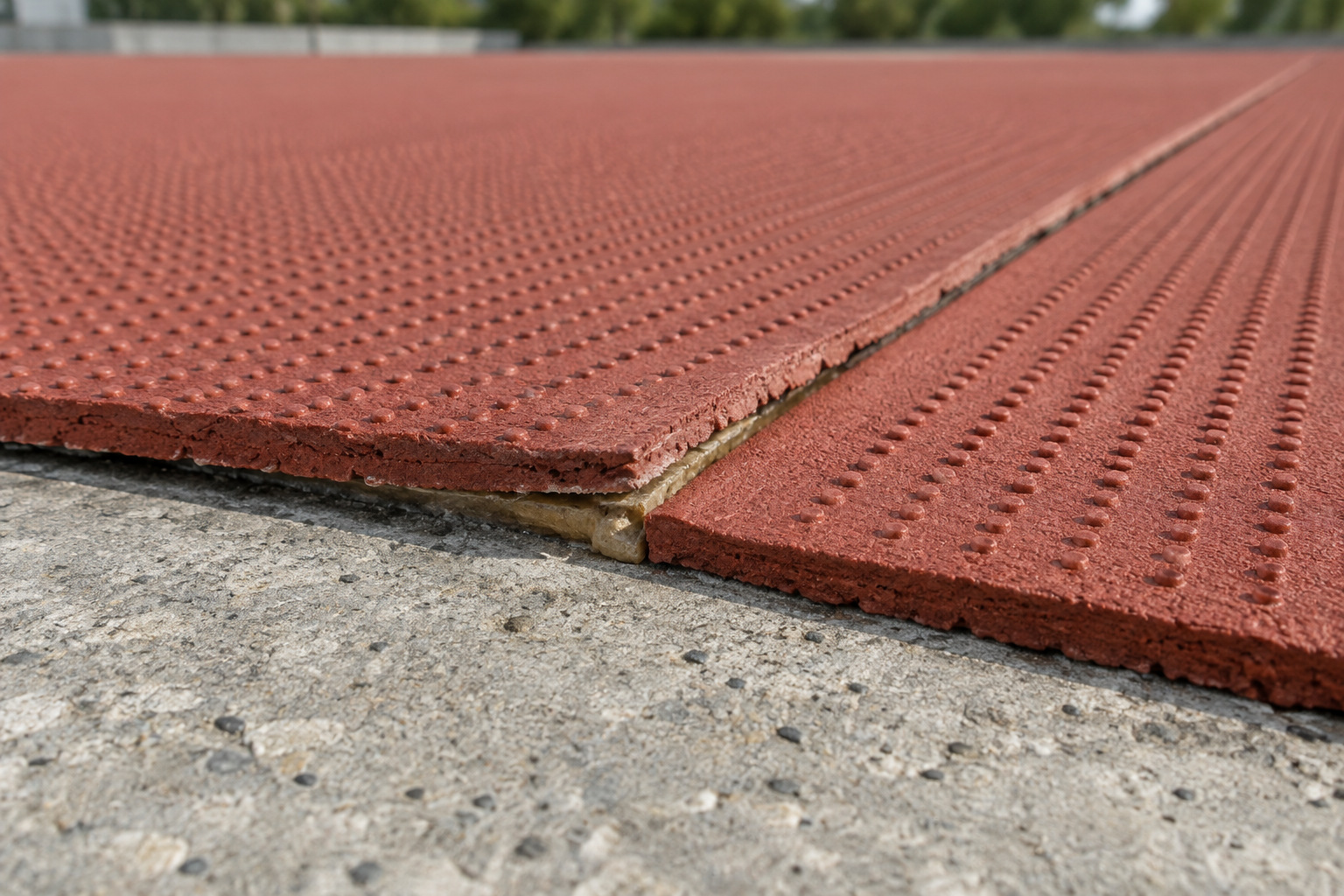
![Small lifted edge at a butt joint between embossed prefabricated rubber track sheets]()
Figure 1. Small lifted edge at a butt joint between embossed prefabricated rubber track sheets. AI-generated technical illustration.
Recognize the Type of Seam Failure
A visible line between two sheets is not automatically a defect. A sound butt joint should remain flush, supported and consistent with the approved installation detail. An opening that grows, an edge that catches footwear or a section that lifts under pressure requires investigation.
Distinguish joint opening from interlayer separation. A gap between neighboring rolls concerns the installed seam. Separation between the wearing layer and the backing concerns the sheet construction. A cleanly detached backing can indicate an interface problem, while concrete attached to the removed adhesive points toward substrate failure. Photographs of both sides of a removed sample are often more informative than a photograph of the gap alone.
Seven Causes That Deserve Investigation
1. Residual roll tension. Material bonded before it has relaxed can continue changing shape while the adhesive develops strength. Pulling a short sheet to close a gap introduces additional stress.
2. Inaccurate edge preparation. A damaged factory edge, angled cut or irregular trim can leave a joint that looks tight at the surface but lacks support below.
3. Incomplete adhesive transfer. Worn trowel notches, contaminated backing or adhesive left exposed too long can reduce contact, especially at sheet edges.
4. Incorrect adhesive preparation. An unsuitable product, wrong component ratio or poorly mixed batch can prevent the intended bond from developing.
5. Moisture or surface contamination. Dampness, dust, laitance, oil and incompatible residues can weaken the adhesive interface.
6. Base movement. Active cracks and movement joints can transfer stress into a bonded sheet. A surface patch alone cannot stabilize a moving foundation.
7. Early loading or temperature change. Traffic before sufficient cure, or a sharp change in sheet temperature during installation, can disturb a recently formed joint.
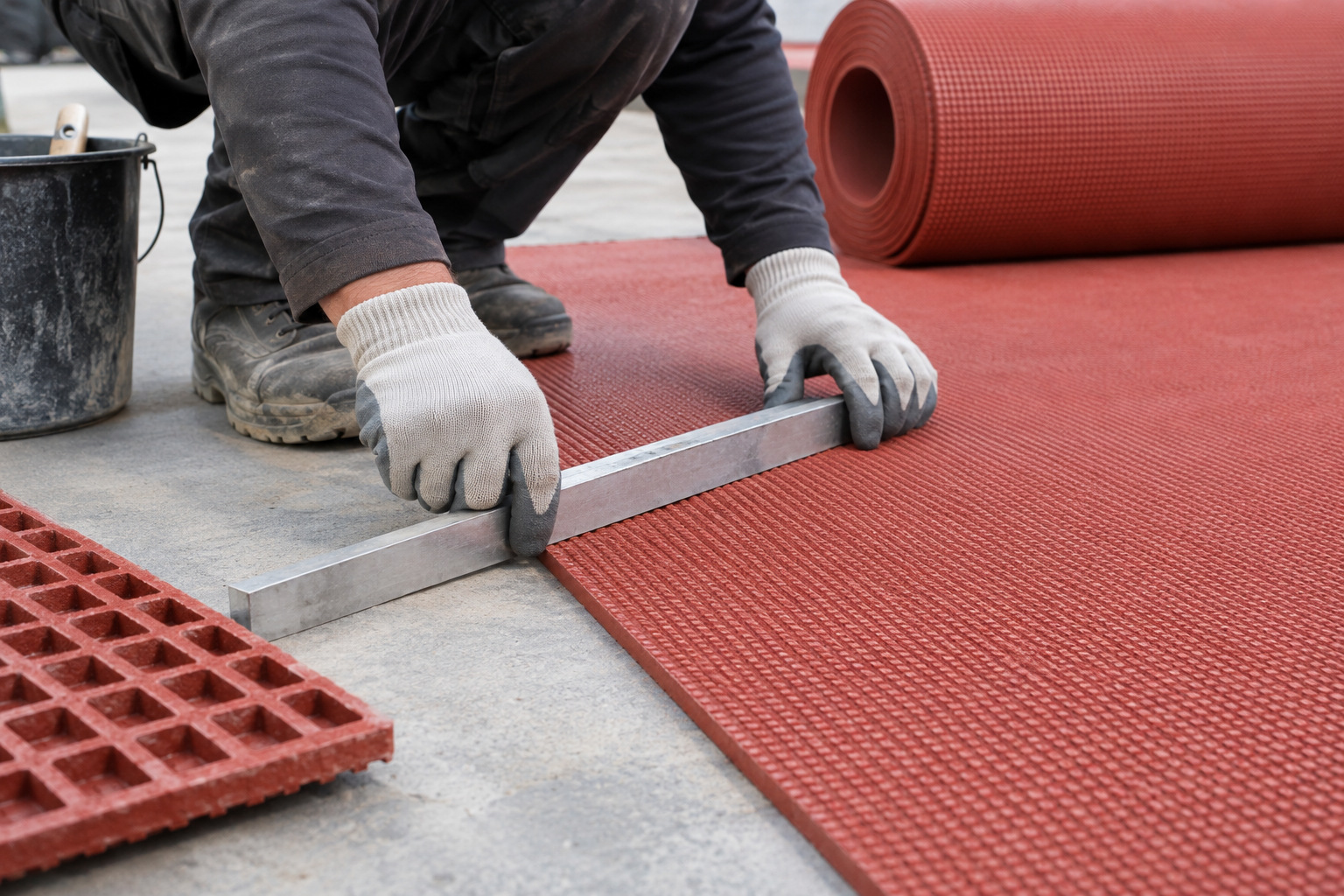
![Installer checking the trimmed edge of a prefabricated rubber sheet with a straightedge]()
Figure 2. Installer checking the trimmed edge of a prefabricated rubber sheet with a straightedge. AI-generated technical illustration.
Match the Evidence to the Correct Response
Record the location, recent weather, installation batch and extent of the defect. The following matrix guides the investigation; it does not replace inspection of the actual bond.
| Observation | What to investigate | Corrective direction |
| Clean rubber backing | Contamination or poor adhesive transfer | Prepare the backing and verify a compatible bonding method |
| Powdery concrete on adhesive | Weak surface or inadequate preparation | Remove unsound material and restore the base |
| Soft or sticky adhesive | Mixing, temperature and curing history | Remove defective adhesive and rework the affected area |
| Gap that changes with weather | Thermal movement and restrained sheet tension | Review conditioning, geometry and movement details |
| Recurring defect over a base crack | Foundation movement or water entry | Resolve the underlying defect before resurfacing |
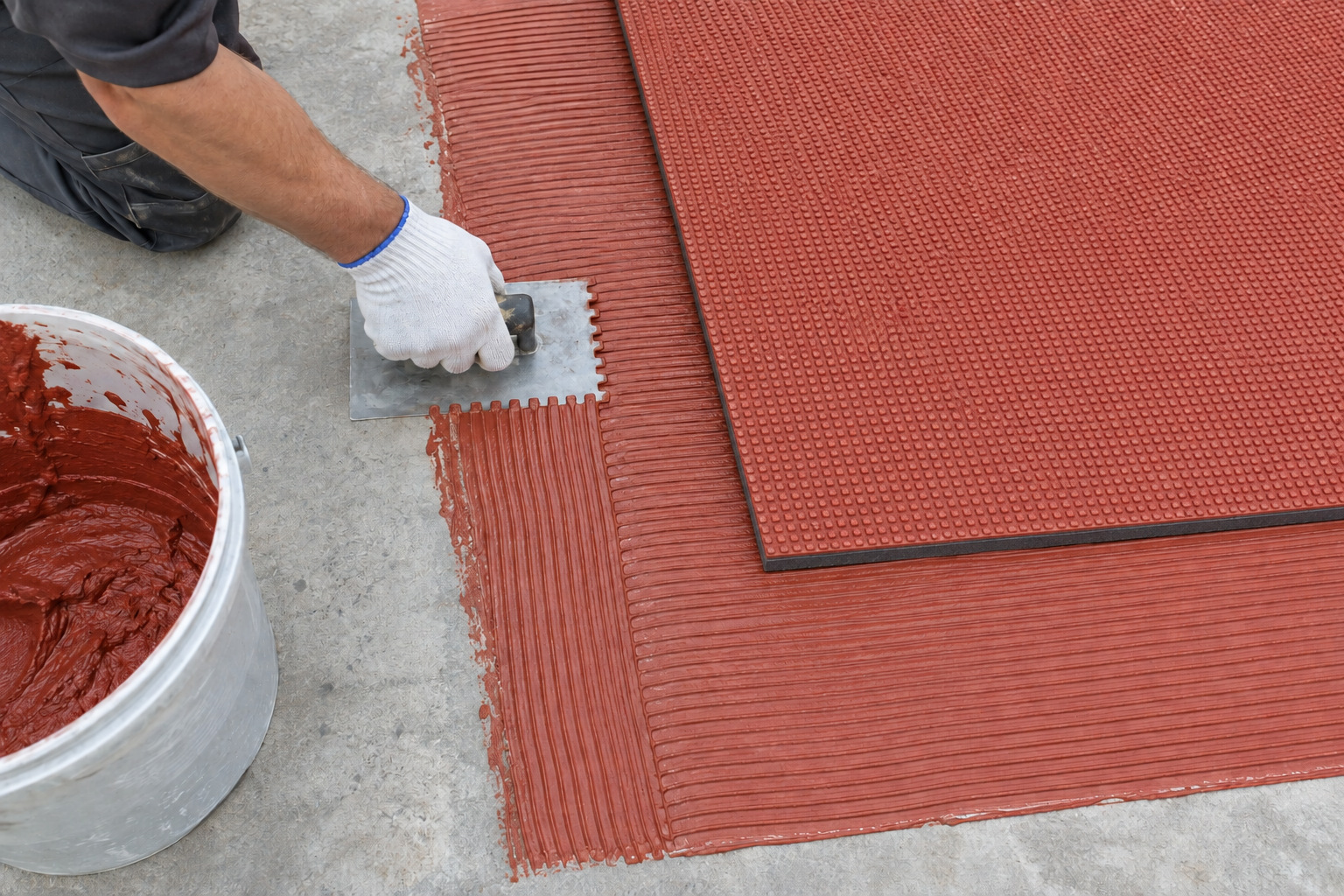
![Adhesive spread beside a flat prefabricated rubber sheet with its red wearing face up and backing bonded downward]()
Figure 3. Adhesive spread beside a flat prefabricated rubber sheet with its red wearing face up and backing bonded downward. AI-generated technical illustration.
Control Bonding Before Closing the Joint
Prepare a small trial area using the actual substrate, adhesive and roll backing. Inspect transfer while the adhesive is still within its working window. A smooth-looking upper surface cannot reveal whether contact underneath is adequate.
The adhesive manufacturer's instructions govern mixing, spreading, assembly and cure. MAPEI's external athletic-track installation method emphasizes a sound prepared substrate and laying matting while the adhesive remains fresh. Detailed requirements still depend on the selected product and project conditions.
Bring relaxed sheets together without stretching them. Consolidate the joint using the approved rolling procedure, clean any squeeze-out with a compatible method and protect the area through curing. Any temporary restraint must distribute load without damaging the embossed surface.
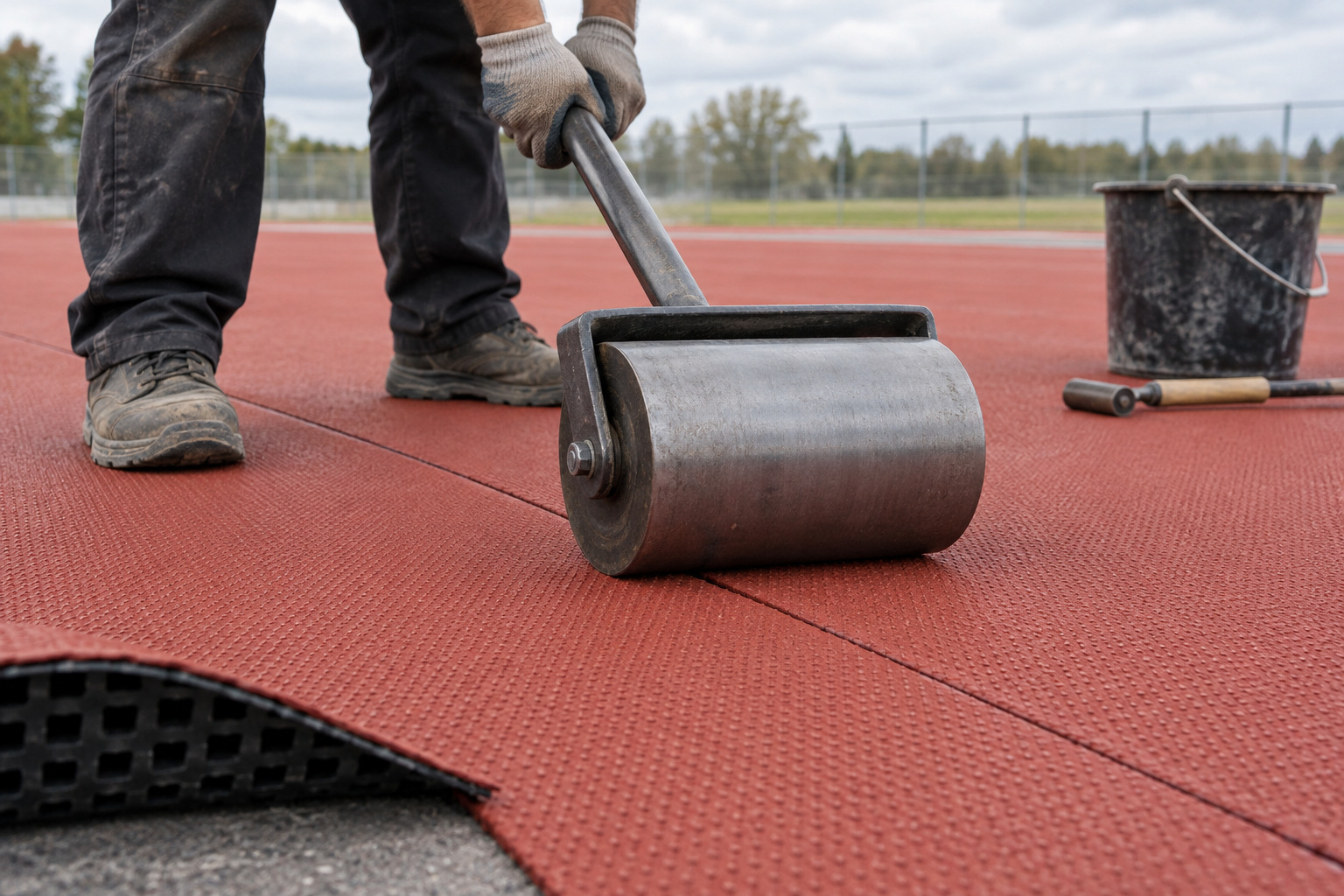
![Steel roller consolidating a straight joint between prefabricated rubber track sheets]()
Figure 4. Steel roller consolidating a straight joint between prefabricated rubber track sheets. AI-generated technical illustration.
Build Seam Inspection Into Handover
Inspect the entire seam network in daylight and check suspect areas by hand. Record edge level, visible gaps, local lifting and any corrected locations. Document the approved acceptance criteria before installation so the owner and contractor are judging the same requirements.
Retain the roll layout, batch identities and photographs of trial bonds. These records help distinguish isolated workmanship issues from material variation or foundation movement. Reinspect repaired seams after the agreed curing period and again during the first maintenance review.
![Completed curved running track with flush sheet joints and continuous lane markings]()
Figure 5. Completed curved running track with flush sheet joints and continuous lane markings. AI-generated technical illustration.
Plan a Complete HUADONG Track System
When specifying a GODER prefabricated rubber running track, include the foundation, adhesive, roll layout and edge details in the same technical discussion. Send HUADONG the base type, climate, intended use and project drawings so the proposed surface can be evaluated as part of the installed system. A durable seam depends on the relationship between those components, not the sheet specification alone.
Frequently Asked Questions
1. Can an open seam simply be filled with adhesive?
Only after the cause has been identified. Filling a gap cannot correct wet concrete, uncured adhesive or moving foundations. The repair must restore support and bonding using a compatible detail.
2. Does a visible seam mean the installation has failed?
No. Prefabricated sheets have joints. The important questions are whether the joint is flush, stable, properly supported and within the agreed acceptance criteria.
3. Should installers stretch a roll to make the seam close?
Avoid forcing a fit. Stretching can store tension in the sheet. Recheck relaxation, layout and cutting dimensions, then use the manufacturer's installation procedure.
4. Can rain cause edge lifting?
Water can contribute when it reaches an inadequately bonded interface or an unfinished edge. Investigate drainage, cure conditions and perimeter detailing together rather than attributing every failure to rain alone.
5. What information is useful for a seam complaint?
Provide wide and close photographs, roll and adhesive batch records, installation temperatures, moisture results and the history of the defect. Preserve a removed sample if an agreed investigation requires one.