Running-track lines are part of the competition geometry, not decoration applied from the design drawing. Start lines, finish lines, hurdle marks, relay zones and staggered starts must be set out from the final installed surface and the actual inner border. A standard 400 m track is accepted from measured geometry, including 28 prescribed control readings, rather than from the appearance of the oval. Marking before the final survey can transfer base, kerb or resurfacing deviations directly into the race distances.
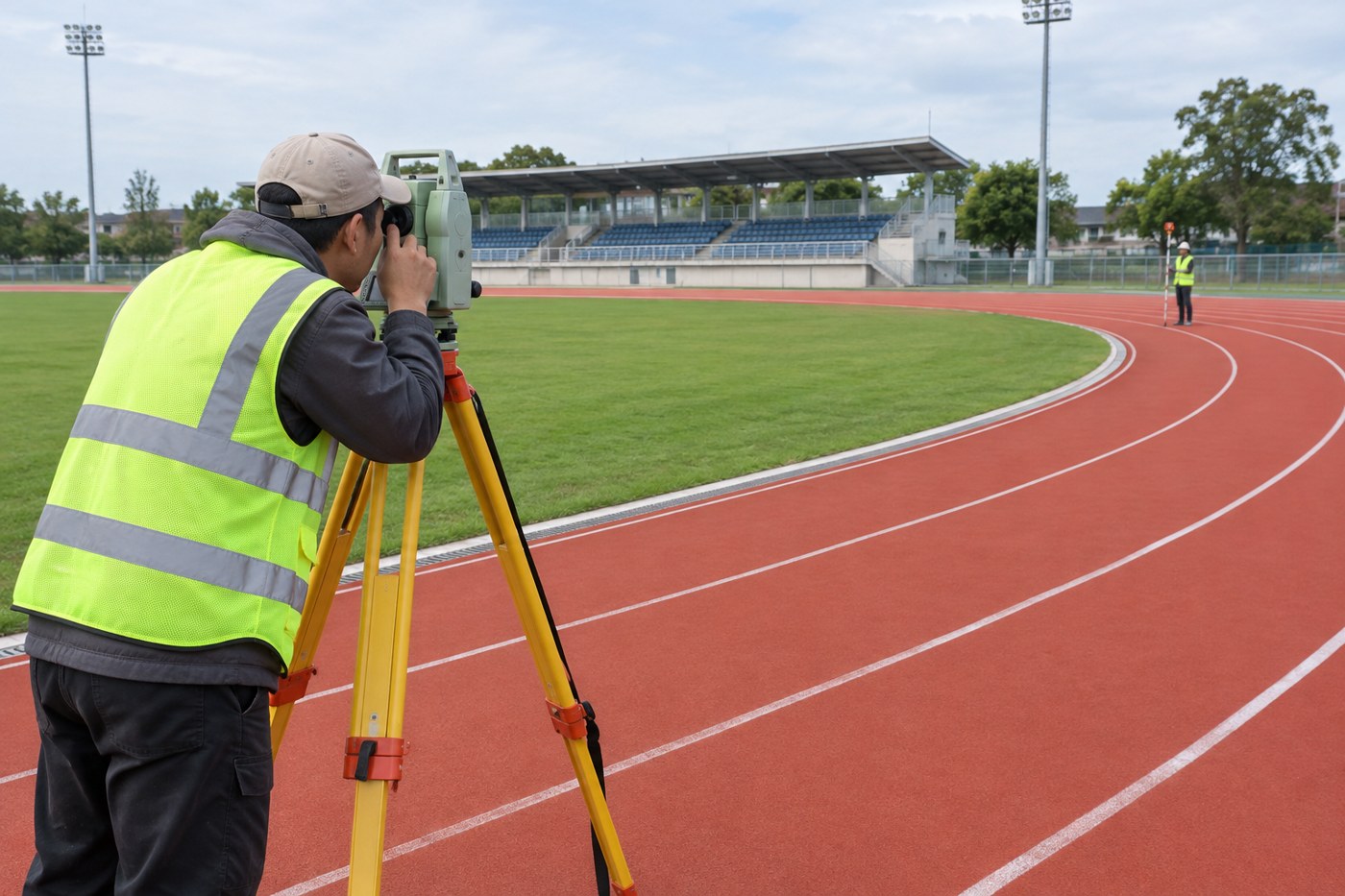
![Surveyor using a total station beside a completed red running track before final line marking]()
Figure 1. A surveyor verifies the completed track geometry before permanent race markings are accepted. Photo: HUADONG project archive.
Complete the Surface Before Establishing Race Marks
The installed surface must be stable enough to measure. For a prefabricated rubber system, the base is inspected, rolls are laid out, cut and bonded, and seams and perimeter details are completed before the marking survey. The finished surface should be free from debonding, bubbles, cracks and open seams. Smoothness is checked independently from geometry, using the cited limits of 6 mm under a 4 m straightedge, 3 mm under a 1 m straightedge and no step greater than 1 mm.
Adhesive cure and material conditioning must be complete before heavy survey and marking activity. If a roll edge moves, a seam is repaired or an inner drainage cover is adjusted after the survey, the affected geometry should be rechecked. Line-marking paint should not be used to hide an unresolved seam, patch or dimensional error.
The HUADONG GOTER prefabricated environmental rubber track and HUADONG GODER prefabricated environmental rubber track are supplied as factory-made rolls, but their final race geometry is established from the completed facility. Sheet seams are installation references, not race-measurement lines.
Measure the Actual 400 m Geometry
Lane one is measured along a line 0.30 m outward from the inner kerb where a kerb is present. Other lanes are measured 0.20 m outward from the outer edge of the adjacent inner lane line. With an inner kerb radius of 36.50 m, the lane-one measurement radius becomes 36.80 m. Using the edge of the sheet, the centre of a painted line or an old mark instead of the prescribed measurement line changes the calculated distance.
The standard lane width is 1.22 m with a tolerance of plus or minus 0.01 m under the cited guidance, and the line on the runner's right is included in the lane width. A small lane-width error changes every stagger calculation. The inner border, tangent points, straight length, bend radius and lane widths therefore need one coordinated survey model before event marks are calculated.
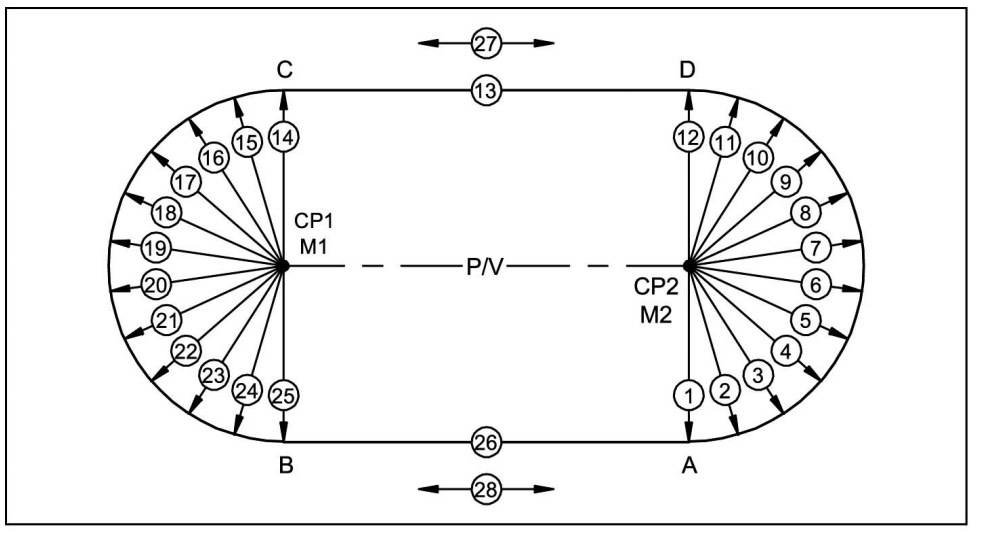
The cited accurate-measurement procedure uses 28 control readings: two straight lengths of 84.390 m with a tolerance of plus or minus 0.005 m; 12 radius readings on each semicircle at 36.500 m with a tolerance of plus or minus 0.005 m; and two checks of inner-kerb alignment on the straights, where deviation should not exceed 0.01 m. The calculated mean lap length should be at least 400.000 m and not more than 400.040 m.
![Plan diagram of a standard 400 metre running track showing 28 geometric control measurements]()
Figure 2. The 28 prescribed control readings combine two straights, 24 semicircle radii and two inner-border alignment checks.
Calculate Starts Hurdles and Relay Zones from the Survey
Once the final geometry has been approved, each event mark is calculated from the prescribed measurement line. At a nominal 1.22 m lane width, the cited 200 m stagger increases from 3.519 m in lane two to 26.516 m in lane eight. The 400 m stagger increases from 7.038 m to 53.032 m, the 800 m stagger from 3.526 m to 26.933 m, and the 4 x 400 m relay stagger from 10.564 m to 79.965 m. These are reference values; actual setting-out uses the measured facility geometry.
Hurdle positions also follow defined segment lengths. The women's 100 m hurdles use 13.00 m to the first hurdle, nine intervals of 8.50 m and 10.50 m to the finish. The men's 110 m hurdles use 13.72 m, nine intervals of 9.14 m and 14.02 m. The 400 m hurdles use 45.00 m, nine intervals of 35.00 m and 40.00 m. The cited position tolerance is plus or minus 0.01 m for 100 m and 110 m hurdles and plus or minus 0.03 m for 400 m hurdles.
A relay takeover zone is 20 m long under the cited layout, extending 10 m on each side of its midpoint. Hurdle position marks are typically 100 mm by 50 mm. All running lines and event marks should be set out from a calculation schedule that identifies the event, lane, baseline, theoretical distance, measured correction, final coordinate and independent checker.
![HUADONG project team reviewing running track survey drawings before setting out event markings]()
Figure 3. The survey and marking team reviews the approved track plan before transferring calculated event points to the finished surface. Photo: HUADONG project team.
Why Early Marking Creates Systematic Error
Design coordinates describe the intended facility. The as-built survey describes the surface athletes will actually use. Kerb placement, drainage-cover alignment, base construction, resurfacing thickness and local repairs can all shift the final measurement reference. If the marking team copies old lines or design points without remeasurement, every event based on those points can inherit the same error.
The risk is especially high after full resurfacing. Old paint can remain visible through construction references, but the new inner edge, lane boundaries and transitions may not match the previous installation exactly. A complete resurfacing should therefore be treated as a new marking exercise supported by a current measurement report. Certified facilities should retain the records required by the applicable certification process.
Premature marking also creates practical rework. A line applied before seam correction or base repair may have to be removed or overpainted, leaving a visible shadow and additional coating thickness. Waiting for the signed as-built geometry makes the marking operation shorter, easier to audit and less likely to require cosmetic correction.
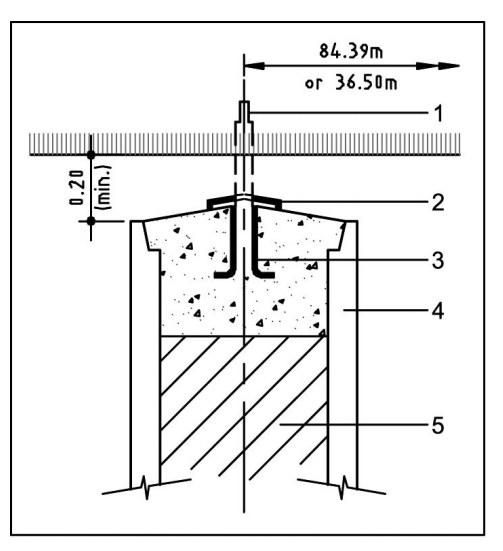
![English technical section of a protected permanent survey control marker for an athletics track]()
Figure 4. A protected permanent survey marker preserves the reference axis used for future checks and remarking.
Build a Traceable Marking and Handover Package
The surveyor, designer and marking team should work from one approved control network. Protect the main control points until the work is accepted. Transfer calculated points to the surface, mark them temporarily, check them independently and only then apply permanent paint. A final walk-through should verify line width, color, continuity, event identity, lane numbering and conflicts with covers, boards or drainage details.
A practical three-layer deliverable consists of the calculation schedule, the setting-out point plan and the field check sheet. The as-built marking plan should record the survey control, lane geometry, event coordinates, revision status and reviewer. Photographs are useful, but they do not replace the coordinate and calculation record.
For formal facility certification, keep the accurate-measurement report, product information, installation records and marking records together. A certified surface product does not automatically certify the completed facility, and a precise paint line does not correct an inaccurate underlying geometry.
Core Measurements and Verification
Lane-one measurement line: 0.30 m outward from a raised inner kerb; other lanes: 0.20 m outward from the outer edge of the adjacent inner lane line.
Standard lane width under the cited guidance: 1.22 m plus or minus 0.01 m, including the line on the runner's right.
Twenty-eight controls: two 84.390 m straights, 24 semicircle radii of 36.500 m and two inner-border alignment checks.
Calculated mean lap: not less than 400.000 m and not more than 400.040 m under the cited acceptance range.
Permanent line width: 0.05 m unless the applicable event rule or approved drawing specifies otherwise.
Sprint straight: at least six lanes, with at least 3 m behind the start and 17 m beyond the finish under the cited layout guidance.
Relay takeover zone: 20 m total, 10 m on each side of its midpoint under the cited layout.
Hurdle mark size: 100 mm by 50 mm; position tolerances plus or minus 0.01 m for 100 m and 110 m hurdles and plus or minus 0.03 m for 400 m hurdles.
Handover: accurate-measurement report, calculation schedule, setting-out plan, field checks, as-built marking drawing and independent review record.
Reference basis: the numerical values in this article are drawn from the supplied technical source document and its cited track-measurement and marking guidance. Confirm the current applicable World Athletics rules, facility certification requirements and approved project drawings before contractual use.
Frequently Asked Questions
1. Why can design coordinates not be used directly for final marking?
Design coordinates describe the intended geometry. Construction, kerb placement, drainage details, resurfacing and repairs can change the final measurement reference. Permanent marks must therefore be calculated from the approved as-built survey.
2. What are the 28 control readings on a standard track?
They are two straight-length measurements, 12 radius measurements on each semicircle and two inner-border alignment checks on the straights. Together they verify the geometry used to calculate the lap length and event marks.
3. Can old lines be repainted directly after resurfacing?
No. Old paint can be used only as a visual reference. The new surface and inner border must be surveyed, calculations updated and event points independently checked before permanent repainting.
4. What should the marking handover package contain?
Include the control network, accurate-measurement report, lane and event calculations, setting-out point plan, field check sheet, as-built marking plan, revisions and reviewer sign-off. Keep these records with the surface and facility documents.
Keywords: running track marking; as-built track survey; 400 metre track measurement; lane marking calculation; athletics track certification.