Upgrading or installing a new athletic track surface requires balancing athlete performance, injury prevention, and strict regulatory compliance. Modern sports engineering leaves no room for guesswork when building these complex facilities. You must meet rigorous biomechanical demands to protect runners and validate records.
For facility managers and athletic directors, choosing the wrong material or failing to meet governing body standards causes serious setbacks. These missteps can result in disqualified records, accelerated wear, and wasted budgets. You simply cannot afford early surface degradation or non-compliant lane geometries.
Selecting the right system requires evaluating your facility’s usage volume, regional climate, and long-term maintenance capacity against established technical benchmarks. You must weigh these factors carefully before breaking ground. We will guide you through the materials, compliance standards, and installation risks to ensure your next facility upgrade succeeds.
Key Takeaways
Competition venues require surfaces that meet precise shock absorption and vertical deformation metrics to ensure athlete safety and valid race times.
Poured-in-place polyurethane systems offer the highest durability and performance for elite competitions, while latex systems provide cost-effective solutions for high schools.
Verifying structural integrity—specifically asphalt or concrete sub-base preparation—is as critical as the surface material itself.
Partnering with an experienced athletic track surface supplier ensures accurate line marking, warranty protection, and adherence to World Athletics or NCAA standards.
Core Requirements for a Competition Venues Athletic Track Surface
Differentiating a recreational jogging path from a certified competition venue requires a shift in mindset. Recreational paths prioritize sheer softness to accommodate casual walkers. In contrast, a competition venues athletic track surface demands precise engineering. It must support high-speed impacts without robbing runners of their kinetic energy. You need a system engineered for elite biomechanical response.
Evaluating performance metrics requires understanding how materials interact with human physiology. We focus on three foundational E-E-A-T criteria:
Force Reduction (Shock Absorption): This metric dictates how much impact the surface absorbs. Proper shock absorption mitigates chronic joint injuries for athletes training daily. If a track feels too hard, athletes suffer shin splints. If it feels too soft, they experience muscular fatigue.
Vertical Deformation: This measures how much the surface compresses under foot strike. Optimal deformation ensures high energy return without causing structural degradation. Runners need the track to snap back instantly to propel them forward.
Friction/Slip Resistance: Athletes need reliable grip under varied weather conditions. Spikes must penetrate and release seamlessly. A track losing its friction profile becomes a major slip hazard during rain.
Usage variables heavily influence your design choices. You must assess the impact of multi-sport usage at your facility. Football or soccer players wearing heavy cleats often cross the track to reach a turf field. These crossing zones experience extreme localized wear. Track-exclusive facilities avoid this cross-traffic damage, allowing for softer topcoats. If you host multi-sport events, you must select high-tensile top layers to resist cleat punctures.
![Athletic Track Surface Installation]()
Evaluating Major Surface Material Categories
Understanding the chemical and structural differences between materials prevents costly specification errors. The market offers three primary categories, each serving different facility needs and athletic levels. You must align these options with your facility goals.
Latex Bound Systems (Black Mat & Color Overspray)
Latex systems remain popular for facilities operating on restrictive budgets. Installers pave a black rubber base and spray it with colored latex binders.
Pros: They demand a significantly lower initial capital expenditure. They provide adequate shock absorption for regional high school dual meets. They install relatively quickly.
Risks: You sacrifice longevity for this lower price. They carry a shorter lifespan, typically requiring resurfacing every 5 to 7 years. Latex exhibits higher susceptibility to UV degradation. Heavy moisture causes the binders to break down prematurely.
Poured-in-Place Polyurethane Systems (Porous & Sandwich Systems)
Polyurethane acts as the gold standard for durable, high-performance venues. Installers mix and pour these systems directly on site.
Pros: They deliver excellent energy return and biomechanical consistency. Polyurethane is highly weather-resistant. You can expect a structural longevity of 10 to 15 years before major interventions. They resist spike damage exceptionally well.
Risks: They require a higher upfront investment. Furthermore, installation relies heavily on ambient weather. Contractors need highly specific temperature and humidity windows to ensure the polyurethane cures correctly. Moisture during pouring ruins the chemical bond.
Prefabricated Rubber (Roll) Systems
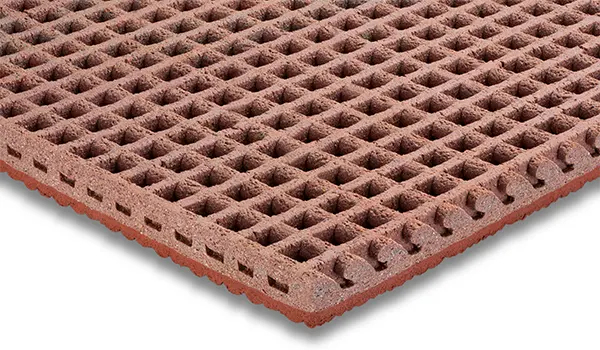
Manufacturers produce prefabricated rubber in controlled factory environments. Installers then unroll and adhere these sheets to the sub-base.
Pros: They guarantee uniform thickness across the entire venue. They provide consistent biomechanical properties because factory manufacturing eliminates mixing errors. Elite and Olympic environments heavily favor these rolls.
Risks: They hold a near-zero tolerance for sub-base imperfections. Even a minor ripple in the asphalt will telegraph through the rubber. They also command the highest initial material and installation costs.
Major Track Materials Comparison Guide
| Material Category | Typical Lifespan | Best Suited For | UV & Weather Resistance |
| Latex Bound System | 5 - 7 Years | Local High Schools, Practice Fields | Moderate |
| Polyurethane (Sandwich/Solid) | 10 - 15+ Years | Universities, Regional Competitions | High |
| Prefabricated Rubber Rolls | 10 - 15+ Years | Elite/Olympic Venues | Very High |
Navigating Athletic Track Surface Specifications and Compliance
Building a fast track means nothing if governing bodies refuse to certify your times. You must adhere to rigid athletic track surface specifications from day one. Regulatory compliance governs every millimeter of the venue.
Different competitive tiers demand different governing body standards:
World Athletics (WA): WA certification is explicitly required for international and elite collegiate events. They focus on stringent material testing. They demand exact track geometries, radius calculations, and certified surveyor reports. Achieving WA Class 1 or 2 certification represents the pinnacle of facility design.
NCAA Standards: Domestic collegiate programs follow NCAA rules. These rules dictate specific lane widths (usually 42 inches or 1.067 meters), precise radius dimensions, and extended safety zones for athlete deceleration.
NFHS Standards: High school federations maintain slightly more flexible guidelines. However, they still enforce strict rules regarding exchange zones, hurdle placements, and overall track distances.
Line marking precision separates amateur facilities from professional venues. Automated laser striping acts as a non-negotiable requirement for competition certification. Hand-taped lines invite human error. Even a one-centimeter deviation in a stagger can render a 400-meter sprint record invalid. Professional stripers use robotic or laser-guided equipment to paint lines with millimeter accuracy.
You must also manage severe compliance risks regarding sub-base slope. Slight deviations in cross-slope and downward slope can instantly invalidate facility certification. World Athletics mandates a maximum lateral inclination of 1.0% and an overall downward inclination in the running direction of 0.1%. If your asphalt contractor misses these tolerances, no amount of rubber will fix the certification failure.
Designing a Custom Athletic Track Surface for Site-Specific Realities
No two facilities face identical environmental challenges. You must tailor your custom athletic track surface to your specific location. Off-the-shelf solutions often fail when confronted with extreme local climates or unique architectural constraints.
Climate adaptations heavily dictate material chemistry. If you operate a facility in high-sun regions like the American Southwest or Australia, UV rays aggressively attack rubber. You must select UV-stabilized aliphatic topcoats. These topcoats resist chalking, fading, and hardening under intense radiation. Conversely, heavy-rainfall zones require enhanced drainage structures. You might need a porous polyurethane system that allows water to percolate through the surface into underlying catch basins, preventing hazardous puddles.
Indoor versus outdoor distinctions require different engineering approaches. Outdoor tracks battle rain and sun. Indoor tracks battle space constraints and air quality. Navigating indoor banking requirements is highly complex. Hydraulic banked curves must integrate seamlessly with straightaways. Furthermore, you must integrate heavy HVAC ventilation during installation. Polyurethane off-gassing indoors requires aggressive air exchange to protect workers. Indoor tracks also require varied friction profiles, as they remain perpetually dry.
Facility branding allows you to build a strong home-field identity. Modern installation techniques allow for striking visual integrations. You can specify dual-color exchange zones to help relay runners visualize handoffs. Many schools integrate custom school logos directly into the D-area (the semi-circle behind the endzones). You can customize these D-area configurations for field events like the high jump or pole vault. A skilled installer embeds these colors chemically, ensuring branding elements never compromise surface integrity or friction.
Implementation Risks and Choosing Your Athletic Track Surface Supplier
The most beautiful topcoat will fail if the foundation crumbles. We refer to this as the sub-base dependency. Industry data shows that 90% of track failures originate below the rubber. Poor asphalt curing causes oils to reject the polyurethane binders. Inadequate compaction leads to severe settling and depression over time. Improper drainage design pushes hydrostatic pressure up through the asphalt, causing the rubber to bubble and delaminate. You must view the sub-base and the surface as one unified structure.
Evaluating supplier expertise helps you mitigate these structural risks. You need a rigorous shortlisting logic when selecting an athletic track surface supplier. Do not simply accept the lowest bidder.
Check for certified builders. Look for credentials like ASBA (American Sports Builders Association) certification in the US, or equivalent international bodies.
Request proof of prior successful certifications. Ask the contractor to provide documentation of NCAA or WA certifications they achieved at similar venues.
Demand references specifically regarding their asphalt paving subcontractors. The paving crew holds your project's fate in their hands.
Warranties require careful decoding. Do not assume a 10-year warranty covers everything. Read the fine print to decode warranty exclusions. Manufacturers often void warranties if damage results from improper maintenance equipment, like driving heavy tractors over the track. They also exclude failures caused by sub-base shifting. If the asphalt cracks, the surface warranty will not cover the resulting rubber tear.
Finally, establish a realistic timeline and budget for structural maintenance. Factor in the cost of structural restriping every few years to keep lines vibrant. Plan a cyclical resurfacing budget for the 7-to-10-year mark. Knowing these timeline realities ensures your facility remains competition-ready long after the initial ribbon-cutting ceremony.
Conclusion
A competition-grade track acts as a holistic system, not just a painted topcoat. Success hinges on precise specifications, sub-base perfection, and strict material suitability. You must align your facility’s usage expectations with the correct chemical application to guarantee safety and compliance. Cutting corners on slope tolerances or material quality ultimately leads to disqualified venues and wasted investments.
Your next steps must prioritize groundwork over aesthetics. Advise your stakeholders to begin with a professional site audit and a comprehensive geotechnical survey. Fix the drainage and dirt before you request material bids. Engage certified track builders early in the design phase to ensure your vision matches biomechanical realities.
FAQ
Q: What is the average lifespan of an athletic track surface?
A: A surface typically lasts between 5 and 15 years. Latex systems generally require resurfacing after 5 to 7 years. Premium poured polyurethane and prefabricated rubber systems often last 10 to 15 years. Climate severity, UV exposure, and proactive maintenance routines heavily influence this timeframe.
Q: How do I know if my track needs resurfacing or total reconstruction?
A: Resurfacing is suitable for surface wear, fading lines, or minor top-layer delamination. Total reconstruction is required when you identify structural sub-base failures. If you see deep asphalt cracking, massive heaving, or widespread water pooling due to slope loss, you must reconstruct the foundation.
Q: Can we host certified track meets on a latex surface?
A: Yes, you can host regional or high school meets on latex surfaces if they meet NFHS dimensional standards. However, elite collegiate (NCAA) or international (World Athletics) events generally require the biomechanical consistency and strict material compliance found in polyurethane or prefabricated rubber systems.
Q: How long does track installation take?
A: Installation usually takes 6 to 8 weeks, heavily depending on weather. Crucially, new asphalt requires a mandatory 14 to 28-day cure time to release oils before applying rubber. Rain, high humidity, or temperatures dropping below minimum thresholds will significantly delay the polyurethane pouring process.