Introduction
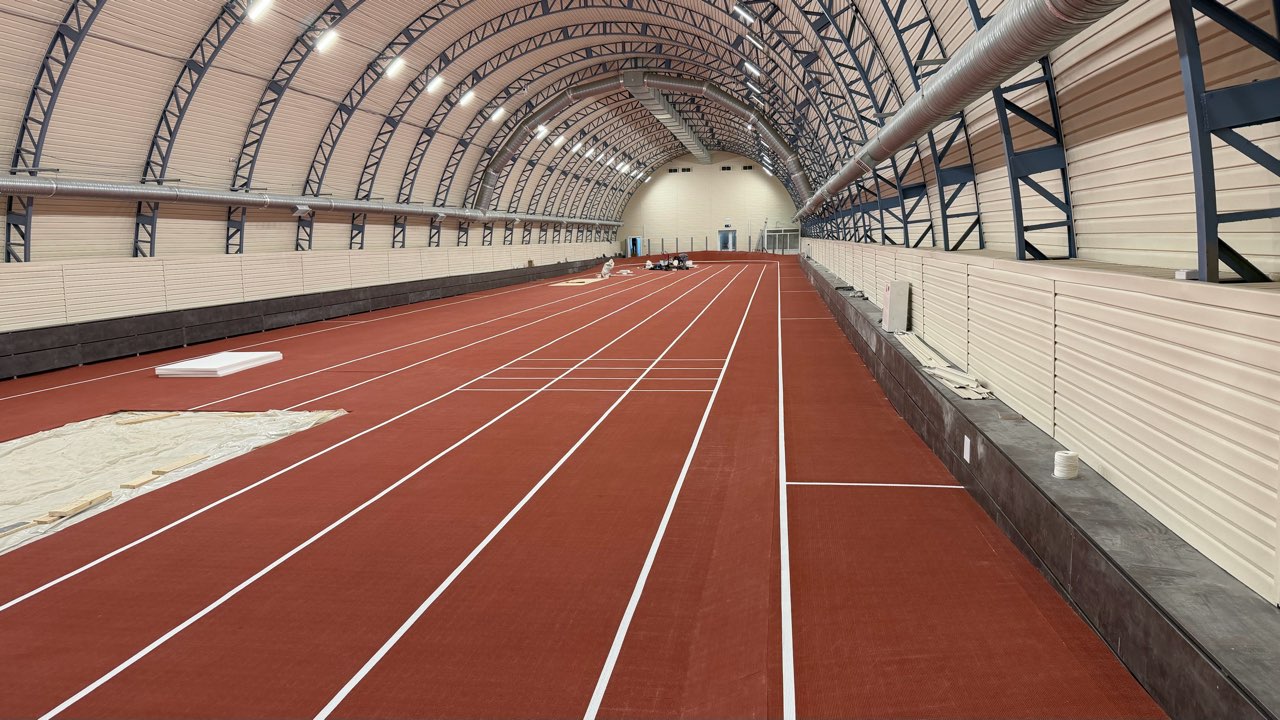
The first Ivanovo photograph looks almost too simple: red lanes, white lines and a high barrel roof running towards a blank wall. There are no grandstands to distract the eye and no infield filling the middle of the frame. The track is the room.
Look again, though, and the project is clearly at that awkward point between installation and handover. Protective sheets are still lying on parts of the surface. A few tools remain near the walls. At the far end, a ladder and small work area interrupt what will eventually be a clean training space. The main surface is down, but the building has not quite stopped being a construction site.
Huadong Track includes Ivanovo Stadium in its 2026 project portfolio. The public page does not identify the exact product model or publish a venue specification, so there is little value in guessing at either. The photographs give us something more useful to discuss: what has to happen during the final stage of a prefabricated indoor track project in a cold-climate region.
![]()
A simple hall is unforgiving
Ivanovo's arched roof creates a series of repeating steel ribs. Below them, the lane lines run almost the full length of the building. Together they form a visual ruler. If a line wanders or a roll edge slowly moves off course, the mistake has nowhere to disappear.
That does not mean the installer should use the wall or roof frame as the sports reference. Buildings have tolerances of their own. The running layout needs independent survey points, checked before the first roll is bonded and checked again as work moves down the hall. Otherwise, a crew can spend the last few metres trying to absorb an error that began near the entrance.
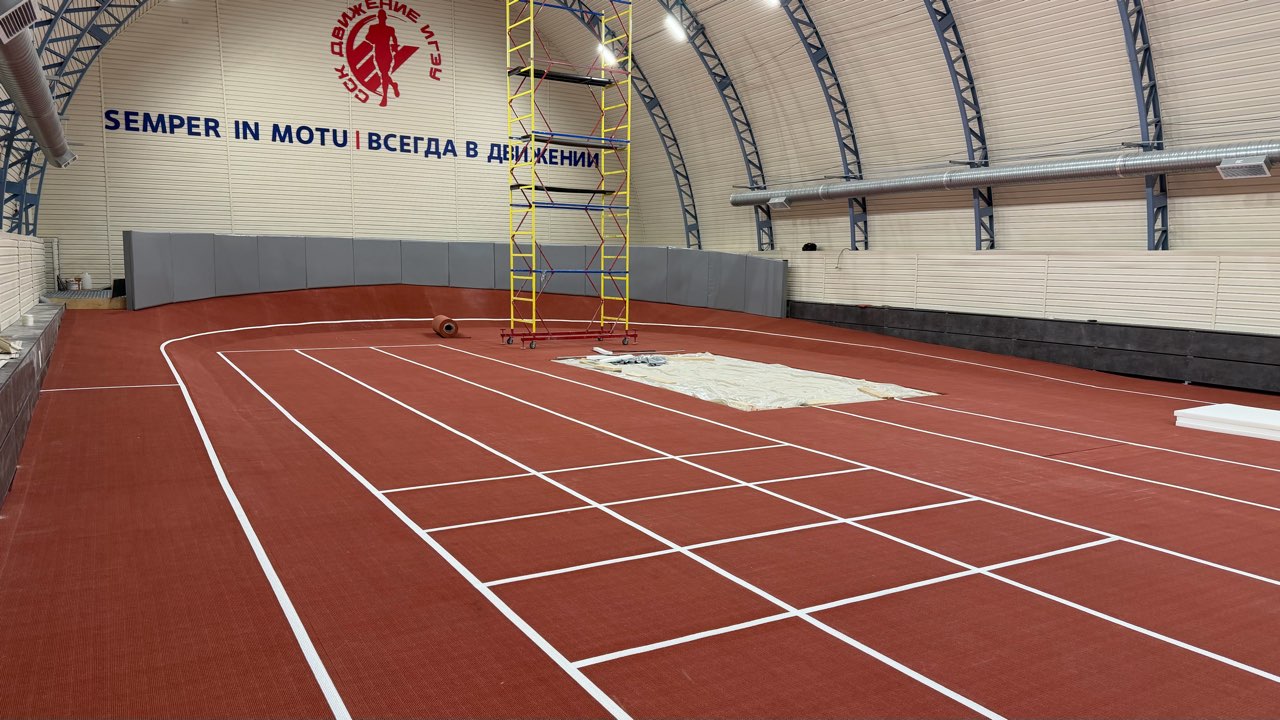
The end of the track is more complicated than the long central section. Cross-lines meet the lanes, smaller rectangles divide the training area, and the surface has to finish neatly against the perimeter. Those details involve more cutting and more short edges. They are also close to the wall, where dust and offcuts tend to collect during construction.
This is why the most visually dramatic photograph is not always the most informative one. A straight-on image makes the room look complete. The end-zone image shows where the installer actually had to slow down.
![]()
Cold-weather installation starts before the rolls are opened
On an overseas Russian project, the material may spend days moving through very different temperatures. The truck can be cold. The storage area can be warmer. The hall may be heated, partly heated or still being commissioned. A rubber roll does not instantly forget that journey when it comes through the door.
The practical response is unglamorous: leave enough time for the material to settle inside the building. Keep the rolls supported and dry. Do not open every package at once. Check the material temperature as well as the room temperature.
The slab deserves the same attention. Heating the air can make a hall feel ready while the floor remains cold. That difference matters to the adhesive, and it can also create a condensation risk. Before bonding starts, the crew needs a record of the air temperature, substrate temperature and humidity in the actual work zone. A reading from an office thermostat is not a substitute.
Conditions may also change along the length of the building. Areas near an external door or unfinished wall can stay cooler than the centre. If material is being brought in throughout the day, doors open repeatedly and the working environment moves with them. One check at the beginning of the morning is not always enough.
None of this is unique to Ivanovo. It is simply easier to understand here because the project photographs show an enclosed hall at the end of construction, exactly when heating, access and finishing trades often overlap.
The last ten metres can damage a finished track
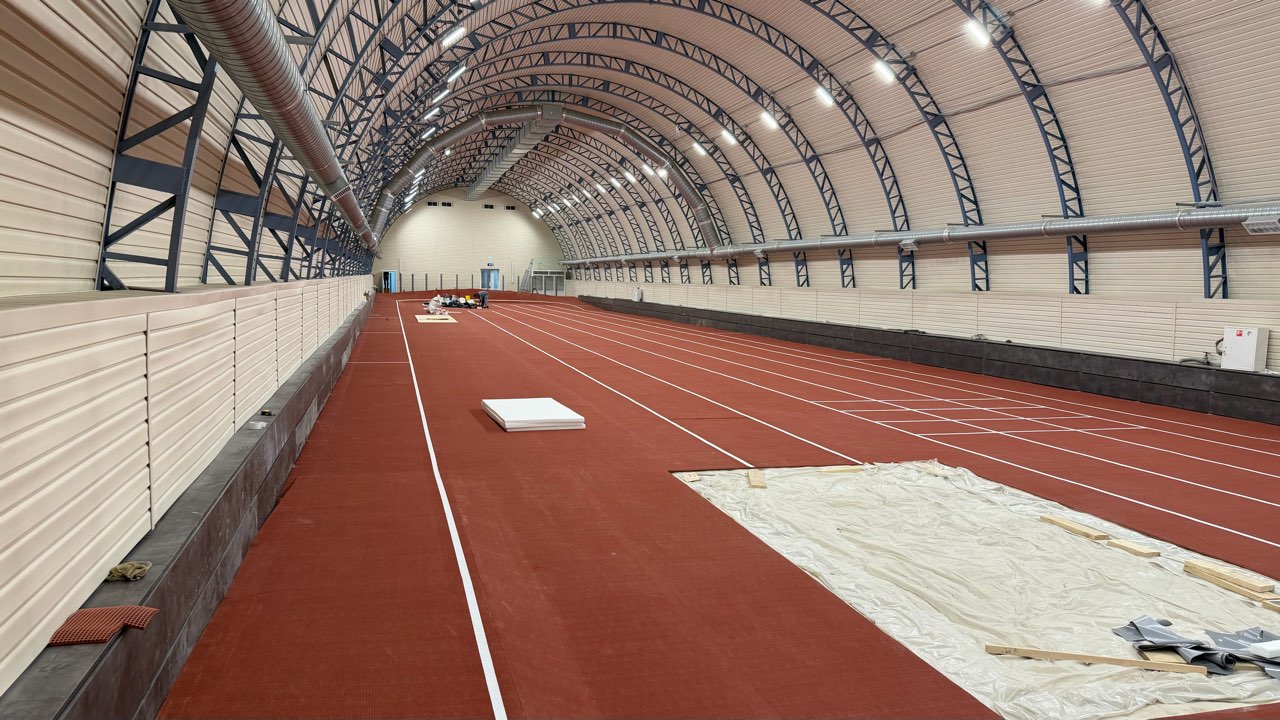
One image shows sheets left across sections of the red surface while edge work continues. They may be protecting the track, protecting another task or waiting to be removed; the photograph alone cannot tell us which. What it does show is that a new sports floor remains exposed to construction traffic after most of the installation team has finished its main work.
This period needs its own plan. Workers require a route that does not cross freshly bonded areas. Tools need a place that is not the edge of the track. Any temporary covering has to be clean underneath, and heavy equipment should not rest on a small contact point. The surface can be technically complete and still be damaged before the operator receives the keys.
Final cleaning is part of that handover, not a cosmetic extra. Dust gathered along the low side walls should be removed with a method compatible with the rubber. Edges need to be checked continuously, especially where several short pieces meet. The white markings should then be viewed under the lighting the athletes will actually use.
![]()
Where Huadong Track enters the process
A prefabricated running surface arrives with much of its colour, texture and elastic structure already formed. That is useful in a project like Ivanovo because the crew is not building the whole surface layer by layer inside a nearly finished hall.
The roll is only one part of an overseas delivery, however. The packages need clear identification. The installer needs the approved adhesive method before the shipment arrives. Storage orientation, acclimatisation time, cutting details and compatible repair material all belong in the same technical conversation. When those items are treated as after-sales questions, they usually appear too late.
There is also a good reason not to name a GOMER, GODER or GOTER system in this article. Huadong Track's public project card does not state the model used at Ivanovo, and the photographs cannot establish it. A professional project account should be precise about what is known instead of turning every image into a product claim.
What would make this a successful handover?
Not an empty photograph and not a sentence saying the client was satisfied. A useful handover would show that the lanes are straight, the end details are secure, the surface has been cleaned, and the operator knows how to protect and maintain it. The first heating season would then provide the next set of observations: whether edges remain stable, whether any local moisture issue appears, and whether cleaning routines suit the building.
For an indoor training hall in Ivanovo, the larger benefit is obvious. Athletes gain a place to run when outdoor conditions restrict consistent training. The track project succeeds when that routine can begin without the surface demanding constant attention.
FAQ
1.Why should cold prefabricated rolls be stored indoors before installation?
Low-temperature rubber can remain stiff and may not relax naturally during layout. Controlled storage allows the material to approach the approved working condition before it is cut or bonded.
2.Can the room feel warm while the floor is still too cold for adhesive work?
Yes. Air warms faster than a concrete substrate. The crew should measure the slab directly and consider humidity and dew point rather than relying on the room thermostat.
3.What should be checked immediately before Ivanovo Stadium is handed over?
The final review should cover lane alignment, short edge pieces, perimeter bonding, surface contamination, temporary-covering damage, marking quality and the cleaning and maintenance information given to the operator.