Introduction
A standard 400 m athletics facility is an integrated construction project, not simply a coloured running surface. Its long-term performance depends on the subgrade, drainage, structural base, sports surfacing, field-event areas and supporting installations working together. Weaknesses below the surface can later appear as settlement, ponding, blistering or loss of adhesion.
This guide follows the construction process from site preparation to handover and explains how prefabricated rubber rolls differ from cast-in-place polyurethane systems. The approved engineering design, applicable local standards, current competition rules and the selected manufacturer's installation instructions must define the project-specific dimensions, materials and acceptance criteria.
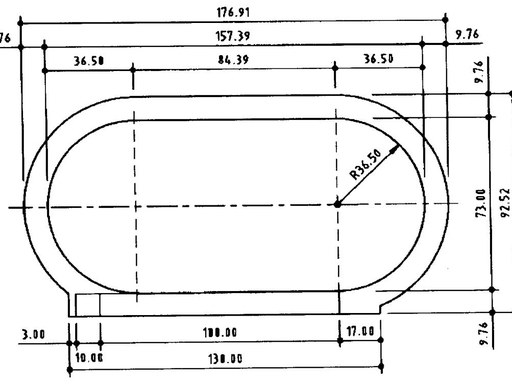
![Geometrical layout of a standard 400 m athletics track]()
Figure 1. Geometrical layout of a standard 400 m athletics track. Technical drawing supplied with the article.
1. Plan the Facility and Its Construction Sequence
Start by defining the venue's intended use: school sport, community exercise, professional training or a specified level of competition. Establish any facility-certification objective before design approval. The surface product alone cannot determine whether a completed venue is suitable for a particular competition.
A coordinated programme normally progresses through survey control and earthworks, underground services and drainage, structural base construction, base acceptance, surface installation, final marking, testing and handover. Field-event foundations, lighting ducts and equipment sockets should be coordinated early so that later work does not damage a finished track. The sequence must reflect the actual project rather than an inflexible rule that every field-event area comes after track surfacing.
| Construction stage | Main control point | Record to retain |
| Earthworks | Formation levels, bearing capacity and compaction | Ground investigation and inspection results |
| Drainage | Falls, outlet capacity and connections | As-built levels and drainage checks |
| Structural base | Thickness, stability, evenness and moisture condition | Layer inspections and base acceptance |
| Sports surface | Material identity, bonding and installed performance | Batch records and installation logs |
| Handover | Geometry, marking, tests and defect closure | Measurement report and maintenance documents |
2. Earthworks and Drainage: Control the Hidden Risks
Remove unsuitable vegetation, organic topsoil and construction debris. Treat soft or variable ground in accordance with the geotechnical design. Replacement depth, fill-lift thickness, compaction targets and equipment selection depend on the ground and the engineered build-up; a single recipe is not suitable for every site.
Protect the track's survey-control points throughout construction. Coordinate the athletics layout with the infield and other sports requirements, including playing dimensions, runoff areas, event positions and safe access. A football pitch and an athletics infield do not automatically share one universal layout.
Drainage should address surface runoff, subsurface water where the site requires it, and specialist facilities such as sand pits and the steeplechase water jump. Channel positions, pipe diameters, gradients, filter layers, outlet capacity and maintenance access must be sized for the site and expected rainfall. The track's finished crossfall must lead water toward the designed collection system, without local reverse falls.
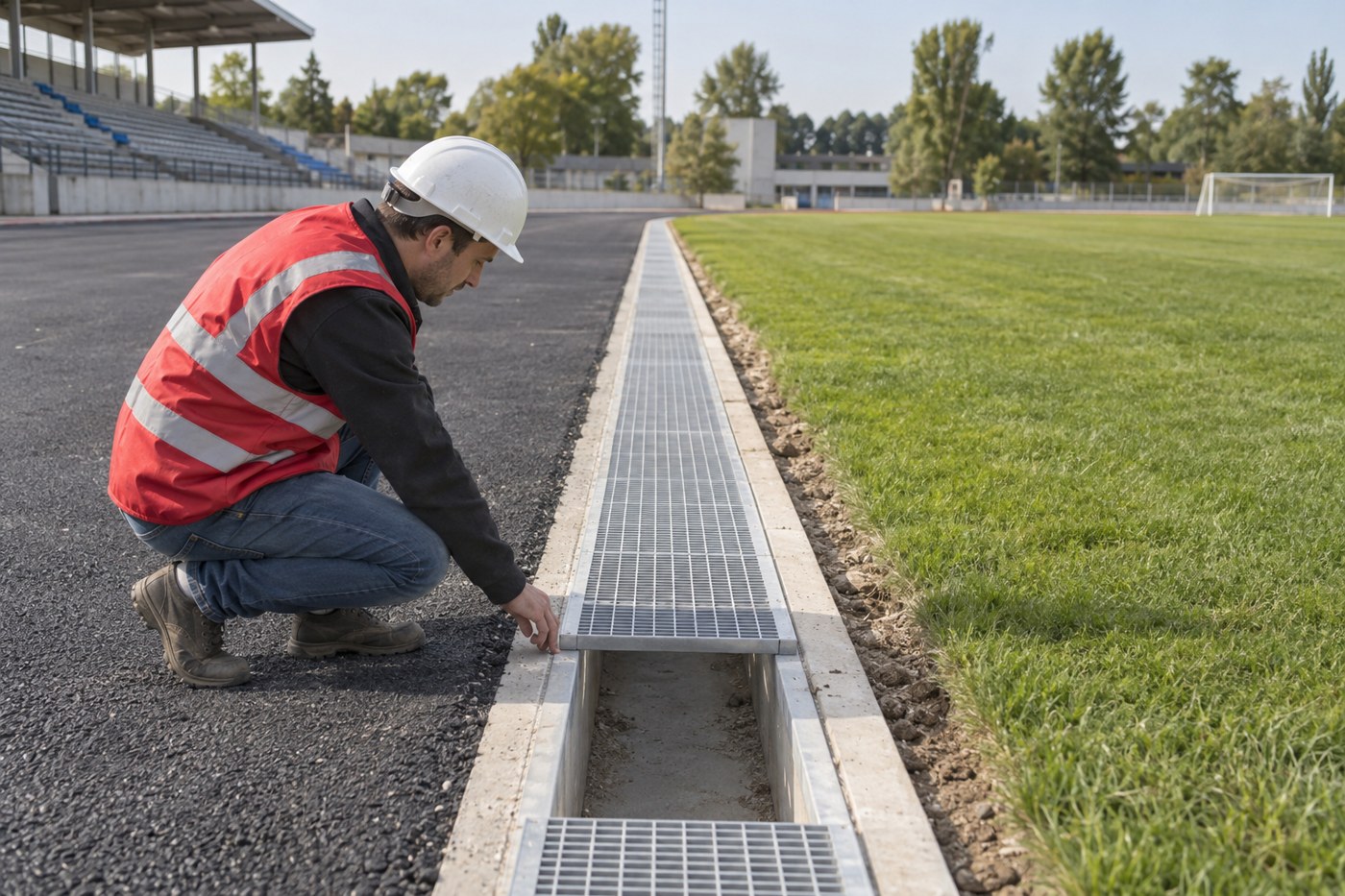
![Inspection of a drainage channel beside an asphalt track base]()
Figure 2. Inspection of a drainage channel beside an asphalt track base. AI-generated technical illustration.
Inspect drains before they are covered, then verify flow and check the completed surface for ponding using the project's specified procedure. Do not present a universal pipe spacing or a fixed twenty-minute drainage test as a requirement for all World Athletics facilities. Surface-water management and groundwater control need separate consideration.
3. Construct and Accept the Structural Base
A common engineered arrangement includes a compacted formation, a graded aggregate layer, an optional stabilised layer and an asphalt base. Some projects use concrete. Layer thicknesses, aggregate grading, binder content and the number of asphalt courses must follow the approved structural design and the chosen surfacing system.
Inspect each layer before covering it. Check elevations and slopes as well as density, stability and thickness. A base that is strong but uneven can still produce poor drainage and an inconsistent finished surface. Prefabricated rubber has a controlled factory-made thickness; it is not a levelling compound for correcting large depressions.
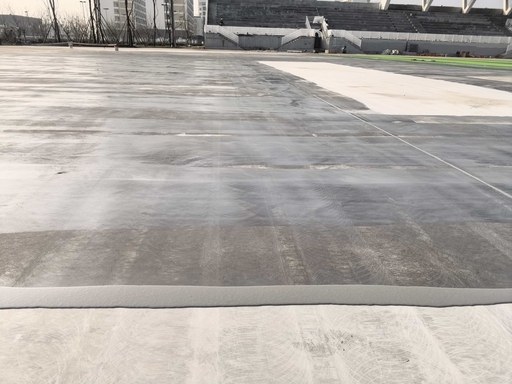
![Prepared track base before the installation of the sports surface]()
Figure 3. Prepared track base before the installation of the sports surface. Image supplied with the article.
Before bonding, the base must satisfy the specified maturity, dryness, cleanliness and surface-strength requirements. Remove dust, loose particles, oil and incompatible residues; investigate cracks and repair defects with approved materials. Use a moisture test suited to the substrate and adhesive rather than a percentage without a defined test method.
There is no single curing period that can safely be applied to every asphalt or concrete base. Release the base for surfacing only when the designer's and surfacing supplier's requirements are met. Temperature, rainfall, ventilation and the composition of the base all affect readiness.
4. Understand the Main Track Surface Systems
Prefabricated rubber and cast-in-place polyurethane are different construction methods. Both require an appropriate base and controlled workmanship, but their production and installation risks differ. Select a tested system against the project brief, maintenance resources and any certification requirement, rather than assuming that one generic material category guarantees approval.
| Surface system | How it is formed | Key site controls |
| Prefabricated rubber | Factory-made rolls or sheets bonded to the base | Roll conditioning, adhesive transfer, alignment, seams and rolling |
| Mixed or sandwich polyurethane | Site-installed rubber/binder base with a specified sealed wearing system | Mixing, layer thickness, cure and top-surface application |
| Porous spray-coated system | Bound rubber base with a compatible textured spray finish | Porosity, binder distribution, finish coverage and drainage |
| Full-pour polyurethane | Site-applied polyurethane layers and a specified surface texture | Mix ratios, working time, thickness and weather protection |
Commercial terminology varies between markets. The exact layer build-up and test evidence matter more than the label. A porous base with a sprayed finish should not automatically be described as a mixed-system polyurethane track. Nor should any category be declared eligible or ineligible for certification without checking the specific product and completed-facility requirements.
5. Install Prefabricated Rubber Rolls Correctly
HUADONG supplies factory-produced running-track systems including GOTER prefabricated rubber track and GODER prefabricated rubber running track. The selected product, thickness and supporting documents should match the project specification.
Inspect delivered rolls, labels, dimensions and storage condition. Allow the material to condition and relax as directed by the supplier.
Accept, prepare and clean the base. Apply any primer or sealing treatment only as part of the approved system.
Plan the roll layout and trial-fit the material without forcing it into position or stretching it to close a gap.
Mix the specified adhesive correctly and spread it uniformly with the approved notched trowel. Observe working time and environmental limits.
Lay the rubber into the adhesive at the prescribed stage. Keep the textured running face upward and the supporting backing downward against the base.
Roll and apply any specified temporary restraint to achieve contact and control edges. Trim and bond joints according to the manufacturer's method.
Remove temporary fixings, surplus adhesive and debris. Protect the installed area until the adhesive system is ready for the next operation.
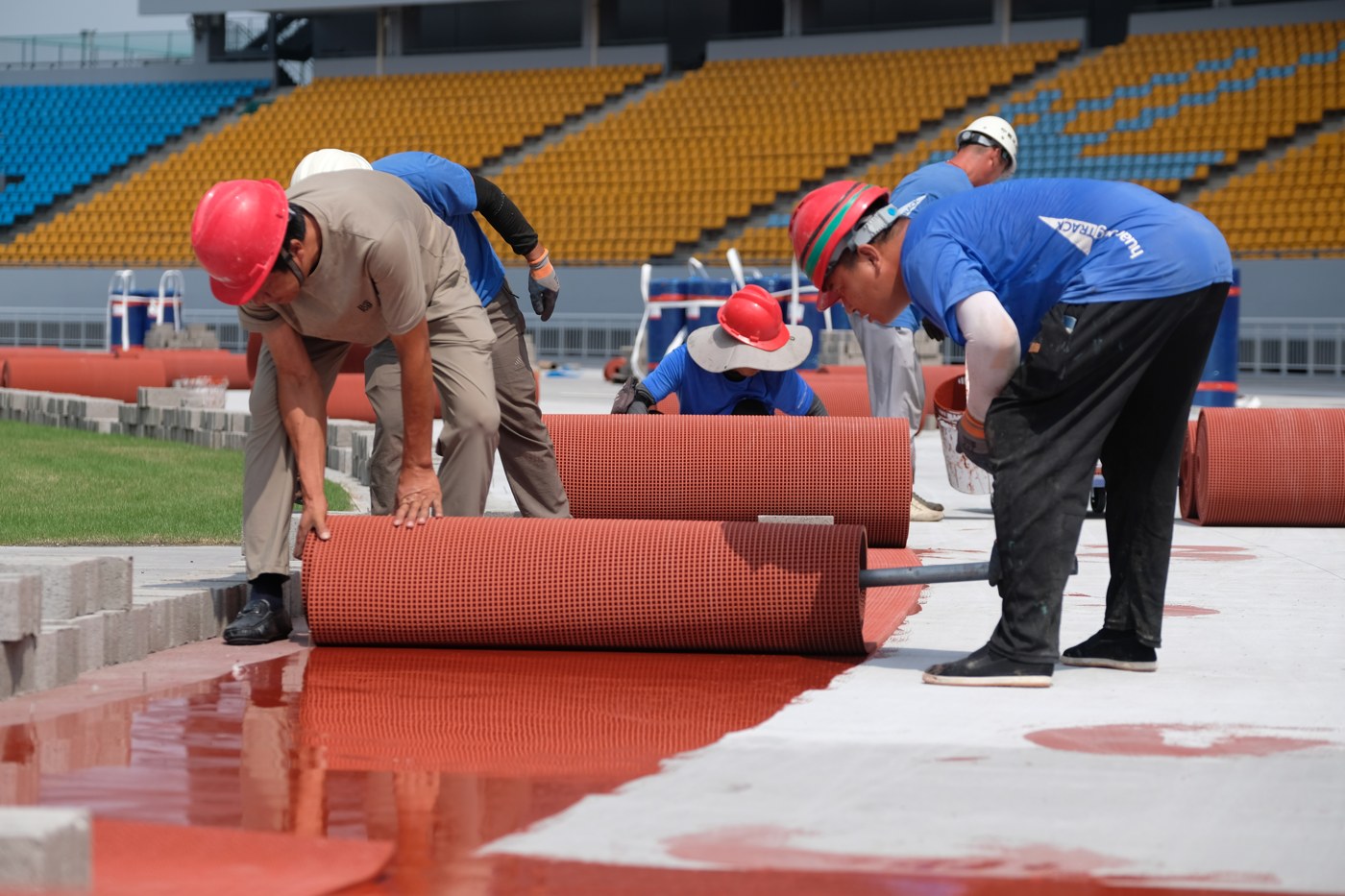
![HUADONG installation team unrolling prefabricated rubber track material over adhesive]()
Figure 4. HUADONG installation team unrolling prefabricated rubber track material over adhesive. HUADONG installation photograph.
HUADONG's published installation process uses joint trimming, adhesive bonding and pressure. Hot-air welding is not a universal method for vulcanised prefabricated rubber and must not be substituted for the specified joint system. Adhesive choice, open time, cure period and edge details likewise require product-specific instructions.
6. Coordinate Field-Event Areas and Supporting Facilities
Long- and triple-jump facilities require accurate runway alignment, take-off-board positioning, level transitions and a properly drained landing pit. Sand selection, pit construction and board details should follow the relevant event specification.
High-jump and pole-vault areas have different approach, landing and equipment requirements. Do not use a single landing-mat size for both events. Pole-vault boxes require accurate installation and drainage; landing systems and clearances must match the intended competition category.
Throwing circles, runways, landing sectors and protective cages require event-specific geometry and safety arrangements. The steeplechase water jump needs its own structure, barrier interfaces, water-depth profile and drainage. Lighting, fencing, access routes, stands and support rooms should be completed without exposing the new surface to uncontrolled construction traffic.
Lighting design must address the actual competition and broadcast brief, glare, uniformity and relevant vertical and horizontal illuminance. A single illuminance figure cannot demonstrate television-broadcast suitability.
7. Mark, Test and Hand Over the Completed Facility
Mark the track only after the surface and adhesive have reached the condition required by their manufacturers. Re-establish the survey controls, verify the completed geometry and set out the correct start lines, lane boundaries, relay zones, hurdle marks and break lines. Roll edges and seams are not substitutes for surveyed lane lines.
Final acceptance should bring together concealed-work records, base inspections, material traceability, dimensional measurement, drainage checks, surface-performance tests and field-event checks. Record defects, repair them using approved methods and verify the result before handover. Any required certification application is a separate documented process.
![Running track and field inside Tangshan New Sports Center]()
Figure 5. Running track and field inside Tangshan New Sports Center. HUADONG project photograph.
Conclusion
A reliable 400 m athletics facility is built through coordinated engineering and verified workmanship. Drainage and the base support long-term stability; the selected surface and its installation determine the finished system's behaviour; accurate marking and event-site construction support fair competition. Inspect each stage before the next trade conceals it, and make the handover evidence as complete as the physical venue.
Frequently Asked Questions
1. Why can a track blister or lose adhesion after installation?
Possible causes include moisture, a weak or contaminated base, incompatible adhesive, inadequate transfer, installation outside the working window or unresolved movement. Diagnose the complete construction rather than blaming the rubber alone.
2. Is prefabricated rubber the same as a poured polyurethane track?
No. Prefabricated rubber is formed in the factory and bonded on site as rolls or sheets. A cast-in-place surface is built from materials applied and cured at the venue. Each has a distinct installation method.
3. Must every asphalt base wait exactly 28 days?
No universal period applies to every system. Follow the approved base specification and the surfacing manufacturer's readiness criteria, supported by inspection and the required moisture or other tests.
4. Are prefabricated rubber seams normally hot-air welded?
Do not assume so. Use the named manufacturer's jointing method. HUADONG's published sequence describes trimming, gluing and pressing joints rather than generic hot-air welding.
5. Does installing a certified product certify the whole venue?
No. Product certification concerns a defined surfacing system. Facility certification also depends on the completed venue, measurement, required testing and the relevant application procedure.
6. Can a school omit subsurface drainage?
That decision requires a site-specific drainage design. Groundwater, soil permeability, rainfall and outlet conditions determine whether subsurface measures are necessary; surface channels alone do not resolve every moisture problem.
7. Can different surface systems be used at one venue?
They may be used in separately designed zones when the applicable rules, interfaces and performance requirements allow it. Do not improvise mixed systems within a competition area or assume that compatibility is automatic.
8. Can installation continue during wet weather?
Stop when rain, substrate moisture, condensation or temperature conditions fall outside the approved system's limits. Protect materials and completed work, then reassess readiness before restarting.
Technical References
World Athletics technical manuals and certification documents; HUADONG prefabricated-track installation process. Apply the current documents and the approved project specification.
Keywords: 400 m track construction; prefabricated rubber track; running track drainage; athletics track base; track surface installation.