Introduction
Surveying a running track is much more than stretching a tape and painting lines. It establishes the geometry that makes competition distances comparable and provides a reference for construction, acceptance and future maintenance. Measurement therefore begins before the base is built and continues after the sports surface is installed.
For the standard 400 m layout described in the World Athletics facilities manual, the equalised lap length must fall between 400.000 m and 400.040 m. Meeting that requirement depends on reliable control points, correct measurement lines, calibrated instruments and properly checked calculations, not simply a neat-looking oval.
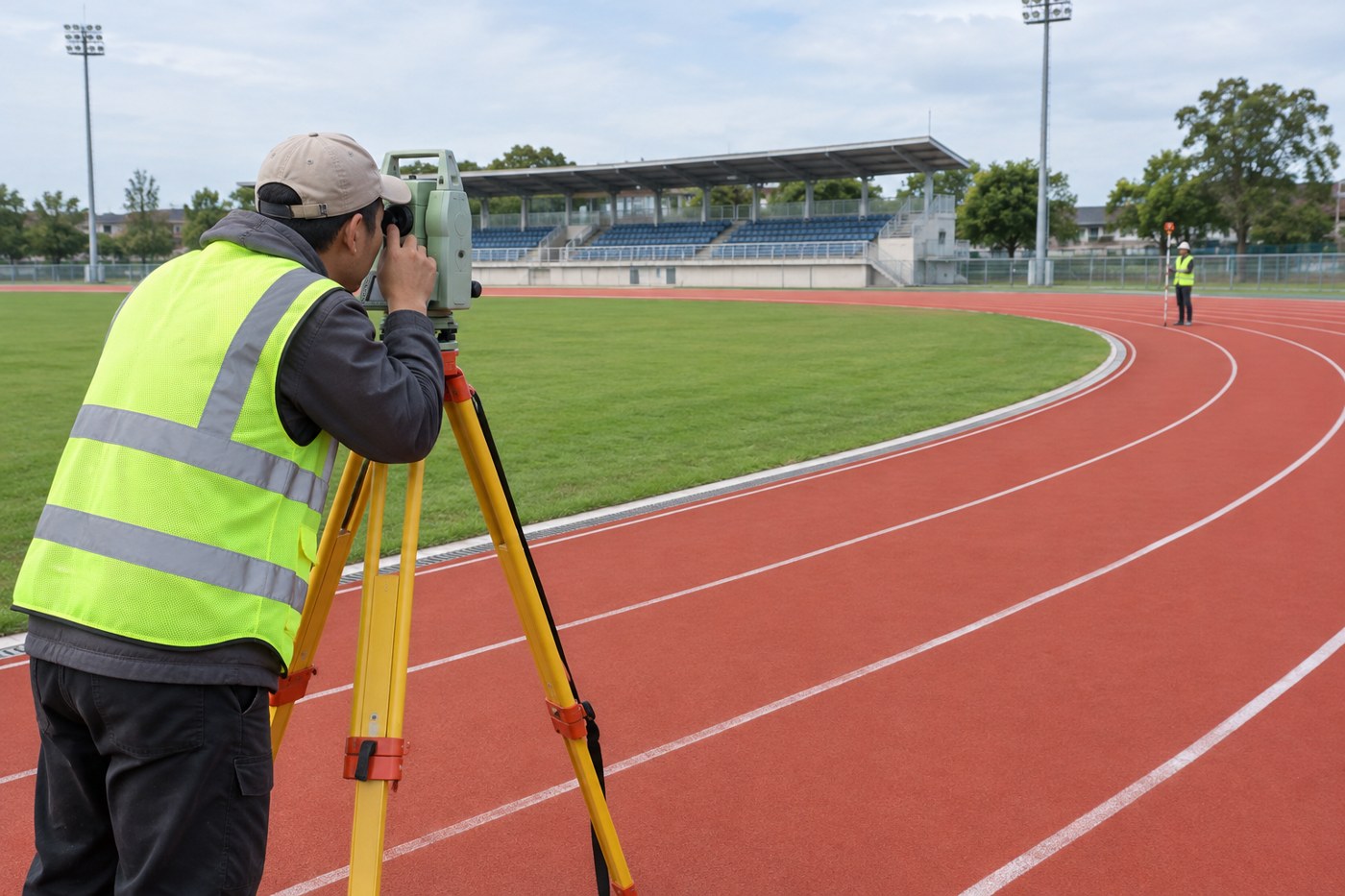
![Surveyor using a total station and a distant prism pole on a running track]()
Figure 1. Surveyor using a total station and a distant prism pole on a running track. AI-generated technical illustration.
1. Establish Reliable Horizontal and Level Controls
The first task is to establish the horizontal-control network and elevation benchmarks for the entire venue. For the standard single-radius layout, two semicircle centres and the tangent points connecting straights and bends form the principal geometrical references.
In that standard layout, the straight length and centre-to-centre spacing are 84.390 m, and the kerb reference radius is 36.500 m. These figures describe a particular standard geometry; they should not be presented as the only possible configuration of every 400 m athletics track.
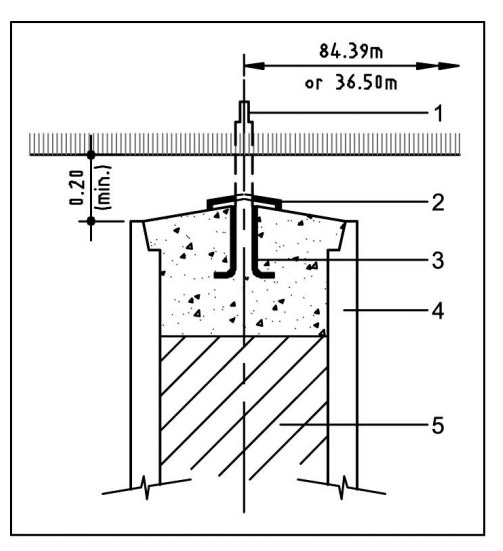
Use suitable calibrated surveying equipment, independently verify the centres and tangencies, and preserve permanent markers outside construction disturbance where practicable. The control-marker drawing supplied with this article illustrates a protected construction detail. Its foundation, frost protection and installation must be adapted to local conditions.
![Section drawing of a protected permanent track survey control marker]()
Figure 2. Section drawing of a protected permanent track survey control marker. Technical drawing supplied with the article.
Establish a closed levelling network around the facility and adjust the observations using the survey specification. Record benchmark locations, instrument identification, calibration information and closure checks. Those benchmarks provide the common reference for base slopes, drainage levels and final-surface measurements.
2. Check the Standard Track with the 28-Point Method
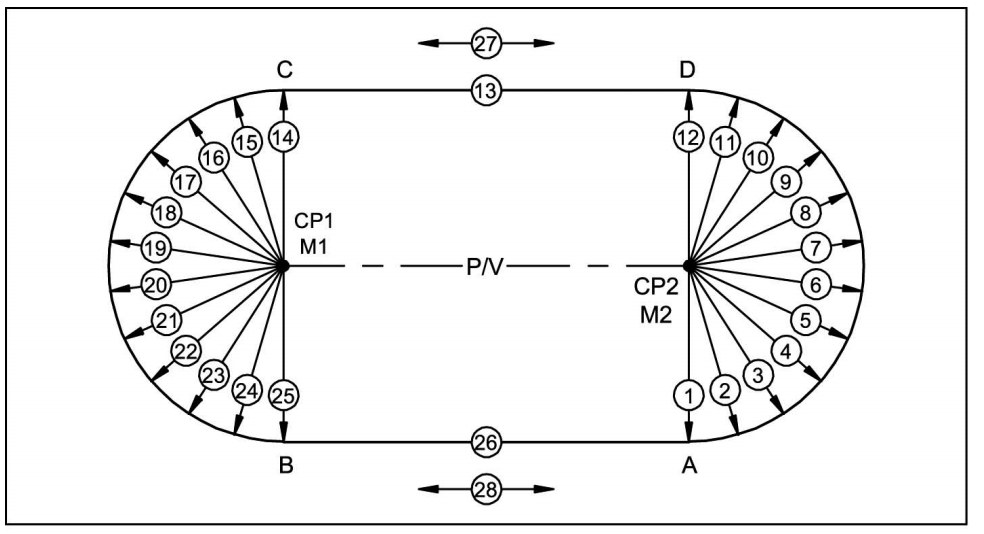
The manual's 28-point control method checks the outside edge of the inner track border. For the standard geometry, it comprises 24 radius readings, two straight-length readings and two straight-alignment checks. The surveyor must use the prescribed measurement record and calculation procedure, rather than averaging unrelated readings into one error.
| Check | Standard-layout reference | Purpose |
| Semicircle centres | 84.390 m apart | Establish the basic geometry |
| Twenty-four radius readings | 36.500 m, each within +/-0.005 m | Check both kerb arcs |
| Two straight readings | 84.390 m, each within +/-0.005 m | Check straight length |
| Two alignment checks | Maximum deviation 0.010 m | Check straightness |
| Equalised lap length | 400.000 m to 400.040 m | Verify the resulting running length |
![Twenty-eight control measurements for the standard 400 m track geometry]()
Figure 3. Twenty-eight control measurements for the standard 400 m track geometry. Technical drawing supplied with the article.
Check the centres first, observe the prescribed radius points and straight lengths, record signed deviations, and calculate the resulting lap length using the prescribed method. Preserve the original observations as well as the final result. An acceptable total length does not excuse an individual geometrical defect that exceeds its own limit.
3. Inspect Base Slopes and Evenness Before Surfacing
A prefabricated rubber sheet follows the base beneath it. Its relatively consistent thickness cannot remove large base depressions, reverse falls or settlement. Survey the foundation before bonding so that corrective work can be completed without disturbing new rubber.
Measure levels across straights, bends, tangent transitions, inner and outer edges, drainage interfaces and areas susceptible to settlement. A project survey plan may use regularly spaced sections and extra points at changes in geometry. The spacing must capture actual low spots, not merely produce a convenient set of passing readings.
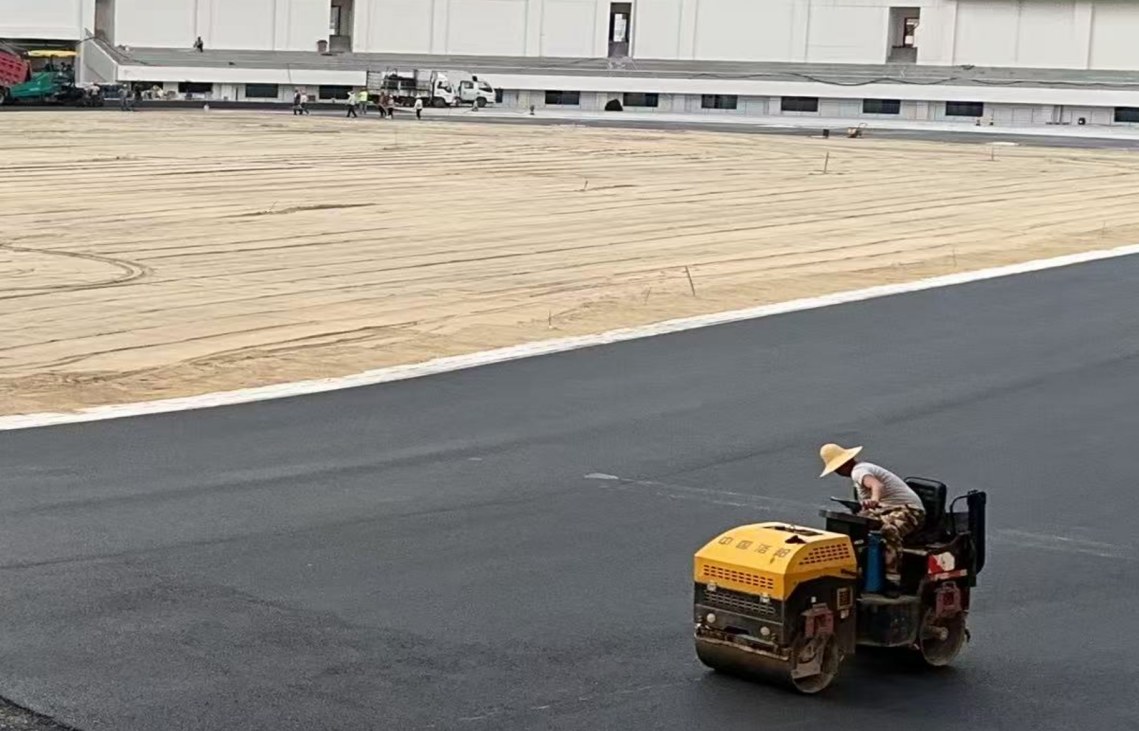
![Roller compacting the asphalt foundation of an athletics track]()
Figure 4. Roller compacting the asphalt foundation of an athletics track. Image supplied with the article.
For the standard outdoor-track rule, lateral inclination toward the inside is generally limited to 1%, and the overall downward inclination in the running direction between start and finish is limited to 0.1%, subject to the rule's stated exceptions. The crossfall direction must match the drainage design. An inward drain cannot be served by a surface that mistakenly falls away from it.
Use a straightedge and an appropriate gap gauge to check local evenness in multiple directions. Distinguish the finished-surface criteria from any tighter base criteria required by the rubber manufacturer. Investigate abrupt steps and joints separately. Do not accept a surface merely because an arbitrary percentage of sample points passes while significant defects remain elsewhere.
4. Calculate Lane Staggers from the Correct Measurement Lines
Outer lanes travel around larger curves. Their start lines therefore need a forward offset, or stagger, so that athletes cover the same race distance. Calculate the stagger for the particular event, lane configuration and actual surveyed geometry.
For a kerbed track, lane one is measured 0.30 m from the kerb; other lanes use a measurement line 0.20 m outward from the outer edge of their inner lane boundary. This difference matters. Simply multiplying the lane width by the number of intervening lanes does not account for the change in measurement offset.
For the standard geometry with 1.22 m lanes, lane eight's radius difference relative to lane one's measurement line is 7 x 1.22 - 0.10 = 8.44 m. A half-lap stagger is therefore approximately pi x 8.44 = 26.516 m; a full-lap stagger is approximately 53.032 m. These examples explain the geometry, but the approved marking plan and checked coordinate schedule must control field setting-out.
Events such as 800 m and relays also involve event-specific break-line and exchange-zone arrangements. They are not always obtained by applying the 400 m stagger unchanged. Check the current event rules and marking plan before preparing the coordinate tables.
5. Set Out and Paint the Markings Precisely
A total station can set out points from known controls using checked coordinates or calculated angles and distances. Verify the setup orientation and independent check points before marking a long sequence of locations. Instrument capability alone does not establish the accuracy of the entire survey.
Where an approved tape-and-chord method is used, calculate the relevant chord lengths and geometrical intersections from the correct references. A single distance from one point cannot uniquely locate another point without an additional constraint. Avoid trying to measure a curved arc by casually laying a straight tape along the surface.
![Guided line-marking trolley applying a white line on a red rubber track]()
Figure 5. Guided line-marking trolley applying a white line on a red rubber track. AI-generated technical illustration.
Use the correct edges of the start and finish lines when measuring a race distance. Confirm the nominal lane width, line width and the current colour-coded marking schedule. White lane boundaries, event marks, relay zones, hurdle positions and break lines must be clear, correctly located and distinguishable. Do not rely on a simplified claim that each colour always represents the same feature at every venue.
For prefabricated rubber running-track systems such as GODER, sheet joints are installation features, not survey datums. Re-establish the competition geometry on the finished surface, and use a compatible line paint after the system has reached the required curing condition.
6. Correct for Tape Calibration and Environmental Conditions
A steel tape's actual length can differ slightly from its nominal length, and temperature changes alter that length during use. Apply the calibration correction, temperature correction and any relevant tension, sag or slope corrections required by the measurement method.
When converting a tape reading into a true distance, the temperature correction is commonly expressed as alpha x (T - T0) x L, using the tape's expansion coefficient and calibration temperature. When setting out a fixed distance, the required tape reading is adjusted in the opposite sense. Confusing these two operations reverses the correction.
For example, with an illustrative steel expansion coefficient of 0.0000115 per degree Celsius, a 36.50 m distance and a tape 5 degrees colder than its 20-degree reference, the temperature effect is approximately 2.10 mm. Use the actual tape certificate and procedure. A low-expansion invar tape reduces temperature sensitivity but does not remove the need for calibration and correct field technique.
7. Recheck the Finished Track and Document the Result
Repeat the geometrical and level checks after surfacing. Confirm that installation has not introduced unacceptable changes at seams, edges or transitions. Survey all competition features required for the venue's intended use, not only the main oval.
Thickness and surface-performance testing are related acceptance activities, but they are not substitutes for dimensional measurement. Use the applicable sampling method and product-certificate thickness requirements, including any designated reinforced areas. An accredited laboratory should undertake the testing required for a facility-certification route.
Complete a visual marking inspection and retain the approved drawings, raw survey observations, calculation sheets, calibration records, control-point descriptions and as-built measurement report. Record and verify corrections before the venue opens. Future repairs and remarking should refer back to the same protected control system.
Conclusion
Accurate track surveying rests on three principles: stable references, correct geometry and verified execution. Permanent control points keep the venue measurable; carefully checked calculations keep race distances consistent; final measurement confirms that the built facility matches its intended design. Precision is achieved through the complete workflow, not through one instrument or a final coat of paint.
Frequently Asked Questions
1. Why is lane one not measured directly along the kerb?
The prescribed running measurement line is offset from the kerb. Measuring directly along its edge would use a different radius and produce a different lap length.
2. Are 36.50 m and 84.39 m mandatory for every 400 m track?
They describe the standard single-radius layout discussed here. Other permitted geometries require their own approved dimensions, calculations and measurement records.
3. Can the seams between prefabricated rolls guide lane marking?
No. Roll layout is controlled by installation needs. Competition lines must be set out from surveyed controls and the approved marking plan.
4. Does a total station eliminate measurement errors?
No. Incorrect control coordinates, orientation, prism setup, calibration or calculations can still produce errors. Independent checks are essential.
5. Why do outer lanes start farther forward?
Their running measurement lines have larger curve radii. The stagger compensates for that extra curved distance so that each athlete covers the prescribed race length.
6. Should a track be surveyed again after resurfacing?
Yes. Resurfacing, kerb changes and new marking can affect the finished geometry. Verify the completed layout and update the required measurement and certification records.
Technical References
See the World Athletics Track and Field Facilities Manual and standard marking plan and the current World Athletics Technical Rules. The project survey specification and approved drawings remain essential.
Keywords: running track surveying; 400 m track measurement; track control points; lane stagger calculation; running track line marking.