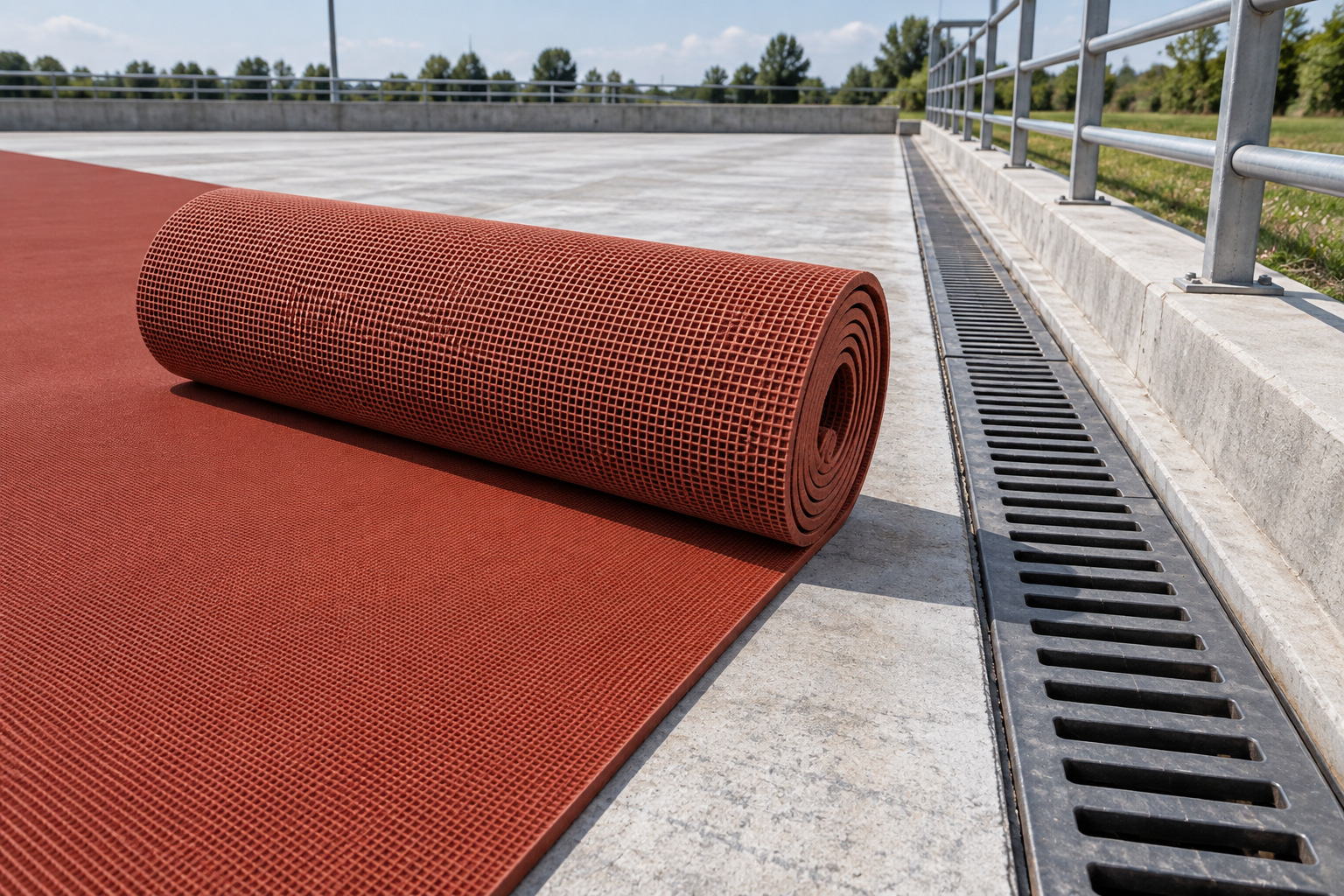
Moisture beneath a prefabricated rubber running track can contribute to adhesive failure, blistering and recurring edge lifting. The risk depends on the water source, the condition of the foundation and the selected bonding system. A surface that looks dry may still contain moisture internally. Before installation, the project team should identify how the base is exposed to water, select a suitable test method and compare the result with the adhesive system's stated limits.
Keywords: running track base moisture, rubber track blistering, concrete moisture testing, track adhesive failure, prefabricated track foundation
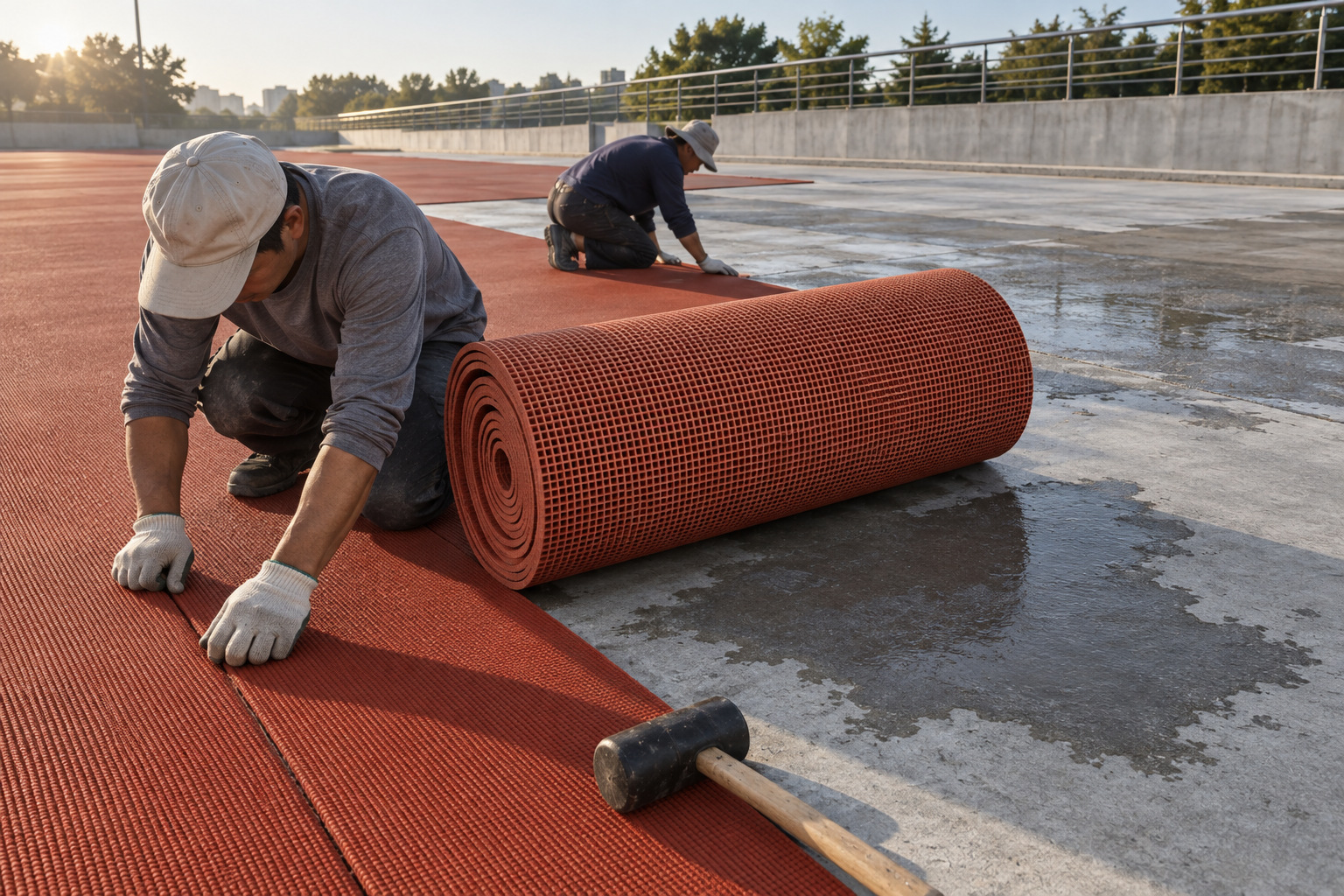
![Damp area on an unfinished concrete track foundation beside a prefabricated rubber roll]()
Figure 1. Damp area on an unfinished concrete track foundation beside a prefabricated rubber roll. AI-generated technical illustration.
Identify the Source of the Water
Moisture may remain from concrete construction, arrive through rain or irrigation, migrate from the ground or enter through defective drains and edges. Condensation can also form when a surface is cold relative to humid air. These mechanisms require different responses.
A drying period cannot solve a continuing leak. A moisture barrier cannot stabilize an unsound base, and a local surface repair cannot redirect water from an adjacent slope. Inspect the foundation, perimeter and drainage as one system. Record recent rainfall and the location of damp areas, then look for patterns rather than treating a single measurement as a complete diagnosis.
Choose the Test Before Choosing the Limit
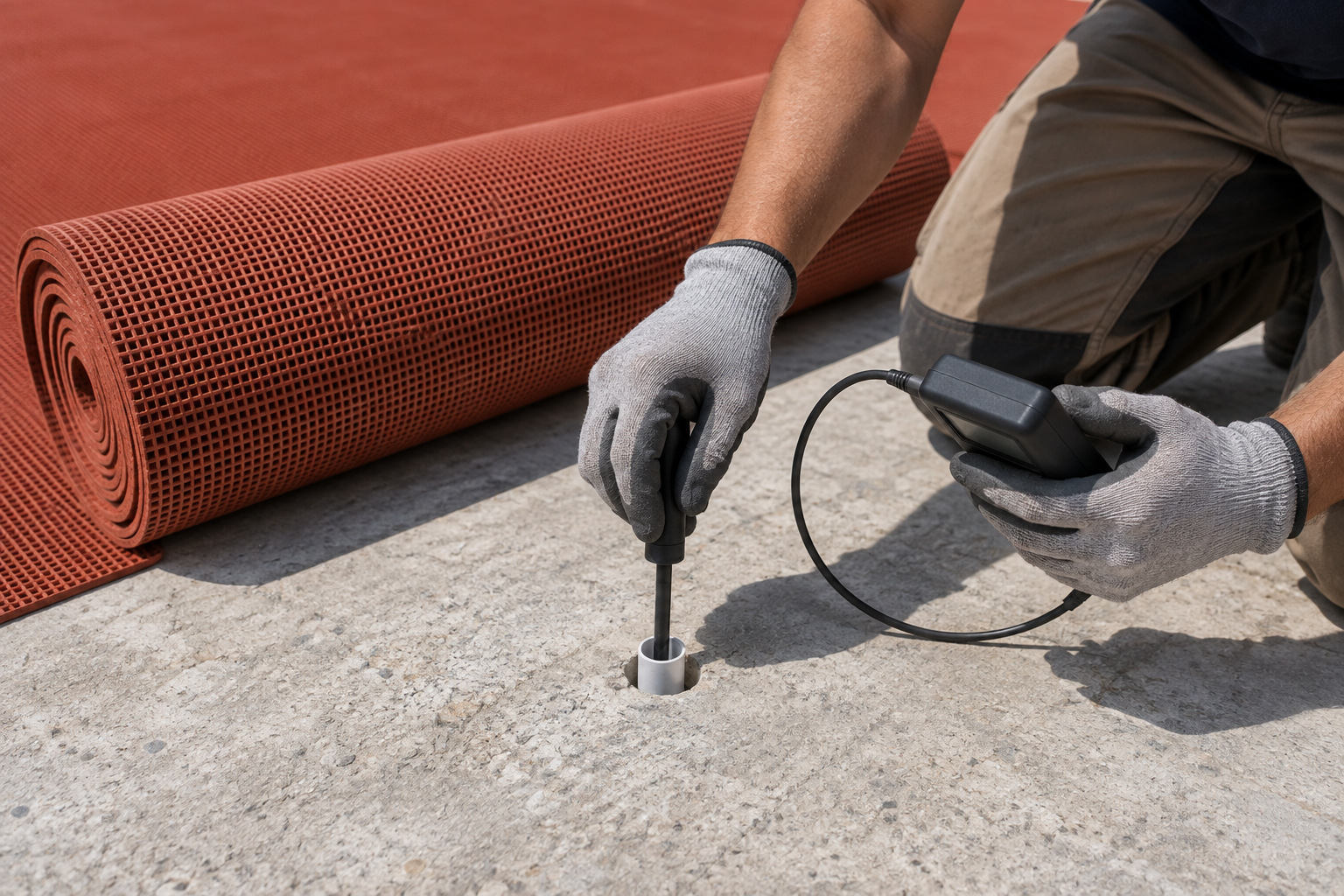
Moisture results are meaningful only when the method and units are known. ASTM F2170 addresses in-situ relative humidity in concrete floor slabs. ASTM F1869 addresses moisture vapor emission using anhydrous calcium chloride. They measure different things and do not supply a universal conversion between results.
Both methods have procedural and environmental requirements. Their suitability for a particular outdoor track foundation needs to be assessed rather than assumed. A consultant or competent testing provider should agree the method with the adhesive supplier, particularly when outdoor conditions cannot meet the method's conditioning requirements. Asphalt requires its own appropriate assessment.
![Gloved installer positioning a humidity probe in a drilled concrete test sleeve]()
Figure 2. Gloved installer positioning a humidity probe in a drilled concrete test sleeve. AI-generated technical illustration.
Know What Each Check Can and Cannot Tell You
| Check | Useful information | Important limitation |
| Visual inspection | Damp patches, leakage and drainage problems | Cannot quantify internal moisture |
| Electronic surface screening | Relative differences across an area | Readings depend on material and instrument |
| In-situ concrete humidity test | Internal relative humidity under defined conditions | Requires the specified procedure and suitable conditions |
| Vapor emission test | Emission over the defined test period | Not interchangeable with internal relative humidity |
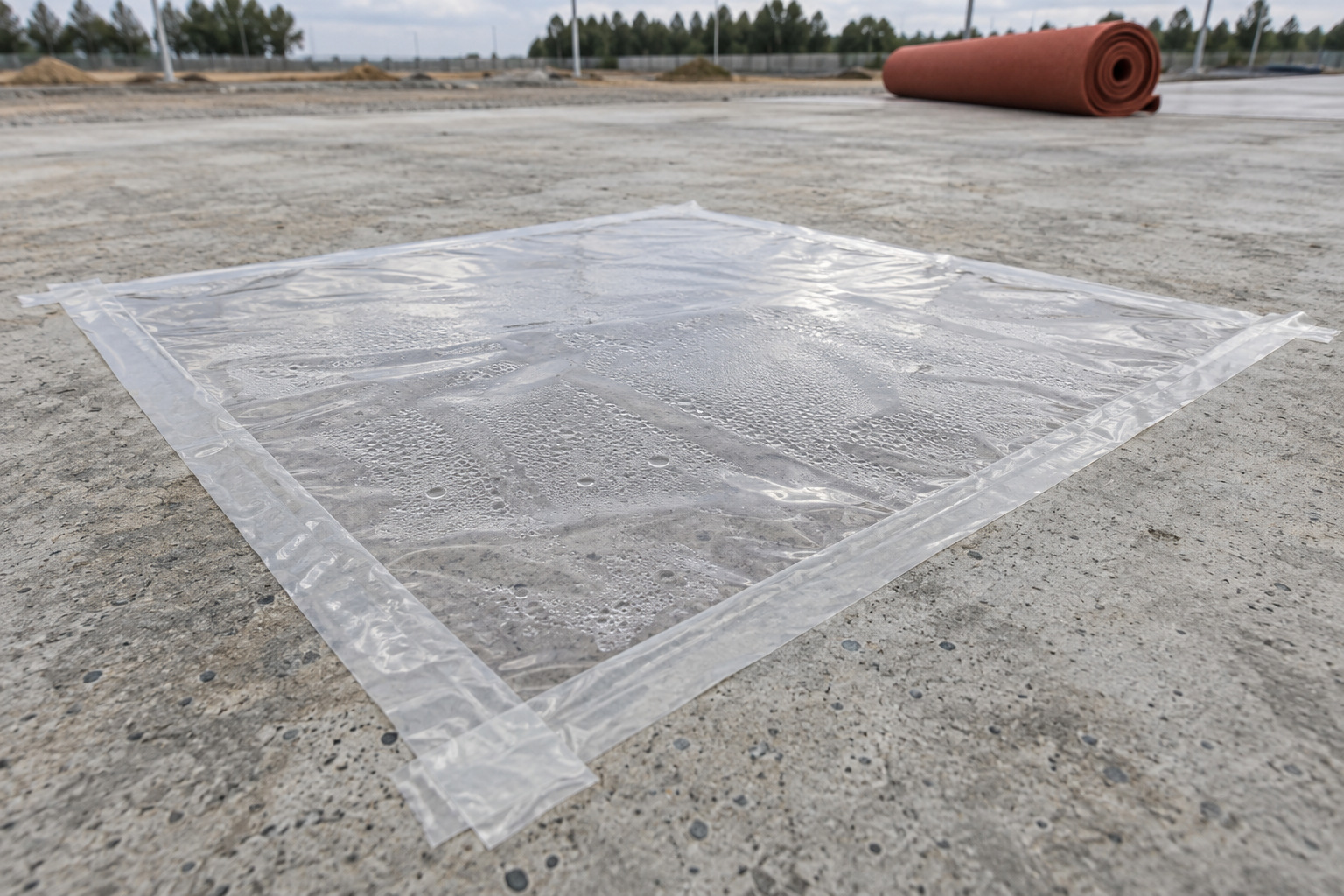
| Taped plastic sheet | Qualitative indication of moisture or condensation | Absence of droplets does not prove suitability for bonding |
Do not combine values labeled percent if they come from different instruments or methods. Report the instrument, method, location, depth where relevant and environmental conditions. State the acceptance limit with the test it belongs to.
![Transparent taped sheet used as a qualitative moisture indication on concrete]()
Figure 3. Transparent taped sheet used as a qualitative moisture indication on concrete. AI-generated technical illustration.
Understand Why Moisture Can Disturb the Bond
Excess water can interfere with some adhesive systems or weaken a moisture-sensitive layer beneath them. A dense rubber sheet also changes how an exposed foundation can dry. Heating and cooling may affect the behavior of trapped moisture and an already weak interface.
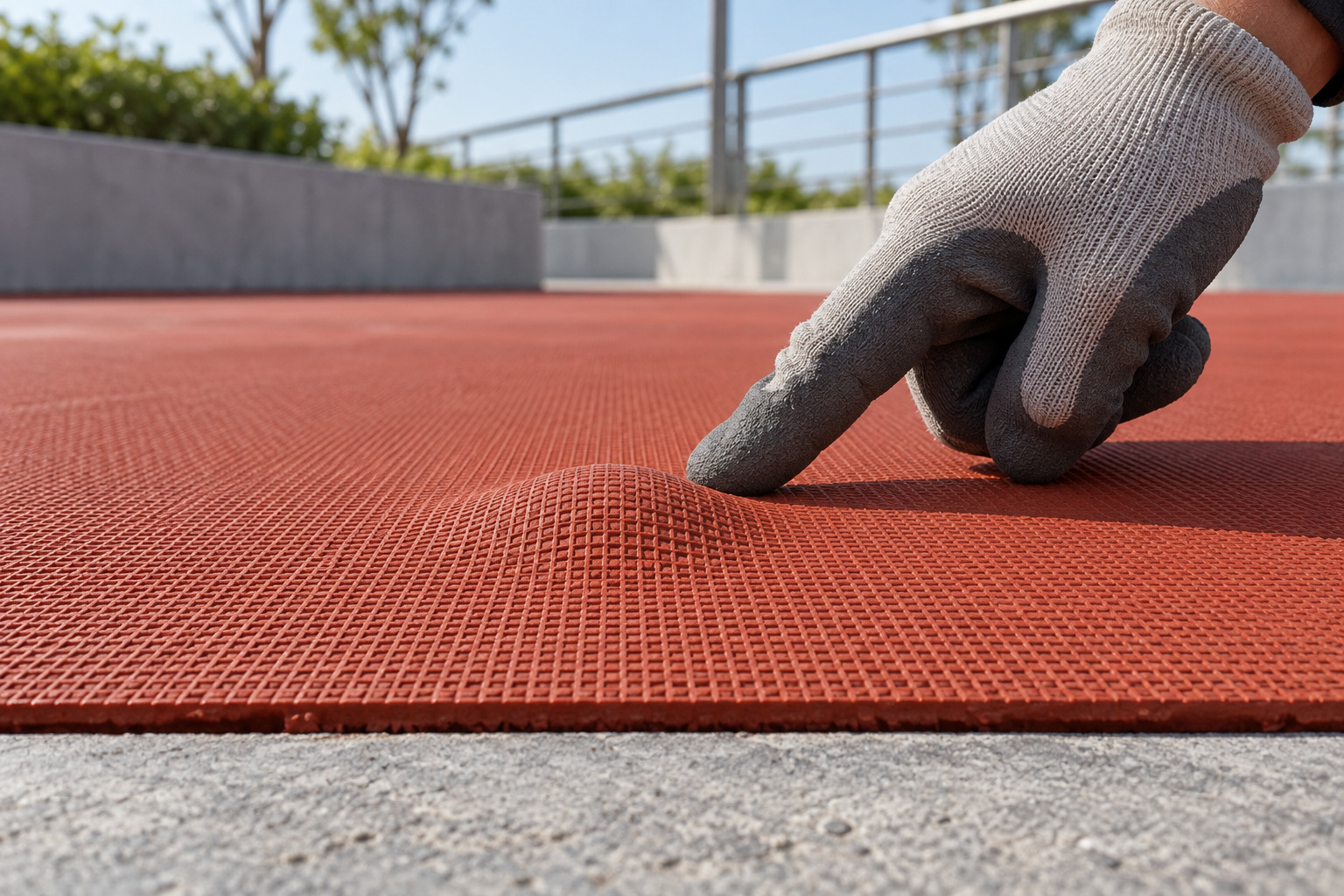
Blistering does not prove that vapor pressure is the only cause. Poor adhesive transfer, uneven substrate support, contamination and curing problems can produce similar symptoms. Carefully opening an agreed inspection area and examining both interfaces can help distinguish these mechanisms. Document whether the adhesive is cured, where separation occurred and whether the base is sound before prescribing a remedy.
![Localized blister in a prefabricated rubber sheet above its foundation]()
Figure 4. Localized blister in a prefabricated rubber sheet above its foundation. AI-generated technical illustration.
Establish a Moisture Hold Point Before Bonding
Agree the required test method, acceptance conditions and responsibility for release before installation begins. Test representative areas and locations with higher exposure, then map the results. Repeat checks after conditions change, including substantial rain or a delay between preparation and bonding.
If results are unsuitable, identify the water source and allow appropriate drying or use an engineered, compatible treatment. Any primer, barrier or leveling layer must be approved within the complete system and installed on a suitable foundation. Exterior exposure, hydrostatic pressure and movement may restrict which treatments can be used. Recheck the prepared assembly and complete a trial bond before releasing the main works.
![Prepared dry foundation and perimeter drainage channel ready for rubber track installation]()
Figure 5. Prepared dry foundation and perimeter drainage channel ready for rubber track installation. AI-generated technical illustration.
Carry Moisture Information Into Product Selection
When discussing a GOMER prefabricated running track with HUADONG, include the foundation age, drainage design, exposure history and test report. The adhesive and preparation proposal should respond to these conditions. Sharing the information early helps coordinate surface supply with the civil works and reduces the risk of covering a foundation that is not ready.
Frequently Asked Questions
1. Is concrete ready when it looks dry?
Not necessarily. Surface appearance does not describe moisture deeper in the slab. Use the agreed testing method and the selected bonding system's acceptance limits.
2. Is there one moisture percentage for every track installation?
No. Limits depend on the test method, adhesive and complete assembly. A number without its method and units can be misleading.
3. Can I rely on a plastic sheet test alone?
It is a qualitative check. A lack of visible condensation does not establish that the foundation meets the moisture requirements of the adhesive system.
4. Does low water absorption in the rubber protect the bond underneath?
Not by itself. Water may arrive from the base, joints or perimeter. The sheet's material properties and the installed assembly's moisture exposure are separate considerations.
5. What should happen if a blister returns after repair?
Investigate ongoing water entry, foundation defects and compatibility of the previous repair. Repeating a surface patch without resolving the source may reproduce the same problem.