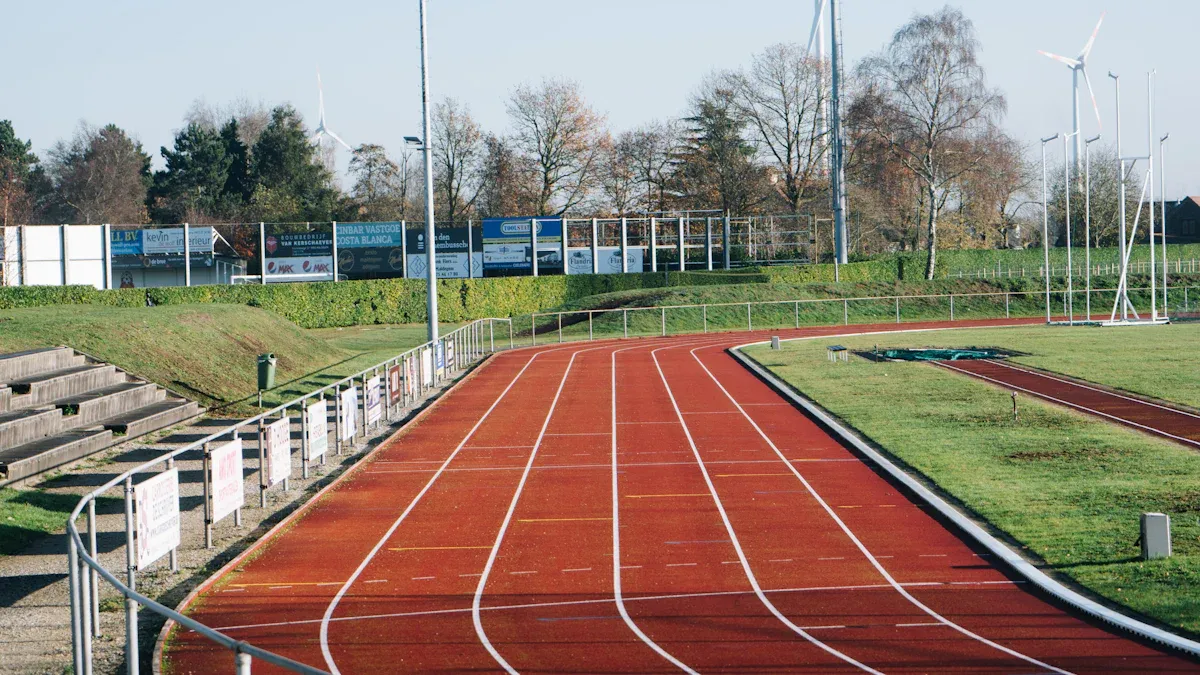
A prefabricated running track is a synthetic rubber running surface that a factory makes in advance and delivers ready to install.
Manufacturers make these tracks from synthetic rubber materials in controlled factory conditions. The finished surface arrives on site in rolls or tiles.
Factory production gives the surface a consistent quality that site-built tracks rarely match. Installation crews simply unroll or lay the pieces and bond them into place.
This article explains how a prefabricated running track is made. It also looks at the benefits, the common uses, and the checks buyers should complete before they place an order.
Key Takeaways
A prefabricated running track is a rubber surface that is made in a factory and delivered ready to install.
Factory production ensures steady quality and faster installation compared to tracks poured on-site.
Routine care, such as cleaning and checking the seams, helps the track last 10 to 15 years.
Buyers should look at test reports and standards to make sure the track meets competition requirements.
Prefabricated Running Track: Definition
A prefabricated running track is made in a factory, not at the sports facility. Workers build the surface off-site using controlled industrial processes. The finished material then travels to the site in rolls or tiles, ready to install.
What "Prefabricated" Means
The word prefabricated describes a product that builders put together in advance at a manufacturing plant. A prefabricated rubber track follows this model. Factory workers control temperature, pressure, and material mixing with precision. Site crews cannot match this level of control when they build a surface by hand.
This production model sets a prefabricated running track apart from a poured-in-place system. Poured-in-place, or in-situ, tracks use liquid polyurethane and rubber granules that workers mix and spread on site. The final quality then depends on crew skill, mixing accuracy, base condition, and weather.
A prefabricated track installs in about a few days once the base passes inspection. A poured-in-place track needs about one to several weeks, including curing and protection time. Prefabricated surfaces are less sensitive to weather during placement, though the adhesive still needs suitable conditions. Workers can cut out and replace damaged sections of a prefabricated track. A poured-in-place surface requires grinding, patching, recoating, and curing. Expected service periods run about 8–15 years for prefabricated tracks and about 6–12 years for poured-in-place tracks with proper maintenance. Seams may show on a prefabricated track if welding or alignment is poor, while poured-in-place surfaces generally have fewer sheet seams.
Materials and Layers
A prefabricated running track uses several core materials. These include natural rubber, synthetic rubber, rubber granules, binders, pigments, and performance additives. Each material plays a specific role in traction, cushioning, color, and durability.
The finished sheet contains distinct layers. The table below summarizes the typical structure.
Layer / Component | Description | Typical Material | Thickness / Notes |
Top (surface) layer | Non-porous, embossed fine-grain rubber for traction; UV- and wear-resistant; non-directional pattern | Solid rubber (natural rubber, or natural + synthetic rubber blends) with eco-friendly/low-VOC additives | ~4 mm colored surface layer |
Bottom (base) layer | Cellular elliptical pattern acting as dynamic cushion; compresses and rebounds to store/release energy | Rubber (natural rubber or blended rubber) with eco additives | ~9 mm gray base layer |
Bonding structure | Co-vulcanized multi-layer dual-durometer design; upper and lower layers chemically bonded into one integrated sheet | Vulcanized rubber layers permanently bonded under heat and pressure | Integrated dual-layer structure |
Overall sheet | Factory-manufactured, rolled, then unrolled and seamlessly bonded on site | Natural rubber + synthetic rubber + eco-friendly additives (no harmful solvents/heavy metals) | Width ~1.22 m; length 15–20 m; total thickness 9–13 mm |
Factory production follows a set order. Workers form the rubber granule or elastomeric layer first. They then add a polyurethane or synthetic binder. Next comes surface texturing and color application. Workers set the thickness, cut the material into modules, label each roll, and pack the rolls in installation order.
This factory-produced sports surface leaves the plant as a factory-made roll. The controlled process gives every sheet the same thickness, density, and elasticity. A polyurethane track built on site cannot promise the same uniformity. Buyers who compare polyurethane track systems should note this difference. The prefabricated approach takes the guesswork out of final surface quality.
How a Prefabricated Running Track Is Made
Factory Production Steps
The manufacturing process starts with choosing materials. Workers get high-quality recycled rubber and strong polymer binding agents. These materials give the track stretch, bounce-back, and weather resistance.
Mixing and blending come next. Recycled rubber granules and binding agents are combined in exact amounts. The team mixes the blend evenly and runs constant quality checks to make sure the mixture stays the same.
Vulcanization comes after that. Controlled heat starts the vulcanization reaction. The rubber then cures to gain better elasticity, strength, resilience, and wear resistance.
During prefabrication, workers pour the vulcanized rubber into molds. The molds form sheets with even thickness and texture. Crews then cut the sheets into sections that are easy to move and install.
Surface treatment adds a polyurethane sealing coat for UV and environmental protection. Workers also add texture to the surface for the best traction.
Quality assurance ends the line. Each section goes through durability testing that copies heavy use. Performance testing then checks shock absorption, traction, and overall performance. The finished factory-cured roll or sheet leaves the plant with verified thickness, density, and composition.
On-Site Installation
Installation starts with the asphalt or concrete foundation. A cement base needs strength of at least C25, flatness within 3mm per 3m, and moisture at or below 5%. An asphalt base needs 3%–5% porosity with no oil stains or cracks. Crews grind and clean the surface, inject epoxy into cracks, and roll on an interface agent to improve adhesion.
A dry layout comes next. Workers place the rolls without adhesive to check orientation, color spread, lane alignment, and seam locations. Laser layout tools set the boundary with an error of no more than 1cm.
Adhesive application follows at a coverage rate of 1.5kg/㎡. Workers unfold the material and let it relax on its own for 24 hours. They then press it down, push out trapped air, and shape curves with a hot-air gun.
Seam treatment uses hot melt welding at 130–140℃. The weld must reach a tensile strength of at least 50N/cm. Polyurethane sealant fills the edges to stop warping and water seepage. Line marking uses hot melt paint at a width of 5cm±1mm.
The finished surface stays closed for 48 hours of curing at temperatures above 10℃. No one may walk on it during this time.
This installation method runs faster than in-situ work. A prefabricated system is less affected by weather during placement. The surface is ready to use right away once curing ends. A polyurethane track built on site needs a longer curing window. Buyers comparing prefabricated rubber track systems with poured alternatives should weigh this schedule difference carefully.
Benefits of a Prefabricated Running Track Surface
Advantages Over Other Surfaces
A prefabricated running track gives you the same surface in every lane. Factory production controls thickness, density, and elasticity, so each roll acts the same way. The material stands up to weather, UV exposure, and heavy athletic traffic. This durability makes the surface last longer.
Athletes get comfort and safety from the dual-layer design. The cellular base layer compresses and rebounds to absorb shock. The textured top layer grips the shoe and lowers the risk of slipping. These traits help with both training and competition.
Installation speed makes prefabricated tracks stand out. Crews unroll and bond the material instead of mixing and spreading liquid parts on site. Factory cutting limits installation mistakes, and the surface is ready to use soon after curing ends. The table below compares these systems with poured alternatives.
Advantage Area | Prefabricated Track Benefit | Contrast with Poured-in-Place / Spray-Coated Surfaces |
Weather resistance | Resists weather, UV exposure, and heavy athletic traffic; longer lifespan | Lower initial cost but shorter lifespans |
Consistency | Controlled factory environment ensures uniform quality and performance; seamless installation; factory-tested thickness and elasticity | On-site systems lack factory-controlled uniformity |
A polyurethane track built on site depends on crew skill and weather. A polyurethane surface also needs a longer curing window. Prefabricated systems take away much of that uncertainty. Buyers who compare a polyurethane track with a factory-made roll should note the difference in consistency.
Common Applications
Schools and universities make up a large share of the market. A prefabricated running track manufacturer for schools supplies surfaces that handle daily student use and need little upkeep. Professional athletics facilities pick these systems for competition-grade performance. Community sports centers value the quick installation and low disruption.
Prefabricated modular systems also serve arenas where the track must be temporary or where the facility switches between sports. Off-site manufacturing gives precision in these settings. The seams between sections need ongoing maintenance to prevent moisture intrusion and surface wear. Facility managers should plan for this inspection work.
These athletic running surfaces fit many venues. A prefabricated rubber track works for training grounds and multi-use fields. Each buyer should match the product to the facility's traffic and climate.
Standards and Buyer Checklist
Standards and Certifications
Buyers should check which standards apply to their region and competition level. The table below lists the main checks.
Standard / Certification | What buyers should verify |
World Athletics requirements | Confirm which World Athletics requirements apply to the planned competition level. This includes track dimensions, lane layout, measurement procedures, and surface performance. A "competition grade" claim does not mean the finished venue holds facility certification. |
EN 14877 | This European standard covers performance properties for synthetic outdoor sports surfaces. Confirm the test report covers the complete surface system. It should also be current and come from a qualified laboratory. |
ASTM and local standards | North America, Asia, the Middle East, and other regions rely on ASTM standards. They also use national building codes, accessibility rules, fire regulations, and local sports-facility specifications. |
A compliance matrix makes checking easier. Buyers should ask for a matrix that lists each required standard, test method, measured result, laboratory, and report date. This tool beats vague claims like "international quality." Test reports should cover the exact product or a clearly equivalent formulation. Buyers should check the test date, laboratory name, sample description, and product batch information. Note that IAAF is the former name of World Athletics. So current project specification documents should use the latest terminology.
Choosing a Manufacturer
A reliable prefabricated running track manufacturer should supply documents that prove compliance. These include a track-surfacing product certificate, a certified facility record, laboratory test reports, a technical data sheet, and completed-track field testing results. Each document should identify the exact product, issuer, scope, and validity.
Buyers should also check the supplier's track record. Ask for completed project references with similar climate, usage, and size. Contact past owners where possible. Warranty terms deserve close reading. Confirm the covered defects, duration, installation responsibility, exclusions, and remedy process. Damage from spikes, vehicles, flooding, or poor maintenance may fall outside coverage.
A professional prefabricated running track manufacturer should provide test reports and installation support. Ask who installs the track, what training comes with it, and whether the supplier reviews drawings, drainage, and color plans. A prefabricated running track manufacturer for schools should also show experience with high-traffic student use. Compare quotations on total cost, including freight, adhesive, installation, line marking, testing, and taxes. A rubber athletic track supplier with strong product data but no proven installations still carries project risk. Performance testing results for force reduction, vertical deformation, slip resistance, and tensile strength help buyers compare options fairly.
Installation, Maintenance, and Selection Tips
Maintenance and Lifespan
Regular care keeps a prefabricated running track surface in good shape for many years. Crews should sweep or wash away dirt and debris on a set schedule. They should also check seams after heavy rain or big temperature changes. Loose or lifted edges need quick repair before water gets under the sheet.
Damaged sections are simple to fix on a prefabricated system. Workers cut out the bad piece and glue a new patch in its place. This spot repair skips the grinding and recoating that a polyurethane surface requires. Lifespan numbers differ by source and conditions.
The manufacturer says its prefabricated rubber running tracks usually last 8–10 years, based on usage, climate, and maintenance, and that good care can make them last longer.
One supplier notes that rubber tracks can last up to 20 years with proper care. Another guide from the same manufacturer reports over 20 years with little maintenance. A sensible planning range stays below those best-case claims.
Track system | Typical service life | Maintenance requirement |
Prefabricated rubber track | 8–15 years | Joint inspection and localized repairs |
Selection Tips
Buyers should match thickness and material to how much the track gets used. Elementary users need softer cushioning than college athletes. The competition level matters too. Local meets need fewer requirements, while state or national events demand tracks that meet international standards. Choosing among EPDM, polyurethane, and recycled rubber affects durability and lifespan.
Climate suitability is a question buyers should ask the supplier directly. Confirm the surface handles local UV exposure, freeze-thaw cycles, and rainfall. Compare the total cost of ownership, not just the purchase price. A pre-fabricated solution works best for high levels of competition where the track gets a lot of use. If the budget is tight, this might not be the best choice.
Buyers should also review the installation method and the asphalt or concrete foundation requirements before signing. Ask for installation instructions, the project specification, and performance testing reports. Check track dimensions against the planned venue. Prefabricated roll tracks offer a seamless surface, while block tracks give a modular option.
A prefabricated running track is a rubber surface made and vulcanized in a factory. Suppliers deliver it in sheets or rolls, and crews glue it on site to a prepared asphalt or concrete base.
Because a factory controls production, every roll has the same quality. The system also lowers weather risk during installation. It supports elite performance and heavy daily training loads.
Buyers should check the base and drainage first. Walking the track 24–48 hours after heavy rain shows ponding or soft spots. Comparing bids on scope, crew experience, and exclusions matters more than price alone. A reliable prefabricated running track manufacturer supplies test reports and installation support. Talking to a professional prefabricated running track manufacturer before purchase is a smart next step. Plan seam inspection and wear management in start zones, curves, and lane one. The right surface will match the facility's climate, traffic, and competition level for years to come.
FAQ
How long does a prefabricated running track last?
A prefabricated track that is cared for well usually serves a facility for 8 to 15 years. How much it gets used, the local climate, and routine care all affect how long it lasts. Crews can extend that time by cleaning it regularly, checking the seams, and fixing damaged sections quickly.
Can crews install a prefabricated track in cold weather?
Installation crews need temperatures above 10℃ for the adhesive to cure correctly. Cold conditions slow the bonding process and make lifted edges more likely. Facility managers should plan the work for a suitable season and make sure the base stays dry before crews start.
What base does a prefabricated running track require?
The track needs a stable asphalt or concrete foundation. A cement base should reach a strength of at least C25, stay flat within 3mm per 3m, and hold moisture at or below 5%. An asphalt base needs 3%–5% porosity with no cracks or oil stains.
How do buyers confirm a track meets competition standards?
Buyers should ask for a compliance matrix that links each world athletics requirements item to a test method, a measured result, and a report date. They should also check that the project specification names the exact product and that track dimensions match the planned venue. A facility certification claim needs its own proof, separate from a product certificate.
How thick is a prefabricated running track?
Most prefabricated sheets are 9 to 13 mm thick in total. The top layer adds about 4 mm of textured rubber, and the base layer adds about 9 mm of cellular cushioning. Buyers should match the thickness to how much the track is used and what competition level it serves.