Many failures blamed on synthetic track material begin below the surface. A base that is weak, wet, contaminated, cracked, out of level or poorly drained can later appear as ponding, bubbles, debonding, visible depressions, edge lifting or open seams.
This risk is especially important with a prefabricated rubber running track. Factory-produced sheets provide controlled thickness, but they cannot be adjusted on site to hide every low spot or ridge in the substrate. The base must therefore be treated as a precision interface, not ordinary road paving.
The checklist below is intended for the formal handover from the civil contractor to the synthetic-surface installer. It should be completed before materials are bonded. Project specifications, local codes, the design engineer and the selected surface manufacturer's written limits always take priority.
![]()
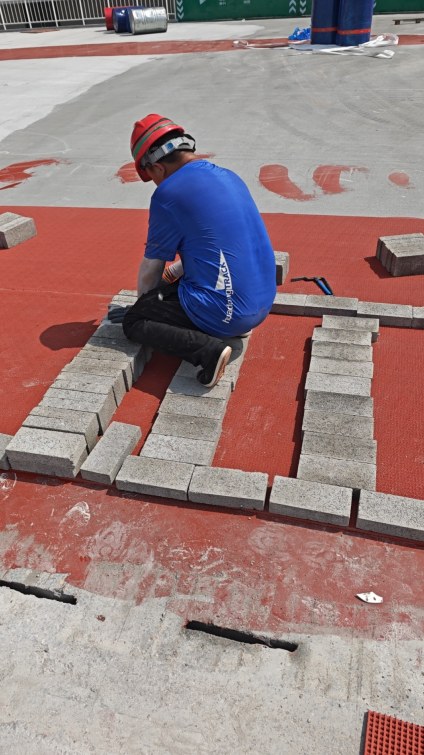
Base inspection must be completed before adhesive, temporary weights and prefabricated sheets conceal the substrate.
Base Inspection Record
Complete this information before the twelve checks:
| Field | Project record |
Project and location |
|
|
Facility type and certification objective |
|
|
Track area and lane count |
|
|
Base type and construction date | Asphalt / concrete / existing synthetic / other |
|
Base contractor |
|
|
Surface manufacturer and system |
|
|
Inspection date and weather |
|
|
Inspectors and organisations |
|
|
Drawing/specification revision |
|
|
Instruments and calibration status |
|
|
Areas excluded from inspection |
|
|
Overall status | Accepted / accepted with conditions / rejected |
|
1. Documents, Design and Intended Use
Why it matters
An inspector cannot decide whether a base is compliant without knowing the approved geometry, gradients, material build-up, surface system and facility objective. A school training track and a World Athletics certification project may have different documentation and acceptance requirements.
Check
• Approved-for-construction drawings and latest revisions are available.
• Track geometry, event sites, kerbs, drainage channels and elevations are coordinated.
• Base material, thickness, joints and structural design are documented.
• The proposed synthetic surface and adhesive are identified.
• The certification objective and measurement forms are known.
• Civil works test results and as-built records are available.
• All design changes and repair methods have written approval.
Evidence
• Drawing register.
• Approved material submittals.
• Geotechnical and structural reports.
• Compaction/asphalt/concrete records.
• As-built survey.
• Non-conformance and repair records.
Acceptance status
Do not proceed if the team is inspecting against superseded drawings or an undefined surface system.
2. Track Geometry and Survey Control
Why it matters
The synthetic surface does not correct an incorrect radius, lane width, straight length, event-site position or elevation. Geometry errors discovered after surfacing can require destructive correction.
Check
• Permanent survey control points are protected and identifiable.
• Track centre, radii, straights and lane geometry match the approved design.
• Kerb and drainage-channel positions are correct.
• Runways, take-off zones, water jump and field-event interfaces are coordinated.
• Level transitions to the infield and external paving do not create trip edges or trapped water.
• The survey format is compatible with the intended federation measurement report.
Method
Use calibrated surveying instruments and a qualified surveyor. Record coordinates and levels, not only a signed statement saying “survey completed”.
Corrective action
Resolve geometry deviations with the designer and certification adviser before surface installation. Local patching cannot fix fundamental track geometry.
3. Structural Stability and Load-Bearing Condition
Why it matters
Settlement or movement in the formation, sub-base or base can crack or distort the finished surface. The track must also carry maintenance equipment, officials, temporary event loads and controlled access vehicles without long-term deformation.
Check
• No pumping, rutting or detectable movement under approved loading.
• No loose, fretting, segregated or unstable areas.
• Compaction and density records comply with the project specification.
• Asphalt or concrete strength/cure records are complete.
• Utility trenches, drainage crossings and repaired excavations are stable.
• Heavy-access points have the designed reinforcement.
Method
Use the civil specification's compaction, density, strength or proof-rolling methods. A surface installer should not invent structural acceptance criteria after construction.
Red flags
• Tyre marks or footprints that permanently deform the base.
• Loose aggregate under brushing.
• Cracks that continue through repaired areas.
• Settlement around manholes, channels or service crossings.
4. Surface Flatness and Local Level Variation
Why it matters
Ridges can telegraph through the surface. Depressions can hold water. Abrupt variations can create inconsistent thickness, affect athlete comfort and make seams difficult to close.
Check
• Entire base is surveyed on an agreed grid.
• Straights, bends, lane interfaces and event areas are checked.
• Paving-bay joints have no lips.
• Local repairs blend gradually into surrounding levels.
• Drain and kerb edges are flush with the designed finished build-up.
Method
Use the project-specified straightedge length, digital level or total-station grid. Mark each high and low area on a plan.
SAPCA's published athletics-track code gives an example wearing-course tolerance of 6 mm under a 3 m straightedge and explicitly notes that finer tolerances may be required for prefabricated systems. That value should not be copied automatically. Many prefabricated projects adopt a tighter manufacturer-approved acceptance criterion because sheet thickness cannot be varied to mask irregularities. See the SAPCA Code of Practice .
Inspection record
| Area/grid | Test method | Maximum deviation allowed | Result | Pass/fail | Repair reference |
|
|
|
|
|
|
|
Corrective action
• Mechanically grind approved high spots.
• Repair depressions with a compatible, approved levelling material.
• Recheck drainage after repair.
• Do not use extra adhesive as a general-purpose levelling compound.
![]()
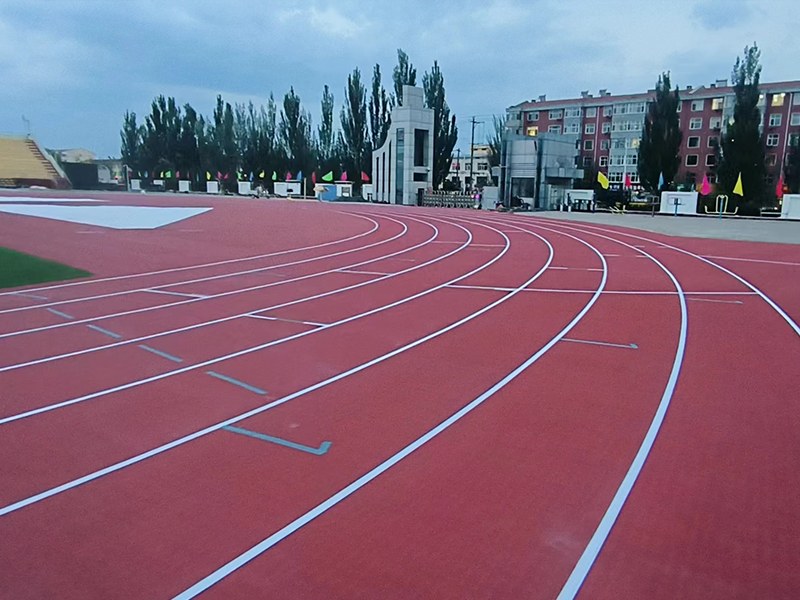
Long, continuous lane geometry makes base flatness, level variation and transition errors visible after installation.
5. Gradients, Crossfall and Surface Drainage
Why it matters
Most prefabricated and solid synthetic systems are impervious. Water must move across the surface to a channel or outlet. A visually smooth base can still produce ponding if gradients reverse or drainage levels are wrong.
Check
• Longitudinal and transverse gradients follow the approved design and applicable athletics rules.
• There are no reverse falls.
• Water reaches the intended channels and outlets.
• Slot drains and channels have consistent line and level.
• Outlets are connected, clean and free-flowing.
• Drainage around runways, event areas and transitions is coordinated.
• Subsurface drainage is complete and functional.
Method
• Review level survey and contour/gradient report.
• Conduct the specified flood, hose or rainfall-simulation test after the base has stabilised.
• Mark ponding boundaries and measure depth/duration using the project's method.
Corrective action
Correct the base or drainage system before surfacing. Drilling isolated holes through an impervious system is not a substitute for a designed drainage solution.
6. Substrate Moisture and Vapour Risk
Why it matters
Moisture can interfere with primer and adhesive cure, reduce bond strength and create vapour pressure. Symptoms may include bubbles, lifting and dark or wet patches. A dry-looking surface is not proof that a concrete slab or lower layer is ready.
Check
• Base has completed the specified curing period.
• Recent rain, washing or irrigation has been recorded.
• Moisture test method and acceptance limit are approved by the surface/adhesive manufacturer.
• Concrete vapour transmission or internal relative humidity is assessed where relevant.
• Groundwater and missing vapour barrier risks are understood.
• Drains, irrigation and infield watering do not introduce hidden moisture.
• Ambient humidity and dew-point conditions are within installation limits.
Method
Use the method required by the adhesive and substrate specification. Depending on the project, this may include calibrated electrical moisture readings, calcium-carbide testing, in-slab relative-humidity testing, plastic-sheet observation or a combination. Results from different methods are not interchangeable.
Important distinction
Base moisture, ambient relative humidity and dew point are different controls. A project can pass one and fail another.
Corrective action
• Allow additional drying.
• Improve drainage or stop the moisture source.
• Use an approved moisture-mitigation system only with written compatibility confirmation.
• Retest and record the result before release.
![]()
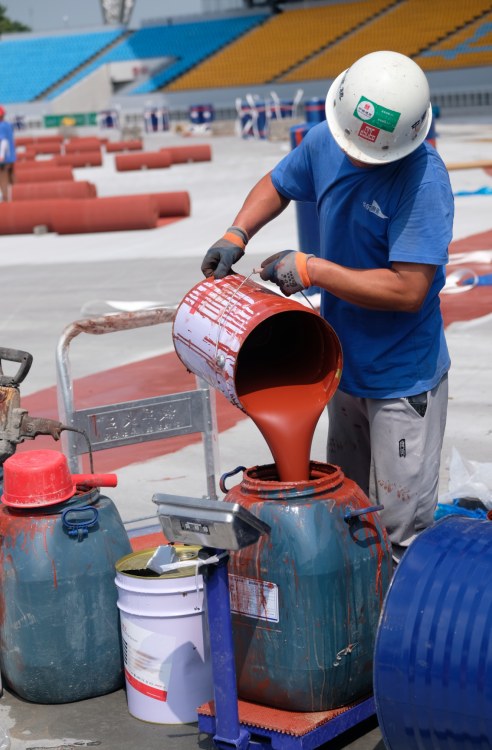
Moisture, cleanliness and surface soundness must be accepted before a controlled primer or adhesive batch is mixed.
7. Surface Soundness, Texture and Bonding Suitability
Why it matters
Adhesive can bond strongly to a weak skin that later separates from the base. Very smooth, dusty, polished, bleeding or porous surfaces can also produce inconsistent bonding.
Check
• Base is dense, coherent and free of laitance or friable material.
• Asphalt is fully stable with no bitumen bleeding.
• Concrete curing compounds, sealers or release agents have been removed or approved.
• Surface texture is suitable for the specified primer and adhesive.
• Repairs are compatible and well bonded.
• A trial bond/pull test is completed when required.
Method
• Visual and hammer/sounding inspection where appropriate.
• Scratch or surface-strength test specified by the engineer.
• Manufacturer-approved adhesion trial with recorded failure mode.
What to record
Do not record only the pull value. Note whether failure occurred in the substrate, primer, adhesive, surface sheet or at an interface.
8. Cracks, Joints and Existing Repairs
Why it matters
Active cracks and movement joints may reflect through the finished track or place stress on seams. Concrete joints require special treatment; simply covering them can transfer movement to the surface.
Check
• All cracks and joints are mapped and photographed.
• Crack width, direction and signs of movement are recorded.
• Structural and non-structural cracks are distinguished by the engineer.
• Construction, control and expansion joints are identified.
• Previous repairs are sound and compatible.
• Surface details at channels, kerbs and penetrations allow movement where required.
Corrective action
Use an engineer- and manufacturer-approved detail. Flexible filling, routing and sealing, stitching, local reconstruction or a movement detail may be appropriate depending on cause. Cosmetic filling without diagnosing movement is not a durable repair.
9. Cleanliness and Contamination
Why it matters
Dust, oil, diesel, tyre dressing, algae, curing compounds, salts and loose aggregate can prevent adhesion. Contamination can also migrate through coatings or create local softening.
Check
• Surface is free from dust and loose particles.
• No oil, fuel, grease, paint, chemicals or organic growth remains.
• Cleaning water and detergents are removed and the base is dry.
• Construction traffic is controlled after cleaning.
• Adjacent earth, sand and infield works cannot recontaminate the released area.
Method
• Vacuum and visual inspection.
• White-cloth wipe or project-approved cleanliness test.
• Water-break or other contamination test if specified.
• Reinspection immediately before adhesive application.
Corrective action
Use a compatible mechanical or chemical cleaning process approved by the designer and manufacturer. Do not spread contamination over a larger area by careless solvent wiping.
10. Edges, Kerbs, Channels, Penetrations and Transitions
Why it matters
Many local failures occur at details rather than in the middle of a roll: drain edges, kerbs, pits, covers, sleeves, runways and material transitions.
Check
• Edge heights allow the specified surface thickness and adhesive.
• Drainage-channel covers can be removed and maintained.
• Kerbs, pit boxes and covers are secure and correctly aligned.
• There are no sharp edges that could damage the sheet.
• Penetrations are sealed and stable.
• Transition details avoid exposed sheet edges and water entry.
• Termination strips or recesses are installed where required.
Evidence
Create a photographic detail schedule. A general base photograph cannot prove that every drain, kerb and cover is ready.
11. Weather, Ambient Conditions and Installation Window
Why it matters
Adhesives and primers have limits for air temperature, substrate temperature, relative humidity, rain, wind and dew point. Weather can change open time, cure and contamination risk.
Check
• Manufacturer's written installation limits are included in the method statement.
• Calibrated instruments are available for air, surface temperature and humidity.
• Dew-point margin will be monitored where required.
• Reliable weather forecast and rain protection are available.
• Wind will not carry dust onto adhesive.
• Work zones can be closed until cure is complete.
• Indoor ventilation is adequate.
Installation log
Record conditions at the frequency required by the method statement, not only once at the start of the day.
| Time | Air temp. | Base temp. | RH | Dew point/margin | Weather | Adhesive batch | Area installed |
|
|
|
|
|
|
|
|
|
12. Logistics, Protection and Formal Base Release
Why it matters
A technically acceptable base can be damaged while rolls, adhesive and installation equipment are moved into position. Without a signed release, responsibility for later defects becomes disputed.
Check
• Material access route does not overload or contaminate the base.
• Rolls can be stored flat/securely under the manufacturer's conditions.
• Adhesive storage temperature and shelf life are controlled.
• Work zones, emergency access and waste handling are planned.
• Other trades are excluded from released areas.
• Temporary protection does not trap moisture or mark the base.
• Punch-list items are closed or clearly conditioned.
• Civil contractor, surface installer, consultant and owner sign the base-handover record.
Base release statement
![]()
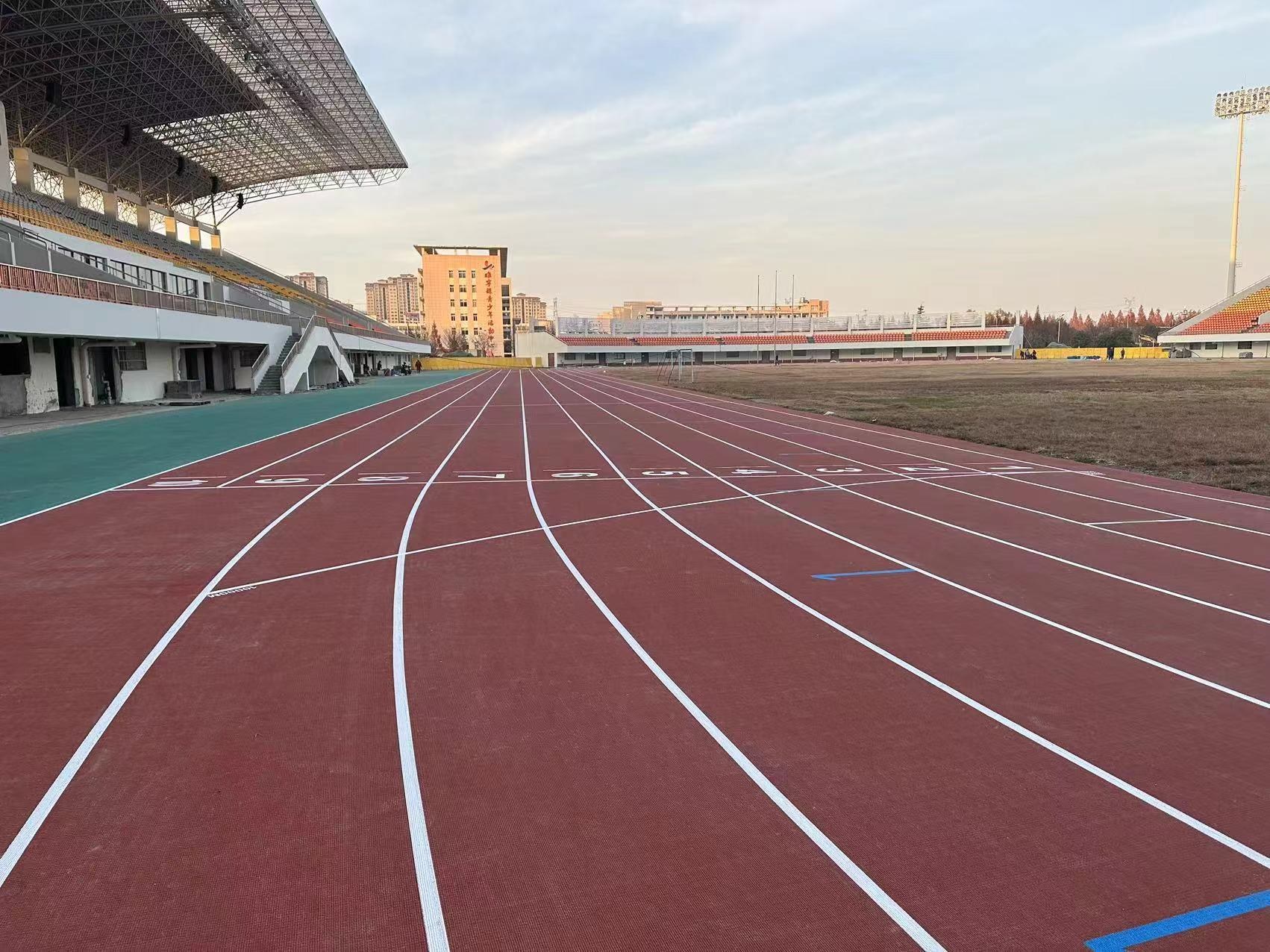
A signed base release provides the measured starting point needed for straight lanes, stable curves and controlled transitions.
Use wording such as:
The inspected areas listed in this record are accepted only for installation of the identified surface system and subject to the stated conditions. Acceptance does not transfer responsibility for concealed structural defects, future movement or deviations outside the inspected areas. Any rain, contamination, damage or further civil work after release requires reinspection. |
Consolidated 12-Point Checklist
| No. | Inspection item | Status | Evidence/reference | Corrective action | Closed by/date |
1 | Documents, design and intended use |
|
|
|
|
|
2 | Track geometry and survey control |
|
|
|
|
|
3 | Structural stability and load bearing |
|
|
|
|
|
4 | Surface flatness and local levels |
|
|
|
|
|
5 | Gradients and drainage |
|
|
|
|
|
6 | Substrate moisture and vapour risk |
|
|
|
|
|
7 | Surface soundness and bond suitability |
|
|
|
|
|
8 | Cracks, joints and repairs |
|
|
|
|
|
9 | Cleanliness and contamination |
|
|
|
|
|
10 | Edges, channels and transitions |
|
|
|
|
|
11 | Weather and installation window |
|
|
|
|
|
12 | Logistics, protection and formal release |
|
|
|
|
|
Common Failure Symptoms and Likely Base-Related Causes
| Symptom after installation | Possible base/interface causes | Investigation starting point |
Bubbles or blisters | Moisture, vapour pressure, missed adhesive, contaminated base | Moisture history, bond pattern, failure interface |
|
Open or raised seams | Poor alignment, base ridges, adhesive cure, movement | Level survey, seam detail, adhesive log |
|
Ponding | Reverse fall, local depressions, drain level error | As-built levels and water test |
|
Visible ridges/depressions | Out-of-tolerance base or abrupt repair | Straightedge/grid survey |
|
Edge lifting | Water entry, weak edge, contamination, insufficient restraint | Edge detail and drainage inspection |
|
Cracks reflected through surface | Active substrate crack or joint movement | Crack map and structural review |
|
Local soft or hollow areas | Weak substrate skin, poor adhesive coverage, moisture | Sounding and controlled opening |
|
Inconsistent performance | Surface thickness/base variation or system mismatch | Thickness, product identity and survey records |
|
These are investigation prompts, not automatic diagnoses. Opening or destructive testing should be agreed by the relevant parties.
Frequently Asked Questions
1.How flat must an asphalt base be for a prefabricated running track?
Use the project and manufacturer's specified test method and tolerance. Prefabricated systems generally need a finer base tolerance than in-situ systems because sheet thickness cannot be adjusted to absorb irregularities. Record a full grid, not a few convenient locations.
2.Can a rubber running track be installed directly over concrete?
It may be possible when the manufacturer approves the system and the design addresses moisture, curing, joints, cracking, texture and drainage. Concrete is not automatically acceptable because it is hard and level.
3.How long should a new base cure?
There is no single global answer. It depends on asphalt/concrete design, climate, moisture, curing method, adhesive and manufacturer. Installation should be based on verified readiness, not calendar age alone.
4.Why do synthetic running tracks bubble?
Possible causes include substrate moisture, vapour pressure, contamination, adhesive mixing or coverage errors, weather during installation and weak substrate layers. A forensic inspection should determine the failure interface before repair.
5.Can adhesive compensate for low spots?
Not as a general levelling method. Excess adhesive can create uneven cure, movement or visible variation. Use an approved base-repair compound and recheck levels.
6.Is a visual inspection enough?
No. A base can look smooth but have incorrect gradients, high moisture, weak layers or geometry errors. Combine documents, measurements, tests and photographs.
7.Should the surface installer sign off the civil contractor's base?
Yes, a formal interface release is good practice, but the document should define the inspection scope and preserve responsibility for concealed structural defects and later damage.
8.When should a flood or hose test be carried out?
After drainage and final base levels are complete and before surfacing, using the project-approved method. Allow for normal drying before moisture-sensitive bonding work.
9.What happens if it rains after the base is accepted?
Reinspect the affected area, repeat moisture/cleanliness checks as required and issue a renewed release before bonding.
10.Who should approve base repairs?
The relevant designer/engineer and the surface-system technical representative should approve repairs affecting structure, drainage, levels, joints or adhesion.
Final Takeaway
A running track base should be released through evidence, not schedule pressure. The few hours spent documenting geometry, flatness, drainage, moisture and bond suitability can prevent weeks of repair and dispute later.
HuadongTrack's base-support page and prefabricated track installation sequence explain the interface from inspection through handover. For a project review, submit the base type, construction date, survey, photographs, moisture data, project location and proposed installation window.